Percy Bysshe Shelley was a mess. Let’s just start there. When he sat down in a wood near Florence in 1819 to write Ode to the West Wind, he wasn't just vibing with nature; he was broke, mourning the death of his son William, and feeling like an absolute failure as a political activist. The poem isn't some polite Victorian floral arrangement. It’s a scream into the void. It is a desperate, chaotic, and oddly hopeful plea for a "wild spirit" to blow away the dead leaves of a failing life and plant something new.
Shelley didn't write this for a textbook. He wrote it because he felt the world was rotting. England was in a state of post-war depression, the Peterloo Massacre had just happened, and the literal climate was shifting. You can feel that frantic energy in the meter. It’s breathless.
The Weird Structure You Probably Missed
Most people see a poem and think "okay, stanzas." But Shelley was showing off here. He used terza rima, the same interlocking rhyme scheme Dante used for the Divine Comedy. It’s hard to do in English. Really hard. Because English has way fewer rhyming words than Italian, using this structure is like trying to build a cathedral out of toothpicks.
Each section follows an ABA, BCB, CDC, DED pattern, ending in a rhyming couplet. It creates this forward momentum, sort of like a rolling wave or, well, a gust of wind. It never lets you rest. You’re dragged from the forest floor to the sky, then down into the Mediterranean, and finally into Shelley’s own anxious brain.
Why the "Destroyer and Preserver" Line Matters
In the first section, he calls the wind a "Destroyer and Preserver." That’s the whole ballgame. He’s obsessed with the idea that you can't have a rebirth without a total wipeout. He watches the "pestilence-stricken multitudes" of leaves—yellow, black, pale, and "hectic red"—and sees them not just as compost, but as a metaphor for dying ideas.
Think about it. We usually view "destruction" as the bad guy. Shelley argues it’s a necessity. If the old, dead leaves don’t get cleared out, the "winged seeds" won't have room to grow when the "azure sister of the Spring" (the gentler south wind) finally shows up. It’s a cycle of creative destruction that feels surprisingly modern.
The Atmosphere of 1819
To understand Ode to the West Wind, you have to understand that Shelley was a radical. He was basically the 19th-century version of a DIY punk rocker who also happened to be a genius at Greek prosody. He had been kicked out of Oxford for writing a pamphlet on atheism. He was an outcast.
When he describes the "locks of the approaching storm" as being like the hair of a "fierce Maenad," he’s referencing the frenzied followers of Dionysus. This isn't a peaceful breeze. This is a riot. He’s looking at the sky over the Arno river and seeing a revolution.
- The wind is the force of change.
- The leaves are the old, corrupt systems of government.
- The "dead thoughts" are his own poems that nobody was buying at the time.
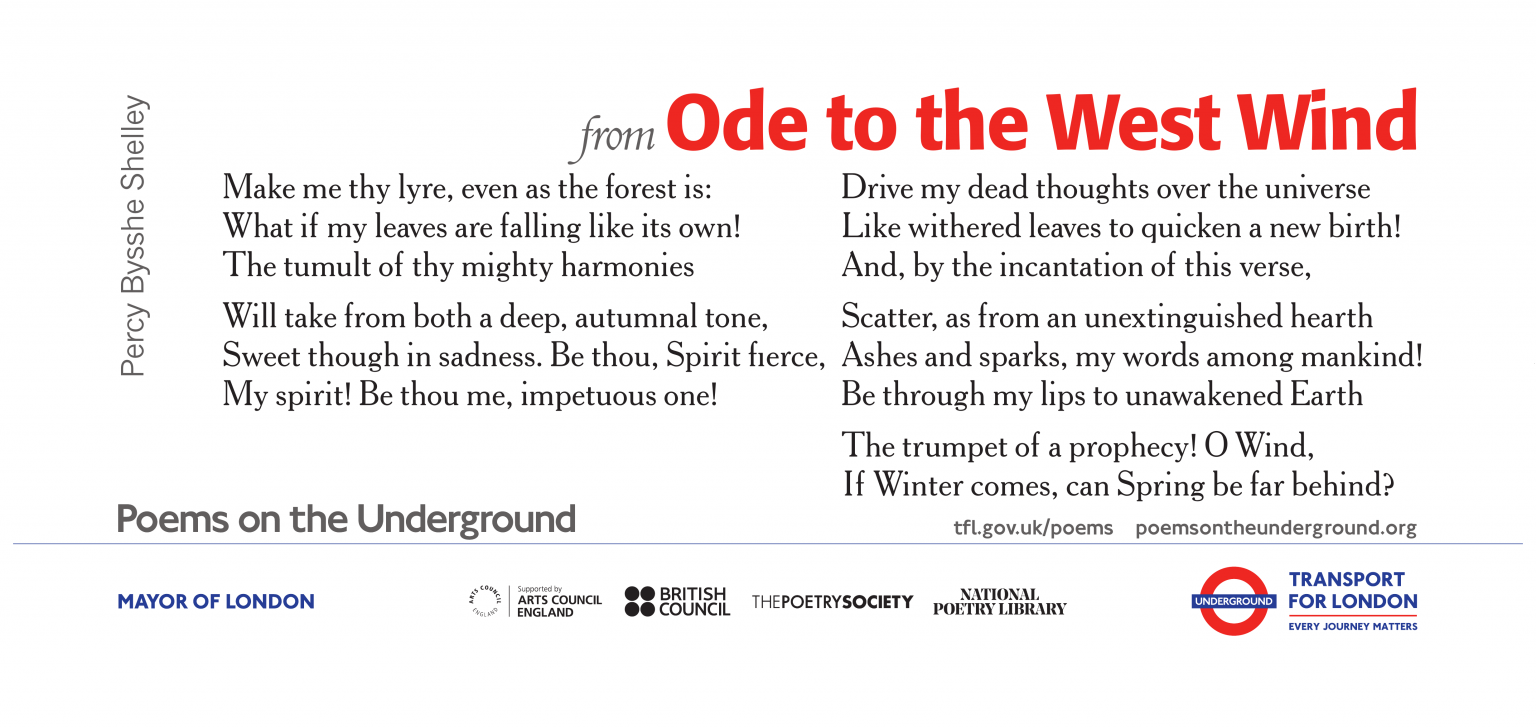
Honestly, it’s a bit heartbreaking. He asks the wind to "drive my dead thoughts over the universe / Like withered leaves to quicken a new birth!" He knew he was dying—or at least felt his career was. He was tossing his words into the gale, hoping someone, somewhere, eventually, would actually listen.
Scaling the Heights and Diving Deep
The poem moves in a specific vertical trajectory. It’s brilliant.
First, we’re on the Ground. We see the leaves. We see the seeds "lying cold and low" like corpses in graves. It’s earthy, damp, and smells like decay.
Then, Shelley yanks us into the Sky. This is the second Canto. Now we’re looking at "loose clouds" being shed like leaves from the "tangled boughs of Heaven and Ocean." He’s describing a literal meteorological phenomenon here—the way cirrus clouds precede a storm. Scientists have actually pointed out that Shelley’s observations of cloud formations were incredibly accurate for his time. He wasn't just hallucinating; he was watching the barometer drop.
Then, he goes Underwater. This is my favorite part. He talks about the "pre-congregated" Mediterranean sea and the "palaces and towers" vibrating under the water. Then he mentions the "sea-blooms" and "oozy woods" of the Atlantic. He notes that these underwater plants "grow gray with fear" and "despoil themselves" when the wind passes over the surface. It’s a weirdly specific, almost biological observation. He’s saying that the power of change is so intense it reaches even the bottom of the ocean. No one is safe. No one is exempt.
The "Make Me Thy Lyre" Moment
By the time we get to the final section, Shelley is done talking about the weather. He’s talking about himself.
"Make me thy lyre, even as the forest is," he begs.
He wants to be an instrument. He wants the wind to play him. This is the peak of Romanticism—the idea that the poet isn't a "maker" so much as a "vessel." He’s asking to be used. He wants his words to be "ashes and sparks" from an "unextinguished hearth."
It’s a bit dramatic? Yeah. But he was twenty-seven.
If you've ever felt like you have something important to say but the world just won't shut up long enough to listen, you get Shelley. You get the Ode to the West Wind. He wasn't writing for the critics of 1819 who called his work "insufferable." He was writing for the future. He was writing for you.
Common Misconceptions About the Poem
A lot of people think this is just a nature poem. It’s not. It’s a political manifesto. Shelley was a firm believer in the "Necessity of Atheism" and the power of the people. When he talks about the "trumpet of a prophecy," he’s not talking about the Bible. He’s talking about the inevitable rise of the working class and the fall of empires.
Another mistake is thinking the "West Wind" is a nice thing. In the Mediterranean, the West Wind (the Favonius or Zephyrus) is usually mild. But in autumn, it brings the storms. Shelley is focusing on the violent, autumnal version of the wind. It’s a terrifying force.
There's also this idea that Shelley was a pure optimist. Look at the famous last line: "O Wind, / If Winter comes, can Spring be far behind?"
We usually use that as a "hang in there" poster slogan. But in the context of the poem, it’s a question. A desperate one. He’s hoping spring is coming, but he’s currently standing in the freezing rain of a metaphorical winter. He’s not sure he’ll survive to see the thaw.
Technical Mastery: The Soundscape
Read the poem out loud. Seriously.
The sibilance—those "s" sounds—mimics the whistling of the wind. "Sweet buds like flocks adread," "the sapless foliage of the ocean." It hisses.
The vowel shifts are also intentional. He moves from the low, mourning "o" sounds of the first section to the sharp, piercing "i" and "e" sounds in the later sections as the storm picks up. It’s a symphony.
Shelley was obsessed with the relationship between sound and meaning. He believed that language was a direct reflection of the "Spirit of the Age." If the age was chaotic, the poetry had to be complex, layered, and slightly dangerous.
Real-World Impact and Legacy
Ode to the West Wind didn't make Shelley famous in his lifetime. He died in a boating accident just three years after writing it, with a volume of Keats's poetry in his pocket. He was a "failure" by almost every metric of his era.
But the poem lived. It became a touchstone for:
- Environmentalists: Who see in Shelley a profound, almost spiritual connection to the "animated" earth.
- Revolutionaries: From the Chartists in England to activists in the 1960s, his "trumpet of a prophecy" has been quoted on picket lines for generations.
- Modern Poets: You can see the DNA of this poem in everything from T.S. Eliot (who actually kind of hated Shelley but couldn't escape his influence) to Sylvia Plath.
It’s a masterclass in how to handle "the sublime"—that feeling of being both terrified and inspired by something much bigger than yourself.
How to Actually Use This Poem Today
If you’re reading this because you’re a student, stop trying to find the "correct" answer. There isn't one. Shelley would have hated the idea of his work being standardized.
If you’re reading this for personal growth, look at that central metaphor of the seed. Sometimes, things have to go "cold and low." Sometimes, a season of your life has to end—violently, perhaps—to make room for the next thing.
Next Steps for Deepening Your Understanding:
- Read it in one go: Don't stop to look up words. Just feel the rhythm. Let the "thou, thou, thou" of the address hit you like the wind he’s describing.
- Compare it to "To a Skylark": This is Shelley’s other big "nature" poem. While the West Wind is about the power of the earth and sky, the Skylark is about the purity of the spirit. Seeing the contrast helps you understand his range.
- Listen to a professional reading: Find a recording of someone like Vincent Price or Tom O'Bedlam reading it. The poem was meant to be heard, not just scanned with the eyes.
- Look at the 1819 political context: Research the Peterloo Massacre. Once you realize Shelley was writing in response to state-sponsored violence against protesters, the "dead leaves" metaphor becomes much more haunting.
Shelley’s wind is still blowing. It’s a reminder that even when we feel like "withered leaves," there is a force—whether we call it nature, history, or art—that carries us toward a spring we might not yet be able to see.