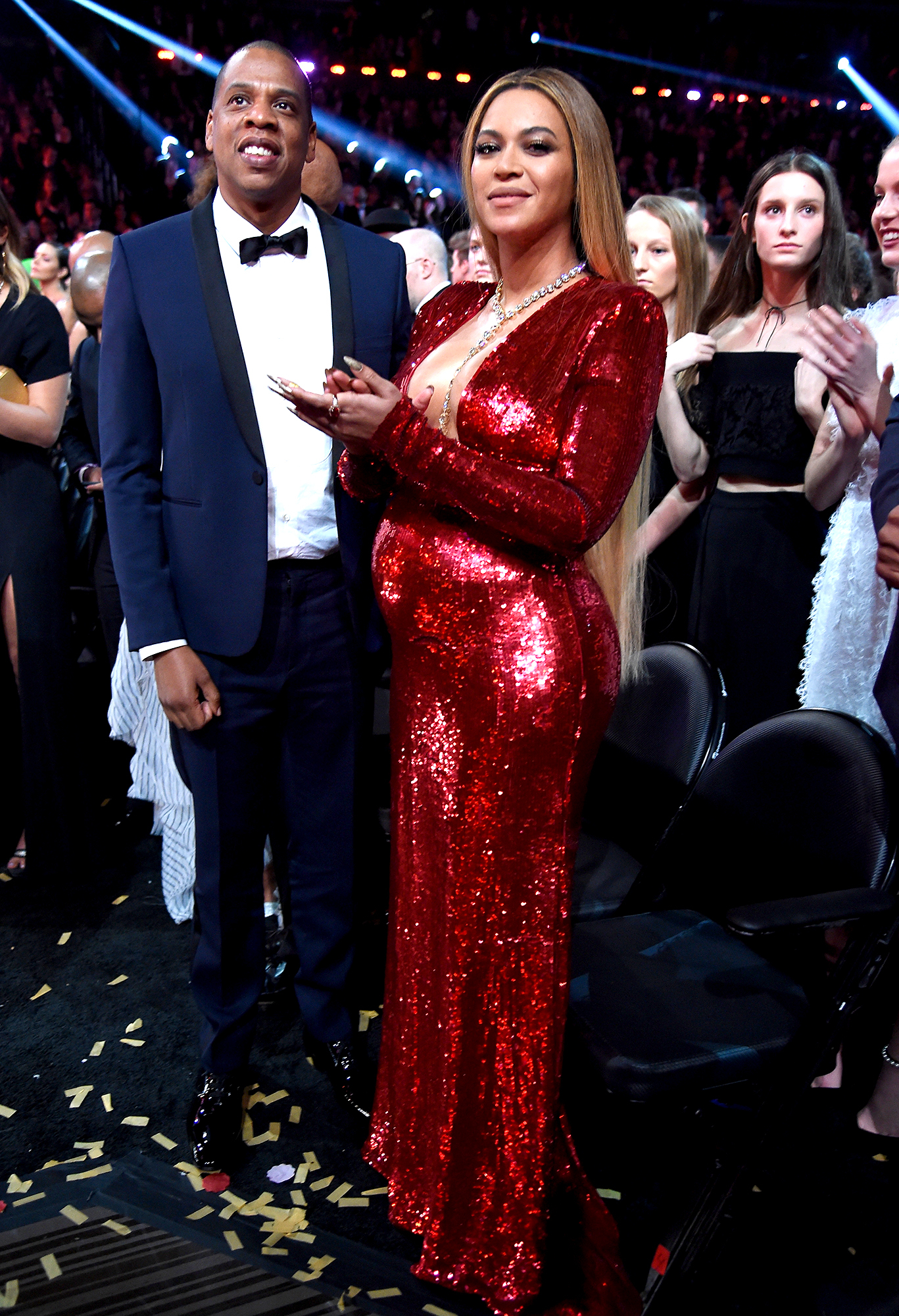
It was late February. Everyone knew it was coming, but nobody was actually ready. When the lights dimmed at the Staples Center, the collective breath of millions just... stopped. Seeing Beyoncé at 2017 Grammys wasn't just about watching a pop star sing some hits from a successful album; it was a high-art fever dream that felt more like a religious experience or a museum gala than a standard awards show segment.
She was pregnant. Very pregnant. With twins, Sir and Rumi.
The imagery was heavy on the gold. It was heavy on the motherhood. Honestly, it felt like she was intentionally leaning into the "Mother Nature" archetype while the rest of the world was just trying to figure out if she’d actually win Album of the Year for Lemonade. Spoiler: she didn't, and that’s a whole other conversation we have to get into, because the Adele vs. Beyoncé debate that night basically broke the internet before "breaking the internet" was a tired cliché.
The Performance: Beyond the Gold Crown
Let's talk about the technical side of that nine-minute set. It started with a complex holographic projection. If you remember, there were these "ghost" versions of Beyoncé and her mother, Tina Knowles, and her daughter, Blue Ivy, all interacting in a way that looked seamless on TV but must have been a logistical nightmare to pull off live.
She performed "Love Drought" and "Sandcastles." These aren't high-energy club bangers. They are slow, methodical, and emotionally raw. At one point, she sat in a wooden chair that tilted back over the edge of a long table.
I remember watching that and thinking, "Is the chair bolted down?" It was. Obviously. But the tension was the point.
She wore a custom Peter Dundas gown that allegedly took a team of people weeks to bead. It featured her own face in the center of the stomach area, framed by rays of sun. It was loud. It was unapologetic. It was also a massive middle finger to the idea that pregnant women should "hide away" or take it easy. She was out there doing vocal runs while carrying two human beings and wearing twenty pounds of gold leaf.
The Album of the Year Controversy
If you want to understand why people still bring up Beyoncé at 2017 Grammys, you have to look at the end of the night. Lemonade lost to Adele’s 25.
It was awkward. It was genuinely uncomfortable to watch.
Adele, bless her heart, spent her entire acceptance speech basically apologizing for winning. She looked at Beyoncé and said, "I can't possibly accept this award." She even broke the Grammy in half (though she later swapped it for a whole one backstage). But the sentiment was clear: the industry had a "Beyoncé problem."
The Recording Academy has a long history of rewarding commercial, traditional pop over experimental, culturally specific Black art. Lemonade was a visual album. It touched on infidelity, generational trauma, the Black Lives Matter movement, and Southern Gothic aesthetics. It was a masterpiece of storytelling. 25 was a collection of great songs, sure, but even Adele knew which album moved the needle that year.
Critics like Greil Marcus and various writers at Pitchfork and Rolling Stone dissected this for months. It wasn't just a "fan war." It was a data-backed discussion about how the Grammys categorize "Urban" vs. "Pop" and who gets to sit at the big kids' table when the final envelopes are opened.
The Visual Language of Oshun
People who weren't familiar with West African mythology might have just seen "Gold Beyoncé." But for those in the know, the 2017 Grammys look was a direct tribute to Oshun.
Oshun is an Orisha—a deity in the Yoruba religion. She represents femininity, love, and fresh water. She is almost always associated with the color yellow or gold. By stepping onto that stage in that specific regalia, Beyoncé wasn't just being a "diva." She was performing a ritual. She was placing her pregnancy and her Blackness into a lineage that predates the United States by centuries.
It’s this kind of layering that makes her work so dense. You can't just watch it once. You have to go back and look at the crown, the flowers, the way the dancers were positioned.
Why it still feels relevant in 2026
We are nearly a decade removed from that night, and the ripples are still felt. Think about it. Before this, "maternity fashion" for celebrities was mostly about looking "glowy" and "soft." Beyoncé turned it into a power move.
- Impact on Live Production: The use of AR and holographic screens in that performance set a new bar for what artists expected from the Recording Academy’s tech crew.
- The "Snub" Legacy: Every time a major Black artist loses a top-tier category today, the 2017 Grammys are cited as the primary "Exhibit A" for institutional bias.
- Cultural Crossover: It bridged the gap between high-fashion editorial and mainstream pop performance in a way that few have replicated since.
The sheer audacity of the set—performing "Sandcastles," a song about forgiveness and a failing marriage, while looking like a literal goddess—is a juxtaposition that only she could pull off without it feeling cheesy.
The Reality of the "Loss"
Let’s be real for a second. Beyoncé didn't "lose" that night. She walked away with Best Urban Contemporary Album and Best Music Video. She has more Grammys than almost anyone in history. But the 2017 ceremony became a flashpoint because it exposed the ceiling.
If Lemonade—an album that had a literal film accompanying it, a world tour that grossed hundreds of millions, and universal critical acclaim—couldn't win the top prize, what could?
It changed the way we talk about awards. Now, when we see the "Beyoncé at 2017 Grammys" clips on TikTok or X, they aren't just nostalgia. They are used as a yardstick. We compare everything to that level of detail.
Actionable Takeaways for the Super-Fan (and the Skeptic)
If you're looking to dive back into this era, don't just watch the YouTube clip of the performance. You're missing half the story.
1. Watch the "Lemonade" Film in its Entirety
The Grammy performance is basically the "epilogue" to the film. You can't understand the gold dress without seeing the "Hold Up" yellow dress first. It's about the evolution from anger to healing.
2. Read the "Adele/Beyoncé" Post-Mortems
Go back and find the articles from The New York Times published the morning after the 2017 show. The cultural critique of how the Academy votes is fascinating and explains why the rules for "Album of the Year" have been tweaked several times since then.
3. Analyze the Peter Dundas Sketches
If you’re into fashion, look up the original sketches for the 2017 Grammy look. Seeing how they translated those drawings into a garment that had to move and breathe on a pregnant body is a masterclass in costume design.
4. Listen to the "Sandcastles" Vocals Raw
There are "stems" or isolated vocal tracks floating around online. Listen to the crack in her voice during that performance. It wasn't perfect. It was gravelly and strained in parts, which was a deliberate choice to show the "ugly" side of grief and reconciliation.
Beyoncé at 2017 Grammys remains the gold standard—literally and figuratively—for what a superstar can do when they have a platform and a clear vision. It wasn't just a song. It was a statement that stayed in the room long after she walked off stage.
To truly appreciate the artistry, one must look past the sparkle and see the labor. The labor of the performance, the labor of motherhood, and the labor of an artist constantly fighting against a glass ceiling that seems to move every time she gets close to it.
Next Steps for Research:
- Compare the 2017 performance to her 2011 "Love on Top" pregnancy reveal to see how her approach to "motherhood as art" shifted over six years.
- Examine the sales data of Lemonade vs. 25 in the week following the ceremony to see how the "Grammy Bump" actually worked for both artists.
- Check the Recording Academy's official "Diversity Task Force" reports that were commissioned shortly after the 2017 and 2018 ceremonies to see what structural changes were actually implemented.