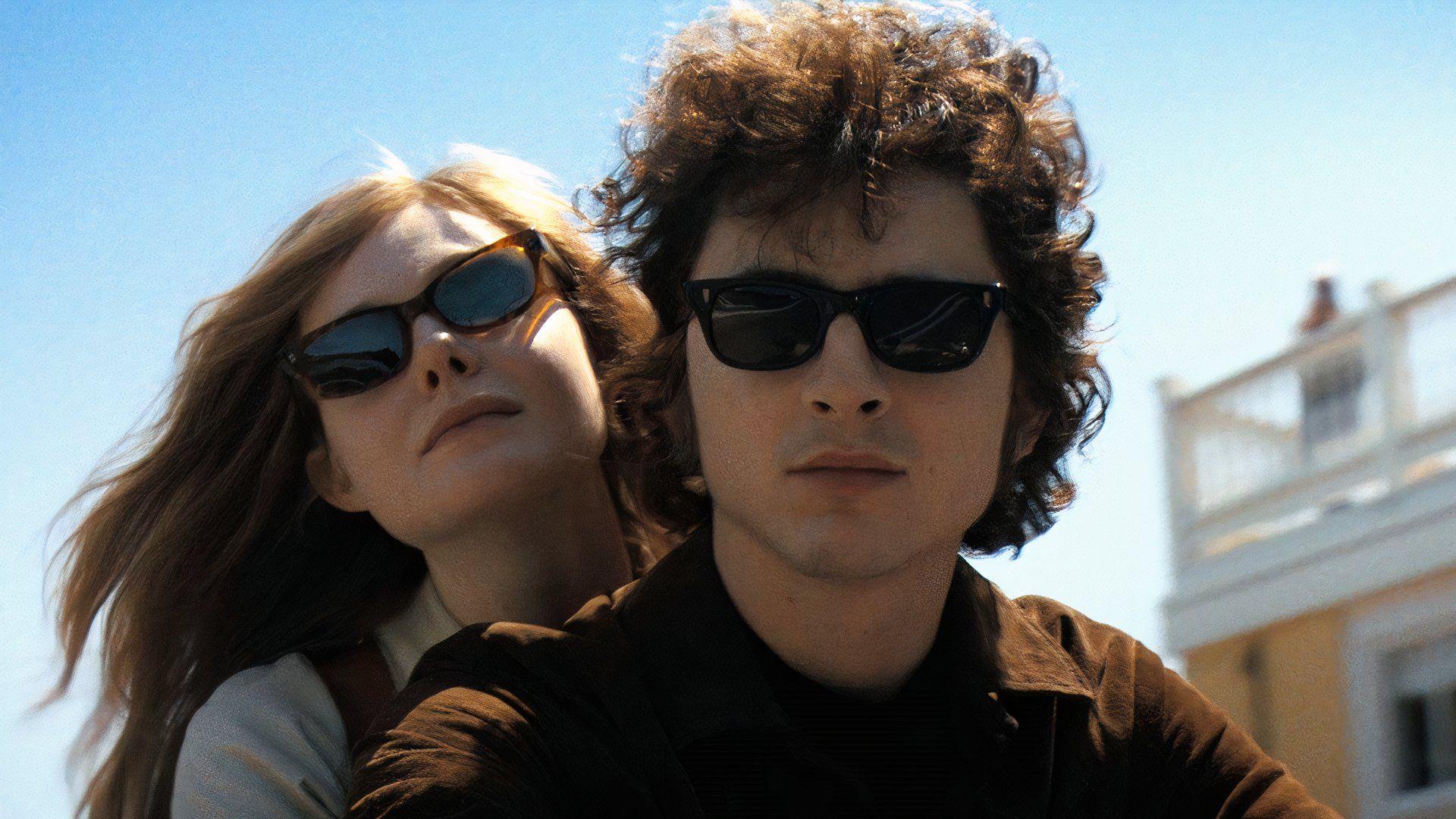
Timothée Chalamet isn't just wearing a wig and holding a harmonica. He's trying to channel a ghost. When the first trailers for A Complete Unknown dropped, the internet did what it always does—it obsessed over the voice. Does he sound like Bob? Is it too "Dewey Cox"? But movies like this, directed by James Mangold, aren't actually about mimicry. They're about that specific, jagged moment in 1965 when a kid from Minnesota decided to plug in an electric guitar and effectively set his own career on fire.
It was messy.
People think of Dylan now as this untouchable Nobel Prize winner, a statue in the pantheon of rock. But in the early '60s, he was a scrappy, somewhat derivative folk singer who became the "voice of a generation" whether he liked it or not. A Complete Unknown dives into the friction of that transition. It’s not a birth-to-death biopic. It’s a snapshot of a cultural earthquake.
The Newport Folk Festival Scandal: What Really Went Down
Most people know the legend. Dylan goes electric, the crowd boos, someone yells "Judas!" and the world changes. But the reality James Mangold explores in A Complete Unknown is way more nuanced than just a loud guitar.
The "Folk Process" was a sacred thing in the early sixties. You had Pete Seeger—played by Edward Norton in the film—who viewed folk music as a communal tool for social change. To that crowd, "selling out" meant using an amplifier. It sounds ridiculous now, but back then, an electric guitar was a symbol of commercialism and the "plastic" pop world.
Dylan didn't care.
He showed up with members of the Paul Butterfield Blues Band and blasted a distorted version of "Maggie’s Farm." The sound mix was actually terrible. That’s a detail many biopics miss but this film leans into. The audience wasn't just mad at the music; they were mad because they couldn't hear the lyrics over the roar of the instruments. It was a sensory assault. Mangold captures the claustrophobia of that moment—the sweat, the feedback, and the genuine fear that Dylan was destroying his identity in real-time.
Chalamet and the Art of the "Un-Biopic"
How do you play someone who spent his entire life lying to the press? Dylan used to tell reporters he was an orphan or that he worked in a circus. He was a shapeshifter.
Honestly, Chalamet’s biggest challenge wasn't the singing—which he did himself, by the way—it was the stillness. Dylan had this way of looking at people like he was bored and electrified at the same time. The film focuses heavily on his arrival in New York City in 1961 with nothing but a few dollars and a desire to meet Woody Guthrie.
- He wasn't a star yet.
- He was a sponge.
- He stole records from friends.
- He borrowed personalities.
The movie tracks this evolution from a Guthrie-clone to the surrealist poet of Highway 61 Revisited. It’s a messy, non-linear progression. You see him interacting with Joan Baez (Monica Barbaro), who was the undisputed Queen of Folk at the time. Their relationship wasn't just a romance; it was a clash of ideologies. Baez wanted to save the world. Dylan wanted to save his own art.
The Sound of 1965
You can’t talk about A Complete Unknown without talking about the production design. They didn't just build sets; they tried to recreate the grime of the West Village. Café Wha? and Gerde's Folk City look lived-in.
The music is the spine of the film.
Instead of using the original Dylan recordings, which are so iconic they’ve become wallpaper, the film uses live performances. This is a gutsy move. When you hear Chalamet sing "A Hard Rain's A-Gonna Fall," it feels immediate. It doesn't feel like a museum piece. It feels like a young man realizing he has something terrifying to say.
The film also captures the specific gear of the era. The Gibson acoustics. The Fender Stratocaster that changed history. For gear nerds, seeing the transition from the "clean" folk sound to the "thin, wild mercury sound" (as Dylan called it) is the highlight of the movie.
Why the Title Matters
"Like a Rolling Stone" contains the lyric "How does it feel, to be on your own, with no direction home, like a complete unknown?"
That’s the core of the movie.
It’s about the terrifying freedom of being nobody. Before the fame, before the "prophet" label, Dylan was just a kid trying to figure out how to be an artist. The movie argues that the moment he became a "known" quantity, he felt the need to sabotage it. He had to become "unknown" again to keep his soul intact.
The supporting cast helps anchor this. Elle Fanning plays Sylvie Russo, a character heavily inspired by Suze Rotolo (the woman on the cover of The Freewheelin' Bob Dylan). She represents the life he could have had—a normal, bohemian life in New York—before the machinery of stardom took over.
Moving Beyond the Hype: Actionable Steps for Fans
If you’ve watched A Complete Unknown and want to actually understand the history behind the drama, don't just stick to the movie. Biopics, by nature, condense timelines and merge characters.
- Listen to the "Live at Newport 1965" Set. You can find the actual audio of the "electric" performance online. It’s shorter than you think—only three songs—but you can hear the tension in the air.
- Read "Chronicles: Volume One." This is Dylan's own memoir. Is it 100% factual? Probably not. Is it a masterpiece of prose that explains his mindset better than any movie? Absolutely.
- Watch "No Direction Home." The Martin Scorsese documentary covers the same period as the film but uses real footage. Seeing the actual Dylan sneer at the press in 1966 provides a perfect "before and after" comparison to Chalamet's performance.
- Visit the West Village. If you’re ever in NYC, walk down MacDougal Street. A lot of the locations from the film are still there, at least in spirit. You can still grab a coffee at places where the folk revival was born.
A Complete Unknown isn't a history lesson; it's an atmosphere. It captures a specific American moment when the old world of acoustic protest met the new world of electric chaos. Whether you love Dylan or can't stand his voice, the film forces you to respect the sheer audacity of a 24-year-old telling his entire audience to go to hell so he could follow his own muse.
Ultimately, the film succeeds because it doesn't try to explain Bob Dylan. It just lets him be.
To fully appreciate the era, track down a copy of the 1965 Highway 61 Revisited album on vinyl. There is a depth to the analog recording—the hiss of the tape and the way the organ sits in the mix—that digital streams simply can't reproduce. It's the best way to hear exactly what those fans at Newport were so afraid of.