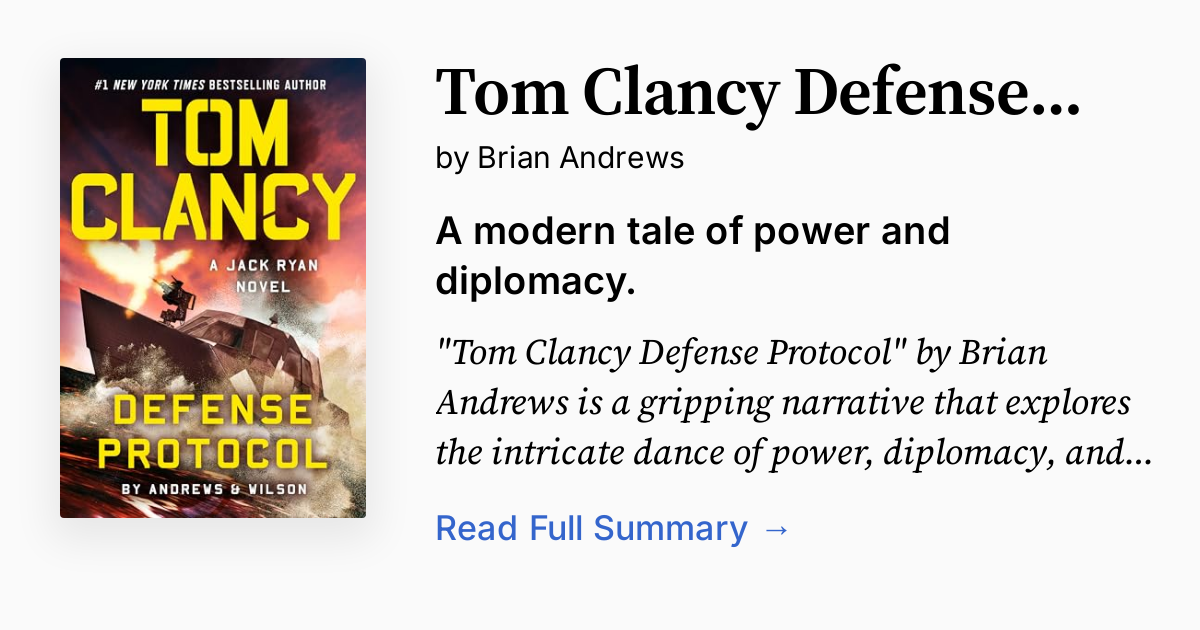
If you’ve been following the Jack Ryan universe for a while, you know the drill. High stakes, geopolitical chess, and enough military acronyms to make a West Point grad dizzy. But the latest entry, Tom Clancy Defense Protocol, feels like a bit of a shift. Written by the powerhouse duo Brian Andrews and Jeffrey Wilson—who honestly have the best "street cred" in the business as a submarine officer and a SEAL team surgeon—this book pushes the Ryan family into a corner we haven't quite seen before.
It’s not just about Jack Sr. sitting in the Oval Office making the big calls anymore. This time, the "Defense Protocol" refers to a terrifyingly thin line between a localized skirmish and a full-blown global meltdown.
Basically, China has a new president, Li Jian Jun, and he’s tired of the "diplomatic pressure" game. He wants Taiwan. Now.
The Core Conflict: What is the Tom Clancy Defense Protocol?
In the context of the novel, the Tom Clancy Defense Protocol isn't just a fancy name on the cover. It refers to the specific, rigid military and political escalation ladders that the United States has to climb when a nuclear power makes a move on a sovereign ally. It’s that "mutual destruction" game where every move Jack Ryan makes has a counter-move that could lead to thousands of American deaths, including his own daughter, Katie.
Katie Ryan is really the soul of this book. She’s a lieutenant commander on the USS Jason Dunham, sitting right in the middle of the Taiwan Strait. While her dad is debating "Defense Protocol" in the Situation Room, she’s looking through the glass at a Chinese armada that is itching for an excuse to fire.
The plot kicks off when the Chinese Minister of Defense, Qin Haiyu, decides he’s seen enough of President Li’s "mad and bloody" plan. He wants out. He signals the CIA that he wants to defect, and that’s when the classic Clancy-style chaos erupts.
- John Clark is back: He leads an international task force that feels a lot like the old-school Rainbow Six days.
- The "Night Spider": A CIA asset in Beijing named Qiu Lei who has to navigate a city that is basically one giant AI-powered surveillance trap.
- The USS Jason Dunham: A destroyer that becomes the "tip of the spear" in a literal game of chicken with Chinese Type 055 destroyers.
Why this book is actually kind of scary
Clancy fans love the "techno-thriller" aspect, but Tom Clancy Defense Protocol leans heavily into how modern tech has changed the spying game. Andrews and Wilson spend a lot of time on how the Chinese government uses machine learning and facial recognition to track every move. It makes the old "cloak and dagger" stuff look like child's play.
There's this one sequence where the "Night Spider" is trying to move the Defense Minister through Beijing, and they’re constantly fighting against a city that "sees" everything. It's claustrophobic. You’ve got the high-tech digital eye of the CCP on one side and the raw, mechanical power of a carrier strike group on the other.
The authors don’t shy away from the "Defense Protocol" implications. If the US defends Taiwan, they risk a direct kinetic war with China. If they don't, the entire global order collapses. It’s a lose-lose scenario that Jack Ryan has to navigate with a "slip of the tongue" potentially triggering a launch sequence.
The "Ryanverse" Evolution
One thing that makes this entry stand out is the generational hand-off. We’ve seen Jack Jr. doing the field work for years, but seeing Katie Ryan in a leadership role on a destroyer adds a fresh layer of tension. It’s personal for the President. Every order he gives for the Tom Clancy Defense Protocol to be enacted is an order that puts his daughter's life on the line.
Honestly, the ending has sparked some debate among the hardcore fans. Some people on Reddit and forums felt the resolution was a bit fast—like things got wrapped up a little too neatly when the CCP Secretary General stepped in. But that’s the nature of these books lately. They’re fast-paced, high-octane, and sometimes the "deus ex machina" comes from the internal politics of the enemy rather than a torpedo hit.
Actionable Insights for Clancy Readers
If you're planning to dive into this one, or you've just finished it and want to understand the "why" behind the military jargon, here’s what you need to keep in mind:
- Watch the "False Flag" Plot: A major part of the tension comes from a Chinese Special Forces unit seizing a Taiwanese anti-ship battery. The goal was to make it look like Taiwan fired first. In the world of Tom Clancy Defense Protocol, information (and the timing of it) is more valuable than the actual missiles.
- The Role of John Clark: If you missed the gritty, boots-on-the-ground feel of the early books, Clark’s mission to extract the defector in mainland China is for you. It’s a reminder that even in an age of drones and AI, you still need a guy with a suppressed pistol and a plan.
- The "Night Spider" Asset: Pay attention to Qiu Lei. She represents the new era of intelligence—educated in math, rhetoric, and Kung Fu. She’s the bridge between the old-school spy and the new-age analyst.
The Tom Clancy Defense Protocol serves as a stark reminder of how close the world can get to the edge. It's a solid 500-plus page journey that manages to feel relevant to the actual news cycles we see regarding the South China Sea today.
To get the most out of this story, you should look back at the previous book, Act of Defiance, as Andrews and Wilson have been building this specific narrative arc over the last couple of releases. Understanding the "Ryan Doctrine" from earlier novels helps explain why Jack Sr. is so hesitant to pull the trigger here, even when the "Defense Protocol" suggests he should. Focus on the tactical maps provided in the front of the book—they actually help visualize the "Maritime Exclusion Zone" that drives the climax of the naval battle.