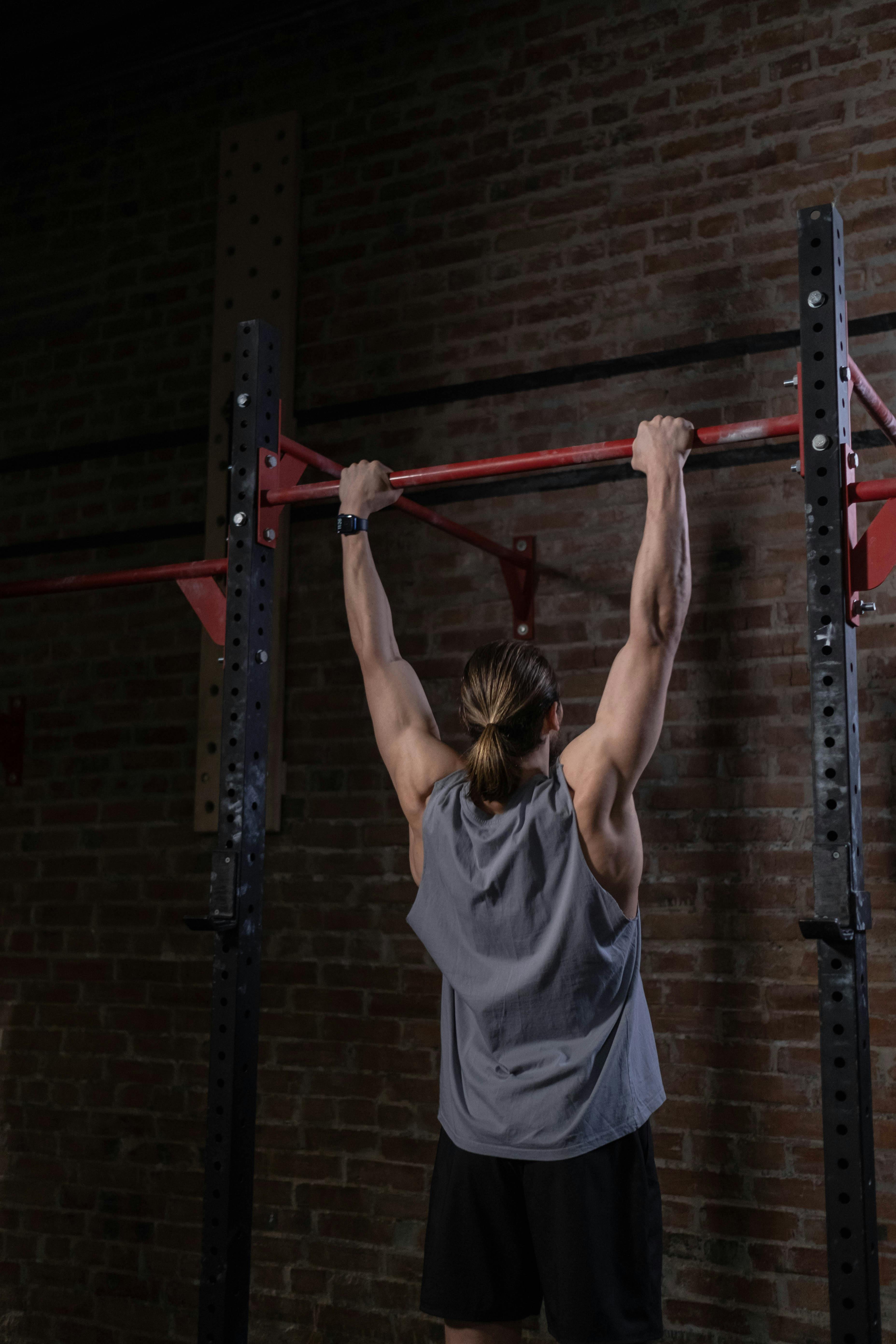
You see it in every commercial gym across the country. A guy doing pull ups is usually a spectacle of momentum. He’s kicking his legs, his chin is barely clearing the bar, and his shoulders are rolled so far forward he looks like a closing book. It’s painful to watch. Not because it’s hard, but because it’s mostly wasted energy.
The pull up is arguably the "king" of upper body movements. It’s a closed-kinetic chain exercise, meaning your hands are fixed and your body moves through space. This requires massive neurological recruitment compared to something like a lat pulldown. But here’s the thing: most people aren't actually doing pull ups. They're doing "chin-overs." There’s a massive difference.
The Biomechanics of the Perfect Pull Up
Most guys think the goal is just to get the chin over the bar. Wrong. If that's your only goal, your brain will find the path of least resistance. Usually, that involves using the internal rotators of the shoulder and the bicep to "cheat" the height.
To actually grow a back that looks like a barn door, you need to focus on scapular depression. This means pulling your shoulder blades down into your back pockets before you even bend your elbows. If you watch a professional gymnast or a high-level calisthenics athlete, they don't just "pull." They depress the scapula, then drive the elbows toward their hips.
Basically, you want to think about bringing the bar to your chest, not your face to the bar.
The Myth of the "Dead Hang"
There is a lot of debate about whether you should start from a complete dead hang. Some experts, like Dr. Stuart McGill, a leading authority on spinal mechanics, suggest that a complete, relaxed dead hang can put excessive stress on the connective tissues of the shoulder if you aren't active.
You want "active" shoulders. This means even at the bottom of the movement, you aren't just dangling like a piece of laundry. You’re keeping tension. You’re ready.
Common Mistakes That Kill Your Gains
Honestly, the biggest mistake is the "ego rep." We’ve all been there. You want to hit ten reps because ten sounds better than six. But if those last four reps involve a violent hip kick (kipping) or a shortened range of motion, you’re just training your ego.
- The Leg Cross: Most guys cross their ankles behind them. This actually causes a slight tilt in the pelvis and can leak power. Try keeping your legs straight and slightly in front of you—this is called the "hollow body" position. It engages the core and makes the whole movement more stable.
- The Grip Width: People think wider is always better for a wider back. Science says otherwise. A study published in the Journal of Strength and Conditioning Research found that a medium grip (slightly wider than shoulders) actually produces more lat activation than an ultra-wide grip.
- The Neck Reach: Don't crane your neck. It’s a great way to strain your levator scapulae and end up with a headache. Keep your gaze neutral or slightly upward.
Why Your Grip is Probably the Weak Link
If you're a guy doing pull ups and you find your hands giving out before your back does, join the club. Your lats are huge muscles. Your forearm muscles? Not so much.
You can fix this two ways. First, stop using straps for pull ups unless you're doing weighted sets with 50+ pounds. Let your grip catch up. Second, try the "thumbless" grip. By putting your thumb over the bar instead of under it, you turn your hands into hooks. This often helps people "feel" their lats more because it reduces the amount of bicep involvement. It sounds weird, but it works.
Programming for Real Progress
If you can only do one or two pull ups, stop trying to do sets of ten. It's not going to happen yet. You need to use "negatives."
Jump up to the top of the bar and lower yourself as slowly as humanly possible. Gravity is a great coach. If you can spend 30 seconds on the way down, you're building the eccentric strength required to eventually pull yourself up.
Another trick is the "Russian Fighter Pull Up Program." It’s a high-frequency protocol where you do a specific number of reps every day, gradually increasing the volume. It’s not about training to failure. It’s about "greasing the groove." You’re teaching your nervous system how to execute the movement efficiently.
Is the Weighted Pull Up Necessary?
Eventually, bodyweight isn't enough. If you can do 15 clean, chest-to-bar reps, you’ve reached the point of diminishing returns for hypertrophy. You need to add load. Using a dip belt to hang a 25-pound plate between your legs changes the stimulus entirely. It forces a level of core stability that unweighted reps just can't match.
Practical Steps to Mastering the Bar
Stop treating pull ups as a "finisher" at the end of your workout when you're already toasted. If you want to get good at them, do them first.
- Record your sets. You'll be shocked at how much you're actually swinging when you think you're being still. Camera angles don't lie.
- Focus on the squeeze. At the top of the rep, try to hold for one second. If you can't hold it, you didn't control the rep.
- Vary your grip. Switch between pull ups (palms away), chin ups (palms facing you), and neutral grip (palms facing each other). This hits the muscles from different angles and prevents overuse injuries like golfer's elbow.
- Fix your posture. If you spend all day hunched over a laptop, your chest is tight and your back is weak. Spend five minutes stretching your pecs before you hit the bar. It opens up your range of motion.
The goal isn't just to be another guy doing pull ups in the background of someone's TikTok. The goal is to own the movement. Slow down. Breathe. Pull with your elbows, not your hands. That's where the real growth is.
To get started tomorrow, pick one variation you usually avoid—maybe it's the neutral grip or slow negatives—and lead your workout with three sets of sub-maximal effort. Focus entirely on the sensation of your shoulder blades moving down and together. Consistency here beats intensity every single time.