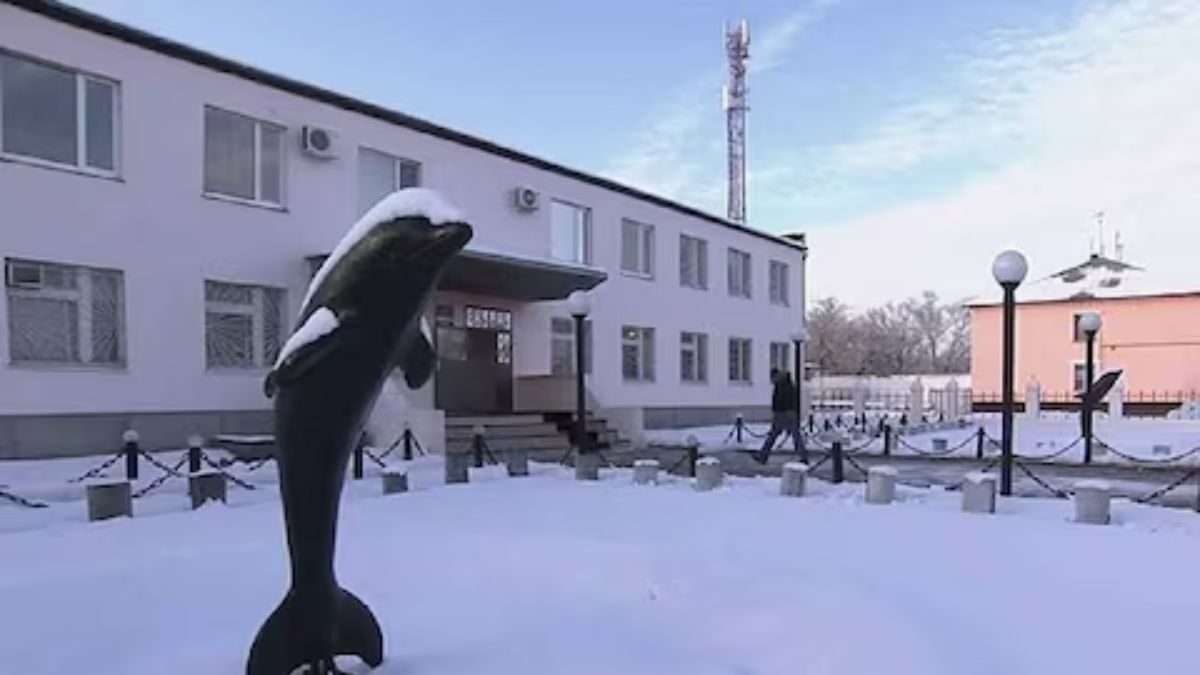
Deep in the Orenburg region, right near the border where Russia meets Kazakhstan, sits a facility that makes most people's skin crawl just thinking about it. Formally, it is Federal Governmental Institution — Corrective Colony No. 6. But nobody calls it that. To the world, it is the Black Dolphin prison, a name derived from the somewhat eerie, amateurish sculpture of a leaping dolphin made by the inmates themselves that sits in the front courtyard. It’s a bit of dark irony. The dolphin is black, painted with lead, and represents a freedom that literally no one inside those walls will ever taste again.
This isn't just a jail. It’s the end of the line.
If you find yourself behind these specific bars, you aren't there for a bar fight or tax evasion. We are talking about the worst of the worst. Serial killers. Terrorists. Cannibals. Child molesters. The facility houses around 700 of the most dangerous individuals in the Russian Federation. Collectively, the inmate population is responsible for thousands of deaths. It's a place designed not for rehabilitation, but for total, absolute containment until death do they part.
The Reality of Life Inside Black Dolphin Prison
Most people think they understand maximum security, but Russia plays by a different set of rules. At Black Dolphin, the psychological pressure starts the second an inmate arrives. They are blindfolded. Always. Whenever they are moved between buildings or taken to a new cell, a thick cloth covers their eyes so they can’t map out the prison layout. They are also forced to walk in a "stress position"—bent over at the waist, hands cuffed behind their backs and held high by a guard.
It looks painful because it is. This "elephant walk" ensures the prisoner is completely disoriented and physically incapable of a sudden lunge or escape attempt.
The cells are essentially a cage within a cage. You have the heavy steel door, then a secondary set of bars, creating a "buffer zone" where guards can observe without being in reach. These men live in roughly 50-square-foot spaces. They are under 24-hour surveillance. Every 15 minutes, a guard checks in. Lights stay on 24/7. Sleeping with your head under the covers? Not allowed. The guards need to see your face and hands at all times.
No Sitting, No Resting, No Peace
One of the most brutal psychological aspects of Black Dolphin is the "no sitting" rule. From the moment they wake up until the moment they are told to sleep—roughly 16 hours—inmates are strictly forbidden from sitting or lying on their bunks. They must stand or pace. For decades. Imagine standing for 16 hours a day for a 40-year life sentence. It’s a slow-motion breakdown of the human spirit.
Food is another exercise in minimalism. You aren't getting a cafeteria tray. You get soup and bread, usually served through a small slot in the door. There is no communal dining. No "yard time" in the way Westerners imagine it. Their "exercise" happens in a slightly larger cell that just happens to have no roof, allowing a glimpse of the sky through heavy iron grating. They are alone or with a single cellmate, hand-picked by the administration to avoid conflicts—or sometimes, perhaps, to create a specific psychological environment.
Why Nobody Ever Escapes
The security isn't just about the walls or the barbed wire. It’s the culture of the guards. These officers are some of the most hardened in the Russian penal system. There has never been a successful escape from Black Dolphin prison. Not one.
The prison operates on a 1:1 or sometimes 2:1 guard-to-prisoner ratio during movement. When a cell is opened, multiple armed guards and often a canine unit are present. These dogs aren't pets. They are highly trained Caucasian Shepherds and Malinois that are taught to be aggressive.
- Total Isolation: Inmates have almost zero contact with the outside world.
- Constant Monitoring: Over 900 cameras watch every inch of the facility.
- The Blindfold Rule: Even after 20 years, an inmate wouldn't know if the exit was left or right.
Honestly, the sheer monotony is what breaks them. Most inmates describe the experience not as "living," but as "existing in a void." It is a machine designed to make you forget you are a person.
The Inmates: Who is Actually Kept There?
To understand why the Russian state is so harsh here, you have to look at the "residents." One of the most infamous names associated with the facility is Vladimir Nikolayev. He’s a convicted cannibal. He didn't just kill; he served his victims to his friends, telling them it was "kangaroo meat." Then there’s Sergey Nikolayev (no relation), a radical who blew up a market in Moscow.
When you realize the person in the cell next to you has killed 50 people, the "cruel and unusual" debate gets complicated. In Russia, the death penalty has been under a moratorium since the 1990s. Black Dolphin is the functional substitute. It is a death sentence that takes 40 years to finish.
Does Rehabilitation Exist Here?
Strictly speaking? No.
While some prisons in the West focus on restorative justice, Black Dolphin is purely punitive. There are no vocational workshops where you learn to fix cars. There are no university correspondence courses. There is a small library, and some inmates are allowed to have a television if their families can afford to send one (and if they behave), but those are rare luxuries.
The Russian government’s stance is basically: "You forfeited your right to be part of society, so we are removing you from it entirely." It’s a stark contrast to the Scandinavian model, and even much harsher than U.S. "Supermax" facilities like ADX Florence.
Comparing Black Dolphin to Other Global Prisons
If you compare Black Dolphin to something like ADX Florence in Colorado, you see similarities in the isolation, but the physical treatment in Russia is significantly more "hands-on." In the U.S., prisoners are often isolated in soundproof cells but have concrete furniture and perhaps a small radio. In Black Dolphin, the forced physical positions and the constant movement under guard make it much more of a physical ordeal.
The Orenburg climate doesn't help. It's bitter. Winters are brutal, and while the prison is heated, the atmosphere is perpetually cold and damp. It’s a place that feels like it’s built out of spite.
The Psychological Toll of Corrective Colony No. 6
Psychologists who have studied the Russian prison system (as much as one can from the outside) note that the "Black Dolphin" method leads to a total detachment from reality. Many inmates eventually develop severe mental health issues, but because the facility's goal is security rather than health, these issues are often ignored unless they become a threat to the guards.
You've got to wonder what that does to a person. After a decade of walking bent over with a bag on your head, do you even remember what it’s like to walk upright? Most inmates eventually become "institutionalized" to the point of catatonia. They follow orders with a robotic precision because the alternative—punishment or the "solitary hole"—is even worse.
Actionable Insights: Understanding the Russian Penal System
If you are researching the Russian legal system or the history of its carceral state, it’s vital to distinguish between "General Regime" colonies and "Special Regime" colonies like Black Dolphin.
- Check the Designation: Always look for "Special Regime" (Osobiy Rezhim). This indicates the highest level of security and the most restricted human rights.
- Verify Sources: Because Black Dolphin is a state-run facility in a sensitive region, official information is filtered. Rely on reports from the Moscow Helsinki Group or Amnesty International for a more balanced view of human rights conditions.
- Historical Context: Understand that Black Dolphin has been a prison since the 1700s. It was once a place for those sentenced to hard labor (Katorga) under the Tsars. The current "Black Dolphin" persona only solidified in the early 2000s when it was designated specifically for those with life sentences.
The facility remains a symbol of the Russian state's ultimate power over the individual. It is a place where time stops, and for the 700 men inside, the black dolphin in the yard is the last bit of "art" they will ever see. It is the most permanent destination on earth.