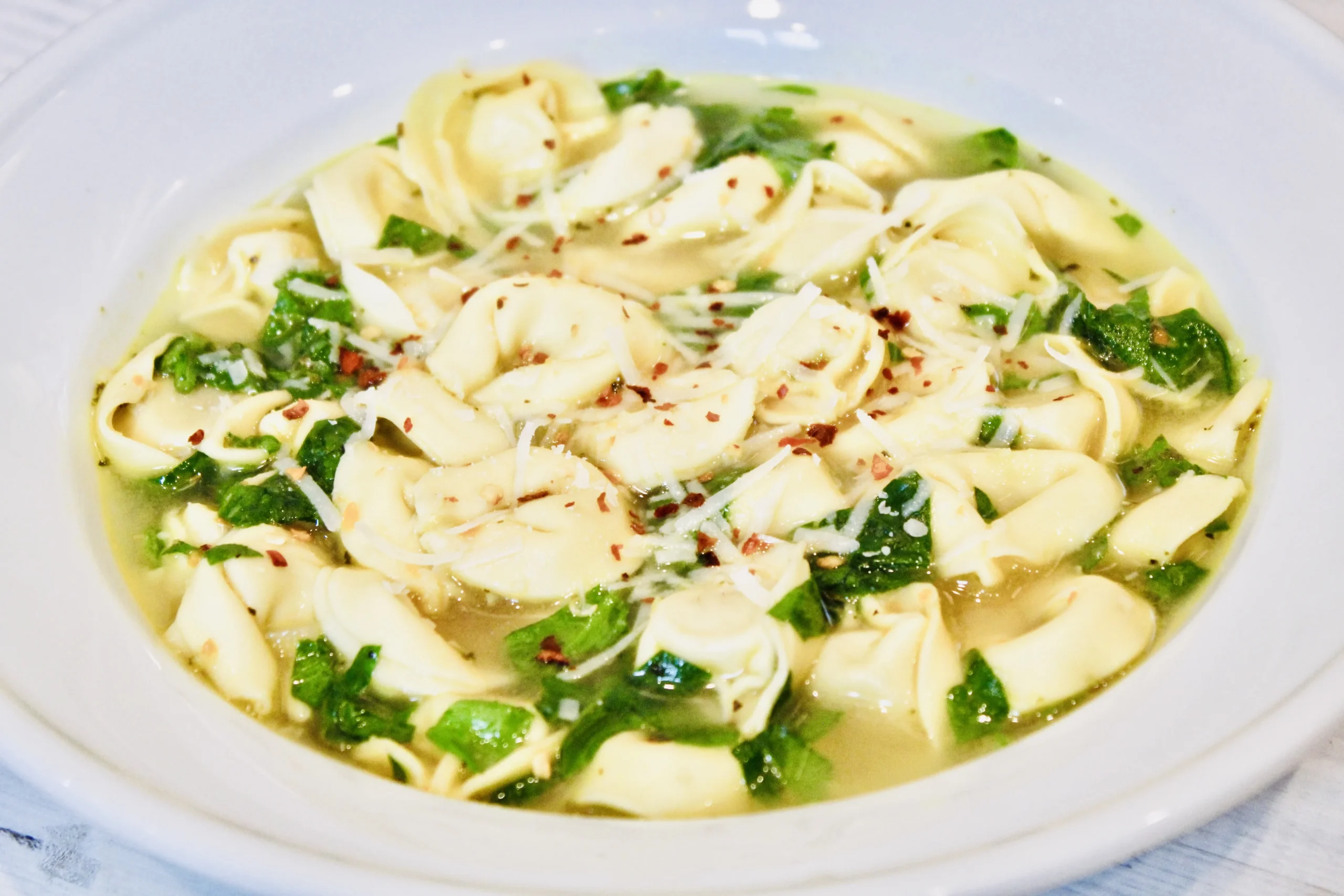
It is the humblest bowl of food you’ll ever see. Honestly, if you saw a photo of authentic tortellini en brodo next to a flashy, cream-laden pasta carbonara, the soup would lose the beauty pageant every single time. It's just beige circles floating in golden liquid. But for anyone from Bologna or Modena, this isn't just "soup." It is a religious experience, a Christmas morning requirement, and a masterclass in the philosophy that says three perfect ingredients are better than twenty mediocre ones.
Most people outside of Northern Italy get it wrong. They buy the thick-skinned, shelf-stable tortellini from a bag and drop them into a pot of salty water with a bouillon cube. Stop doing that. You’re eating cardboard in salt water. Real tortellini en brodo is about the brodo—the broth—which should take you at least four or five hours to make, using enough meat to feed a small village.
The Meat-Water Magic of Real Broth
The broth is the soul. If the broth is weak, the dish is a failure. In the Emilia-Romagna region, the traditional brodo di terza (broth of three) involves a specific holy trinity of meats: beef, capon (or a very good stewing hen), and often a bit of veal or pork bone. You aren't just boiling meat; you're extracting a specific kind of clarity and richness.
The capon is non-negotiable for traditionalists. A capon is a castrated rooster, and because it has more fat and a more delicate flavor than a standard chicken, it gives the broth a silky, yellow fat-cap that sparkles under the dining room lights. If you can't find one, a high-quality organic hen works, but don't tell a grandmother from Bologna I said that. She’d probably chase me out of the kitchen with a rolling pin.
You need to skim. Constantly. If you let the broth boil hard, the fat emulsifies into the water and you get a cloudy, muddy mess. You want a liquid so clear you could read a newspaper through the bottom of the bowl. It’s a slow, rhythmic process of skimming the gray foam off the top while the house starts to smell like the best Sunday afternoon of your life.
Why the Meat Matters More Than the Veggies
While most Americans dump an entire garden into their stockpot, Italians are remarkably restrained. A carrot, a stalk of celery, maybe half an onion that’s been charred on the stove for color. That’s it. No garlic. No bay leaves. No peppercorns that overpower the delicate nutmeg in the pasta. The goal is to taste the essence of the animals, not a vegetable garden.
The Tortellini: Tiny Navels of Legend
Legend says the shape of the tortellini was inspired by Venus’s belly button. An innkeeper caught a glimpse of the goddess through a keyhole and, naturally, decided to recreate her anatomy in pasta dough. It’s a great story. Probably fake, but it captures the reverence Italians have for the shape.
The size is where most people fail. True tortellini en brodo should be tiny. We’re talking about the size of a fingernail. If they look like the giant, thumb-sized dumplings you find in the refrigerated aisle of a supermarket, they are technically tortelloni, and they don't belong in broth. They belong with butter and sage.
The filling is a very specific, very dense mixture:
- Prosciutto di Parma (aged at least 18 months).
- Mortadella (the real stuff from Bologna).
- Pork loin sautéed in butter.
- Parmigiano-Reggiano (the king of cheeses).
- A hint of nutmeg and egg to bind it.
The meat is ground so fine it becomes a paste. When you bite into a tiny tortellino, it shouldn't feel like a meatball; it should melt. There is no garlic in the filling. There are no herbs. It is a concentrated bomb of umami and salt that balances against the clean, light broth.
The Parmigiano-Reggiano Factor
You cannot use the stuff in the green shaker can. Just don't. The cheese used in the filling and the cheese sprinkled on top must be Parmigiano-Reggiano.
Why? Because the cheese acts as the seasoning. Because the broth is usually kept intentionally low on salt, the aged crystals in the cheese provide the "pop." Experts like Massimo Bottura, whose three-Michelin-star restaurant Osteria Francescana is in Modena, have spent decades perfecting the ratio of cheese to broth. In fact, Bottura’s "Tortellini in Broth" is often served in a simple, elegant bowl with exactly 6 or 7 tortellini to emphasize the purity of the ingredients. He treats it like art. You should too.
Common Mistakes That Ruin the Experience
- Cooking the pasta in the main broth pot: Never do this if you plan on having leftovers. The pasta releases starch, which turns your beautiful, clear broth into a cloudy, thick liquid. Cook the tortellini in a separate pot of broth (or a portion of it) so the main batch stays pristine.
- Using "Chicken Broth" from a carton: Most store-bought broths are mostly water, salt, and yeast extract. They lack the gelatinous mouthfeel of home-made stock. If you can't make your own, find a local butcher who sells frozen house-made beef or veal stock.
- Overcooking: Fresh pasta takes three minutes. Maybe four. If they sit in the hot broth too long, they turn into mushy sponges. They should have a slight "snap" to the dough.
- Too many ingredients: Don't add spinach. Don't add carrots to the bowl. Don't add cream. This isn't "Chicken Noodle Soup Plus." It is a minimalist masterpiece.
The Cultural Weight of the Dish
In Italy, specifically in the "Pasta Belt" of the North, tortellini en brodo is the ultimate comfort food. It’s what you eat when you’re sick, what you eat for Sunday lunch at your grandmother’s, and what you eat when the world feels like it’s falling apart.
There is a literal organization, the Dotta Confraternita del Tortellino, dedicated to protecting the original recipe. They registered the official recipe with the Chamber of Commerce in Bologna in 1974. They don't mess around. According to them, the flour must be "00" and the eggs must come from hens that have been fed a certain way.
Is that overkill? Maybe. But when you taste a version made with that level of obsession, you realize that most food we eat is just fuel, while this is heritage.
A Note on Serving Temperature
The broth should be hot. Not "warm," but piping hot. It needs to be hot enough that the fat on the surface is liquid and shimmering. It should be served in shallow bowls, ideally wide-rimmed, so you can appreciate the aroma of the nutmeg and the beef as you lean in.
How to Get the Best Results at Home
If you're going to attempt this, clear your Saturday. Go to a real butcher. Ask for beef shins, marrow bones, and a whole chicken.
Roast the beef bones first. This isn't strictly "traditional" for a light broth, but it adds a depth of color that makes the final product look like liquid gold. Simmer, never boil. Use a paper coffee filter or a very fine cheesecloth to strain the broth at the end. You want to remove every single stray fiber of meat or vegetable.
For the pasta, if you aren't ready to spend six hours folding tiny dough pockets, find an Italian specialty grocer. Ask for "Bologna-style tortellini." They will be small and expensive. Buy them anyway. The difference between those and the mass-market version is the difference between a silk suit and a burlap sack.
Actionable Next Steps for the Perfect Bowl
- Source the Meat: Visit a local butcher for marrow bones and a stewing hen. The older the bird, the more flavor the broth will have.
- The Cheese Rind Trick: Save your old Parmigiano-Reggiano rinds. Throw them into the broth while it simmers. It adds a profound savory depth without adding extra salt.
- The 24-Hour Rule: Make your broth a day in advance. Let it cool in the fridge overnight. This allows the fat to solidify on top so you can easily remove the excess, leaving only the perfect amount for flavor. It also lets the flavors "marry" and mellow.
- Keep it Simple: Resist the urge to add "flair." No pepper, no parsley, no garnish other than a dusting of finely grated cheese. Trust the process.
Real tortellini en brodo is an exercise in patience. It teaches you that you can't hurry quality. Whether you're making it for a holiday or just because it's a cold Tuesday in January, the effort you put into that clear, shimmering liquid will be repaid the moment that first tiny, meat-filled pasta hits your tongue. It is, quite simply, the most sophisticated comfort food on the planet.