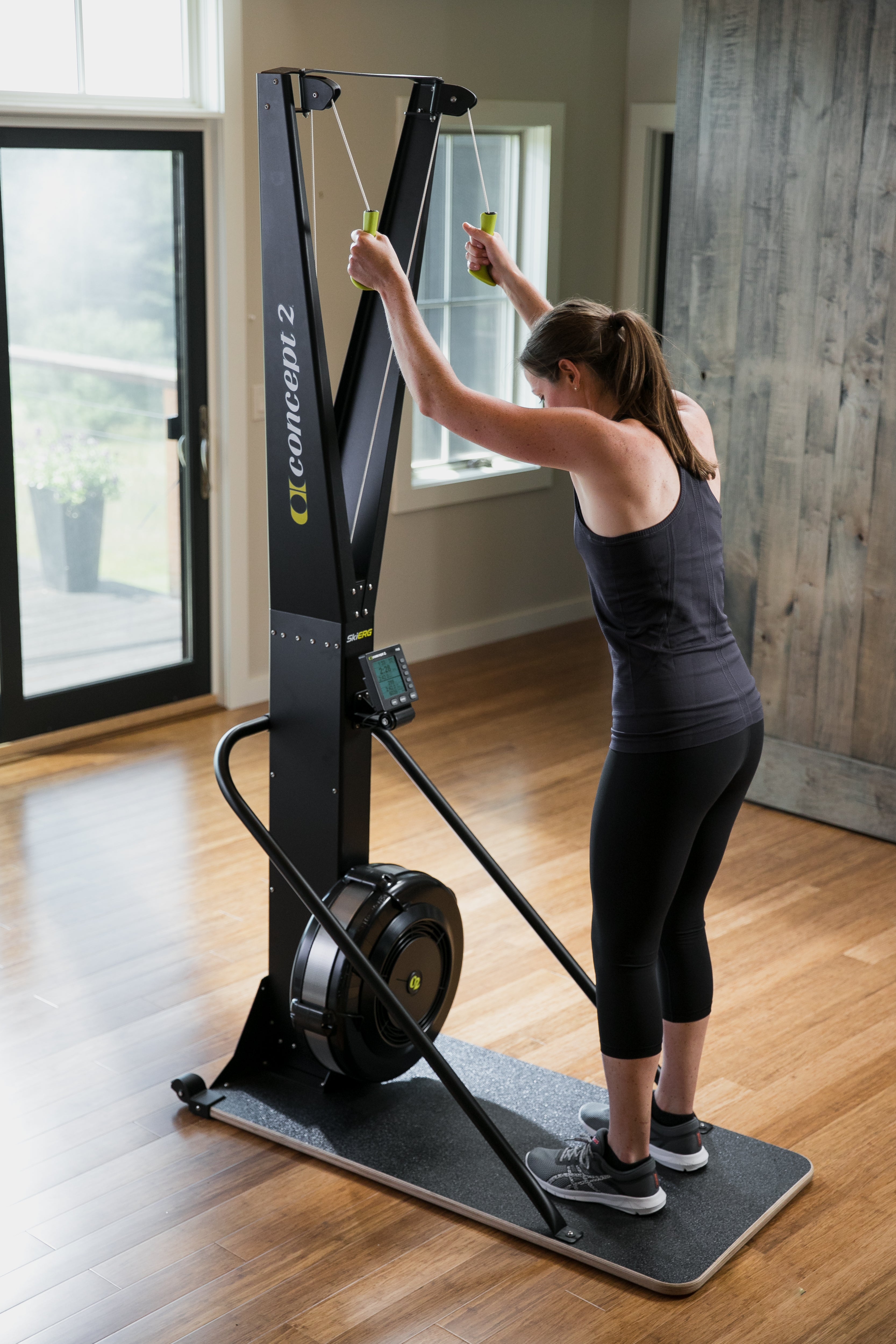
You’ve probably seen it standing in the corner of your gym, looking like a weird, upright torture device with two dangling strings. Most people walk right past it to get to the treadmills or the rowers. Honestly? That’s a mistake. The Concept2 SkiErg is one of the few pieces of equipment that actually lives up to the hype, mainly because it targets the one thing most of us ignore: the "pulling" muscles of the upper body combined with an explosive core contraction.
It's intense.
Think about it. Most cardio is leg-dominant. Running, cycling, even rowing (which is 60% legs) relies on the lower body to move the needle. The SkiErg flips the script. It mimics the movement of Nordic skiing—specifically long-track double-poling—which forces your lats, triceps, and abs to do the heavy lifting. You aren't just waving your arms around. You're hinging at the hips and using your entire body weight to drive those handles down. If you do it right, your heart rate will skyrocket faster than it does on a bike. It’s brutal but effective.
Why the Concept2 SkiErg Actually Works
The magic of this machine is the flywheel. Concept2 uses the same air resistance technology found in their world-standard RowErg. Basically, the harder you pull, the more resistance you create. There are no motors. There’s no preset speed. You are the engine. This makes it incredibly accessible for a pro athlete or someone just trying to get off the couch.
A lot of people think it's just an "arm workout." It isn't. Not even close.
If your arms are the only thing getting tired, you’re doing it wrong. Expert coaches like Dan John or the team over at Gym Jones often emphasize that the power comes from the "crunch." You reach high, engage the core, and throw your weight into the handles. You’re essentially doing a standing, weighted cable crunch every single rep. That’s why your abs are usually the first thing to ache the next morning.
The PM5 Monitor: Where the Truth Lives
You can’t talk about Concept2 without talking about the PM5. It’s the small black box mounted at eye level. While other gym machines give you "estimated calories burned" (which are usually lies), the PM5 is remarkably accurate. It accounts for the air temperature and the drag factor of the flywheel.
It provides data in:
- Pace per 500 meters: The universal language of erg enthusiasts.
- Watts: The raw power you're producing.
- Calories: A calculated rate based on actual work performed.
Because the data is so consistent, you can compare your times with anyone in the world. The Concept2 Online Logbook is a massive database where thousands of people rank their 1000m or 5000m times. It’s a bit of a cult, honestly. But it’s a cult that helps you get fit. You can even connect it to apps like ErgData or Zwift (yes, for skiing) to track your progress over months or years.
It’s Probably the Best Tool for Injury Rehab
One of the biggest advantages of the Concept2 SkiErg is that it’s impact-free. No pounding on pavement. No shearing force on the knees.
I’ve seen athletes with blown-out ACLs or broken ankles use the SkiErg while sitting on a stool or a wheelchair. Because the machine is vertically oriented, you don't necessarily need your legs to generate a workout, though you'll get more power if you use them. If you’re a runner dealing with shin splints or plantar fasciitis, this is your holy grail. You can maintain your VO2 max without putting a single ounce of pressure on your feet.
It’s also "self-limiting." If your form breaks down, you can’t really "force" a bad rep the way you might with a heavy barbell deadlift. The air resistance simply fades. This makes it incredibly safe for high-intensity interval training (HIIT).
Setting Up Your "Drag Factor" Correctly
Here is a common mistake: Crank the damper to 10.
Don't do that.
The damper (that lever on the side of the flywheel) isn't a "difficulty" setting. It’s more like the gears on a bike. A higher damper setting allows more air into the flywheel, which makes it feel "heavier," but it doesn't necessarily mean you're working harder. Most Olympic-level skiers keep their drag factor (which you can check in the PM5 menu) between 100 and 120. For most people, that’s a damper setting of about 3 to 5.
If you set it to 10, you're likely to strain your back before you get a good cardio workout. Keep it lower. Move faster. Speed and snap are better than grinding through a heavy pull.
How to Not Look Like a Newbie
If you want to use the Concept2 SkiErg properly, watch a video of an actual cross-country skier. Notice how they don't just stand straight up and down.
- The Reach: Start on your tiptoes (optional, but adds power) with your hands high, just above your head.
- The Drive: Don't just pull with your hands. Hinge your hips back. Think about trying to slam a medicine ball into the floor.
- The Finish: Your hands should finish past your thighs.
- The Recovery: This is where people mess up. Don't just let the handles snap back. Control the rise. It should be a fluid, rhythmic motion.
It’s a "top-down" movement. If you’re doing it right, it feels like a total body wave. You’ll feel it in your triceps, then your lats, then your abs, and finally your hamstrings as you hinge.
Why Every Home Gym Needs One (Maybe)
If you're building a home gym, space is usually the biggest issue. Treadmills are giant, heavy monsters. Rowers are long and take up half a room. The SkiErg? It has a tiny footprint. If you wall-mount it, it sticks out about 12 inches. If you use the floor stand, it’s still relatively compact and easy to move around on its wheels.
It’s also virtually indestructible. These things are built in Vermont, and they are designed to last decades. There are very few moving parts. Keep the cord clean, occasionally wipe down the flywheel, and it will probably outlive you.
Actionable Next Steps
If you’re ready to actually use the Concept2 SkiErg for more than just a 2-minute warmup, try these specific benchmarks to see where you stand:
- The 1000m Sprint: This is the "middle distance" of skiing. Aim for under 4 minutes if you're a beginner. If you can get under 3:30, you're doing great.
- The 30/30 Interval: 30 seconds of maximum effort, 30 seconds of complete rest. Do this for 10 rounds. It will ruin your afternoon in the best way possible.
- The "Just Row" Alternative: If you’re bored of the rowing machine, swap your 5k row for a 5k ski. Warning: It will take you about 10-15% longer than your rowing time because you don't have the leg drive.
Check your local gym for one of these. Most CrossFit boxes have them, and increasingly, big-box gyms are adding them to their functional fitness "turf" areas. Don't be intimidated by the strings. Get in there, hinge at the hips, and pull. Your heart (and your abs) will thank you eventually.
Log your first session on the Concept2 Logbook website. Seeing your name on a global leaderboard—even if you're at the bottom—is a weirdly powerful motivator to come back and shave five seconds off your time next week.