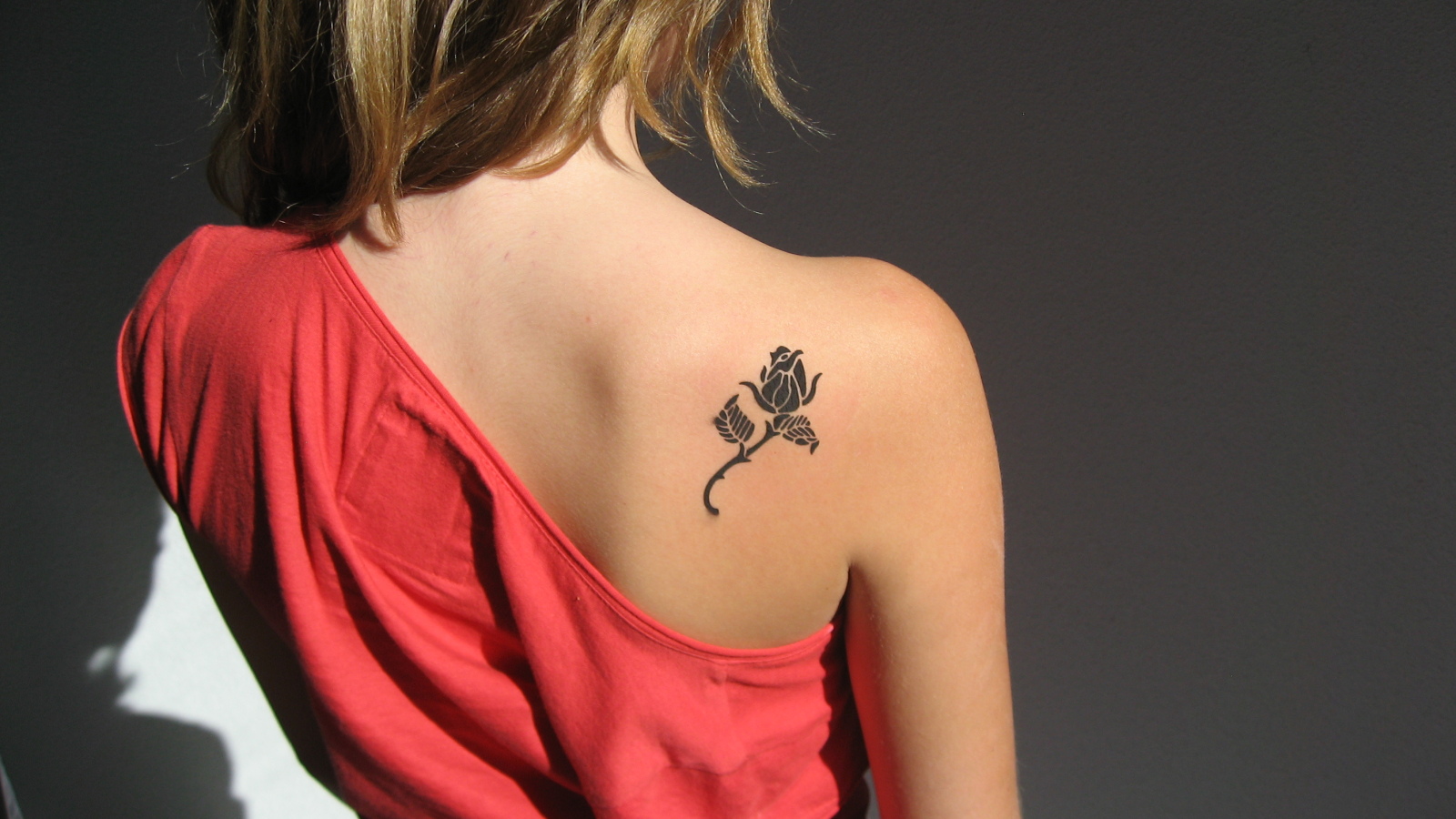
You’re staring at a Pinterest board full of sprawling back pieces and intricate sleeves, but honestly, something about that tiny, single-needle daisy on a wrist just hits different. It's a vibe. People think going big is the only way to show commitment to an idea, but small simple flower tattoos are actually doing the heavy lifting in the industry right now. They’re discreet. They’re elegant. They don't require you to sit in a chair for six hours while your skin turns into raw hamburger meat.
Size doesn't equate to soul.
I’ve seen a lot of people walk into shops with grand plans for a botanical garden on their thigh, only to realize that a tiny sprig of lavender behind the ear tells a much more personal story. It’s about the "less is more" philosophy that’s dominating modern aesthetics. Whether it's a fine-line tulip or a minimalist rose, these pieces carry a specific kind of weight because they rely on perfect execution rather than sheer scale. If a line is shaky on a massive dragon, you might not notice. If a line is shaky on a half-inch minimalist poppy? You’re going to see it every single day.
The Reality of Why We Obsess Over Small Simple Flower Tattoos
There’s this weird misconception that small tattoos are "beginner" tattoos. That’s kinda gatekeep-y and, frankly, wrong. Many collectors with full suits still find spots for a tiny forget-me-not or a micro-lily because those specific flowers represent something that doesn’t need to shout.
Think about the technical side for a second. Artists like Dr. Woo or JonBoy basically built empires on the back of the "micro" movement. They proved that you can capture the essence of a living thing with just a few strategic strokes. When you strip away the heavy shading and the vibrant neons, you’re left with the architecture of the flower itself. That’s the draw. It’s the botanical equivalent of a haiku.
Also, let’s talk about the pain factor. Not everyone wants to endure a marathon session. A small simple flower tattoo usually takes thirty minutes to an hour. You’re in, you’re out, and you’re grabbing a taco before the numbing cream (if you even used any) even wears off. It’s accessible.
Does "Simple" Mean It Fades Faster?
This is where the nuance comes in. You’ve probably heard people say "bold will hold." They aren't lying. Traditional American tattoos with thick black outlines stay crisp for decades because there’s a lot of pigment packed in there. Small, delicate flowers—especially those done in the "fine line" style—do have a different aging trajectory.
Sun is the enemy here.
If you get a tiny wildflower on your finger, expect it to blur or fade significantly within a few years. Fingers are high-friction areas. However, if you put that same small simple flower tattoo on your inner forearm or ribcage, and you’re religious about sunscreen, it’ll look sharp for a long time. The ink molecules are literally being attacked by UV rays and your own immune system. Smaller deposits of ink are easier for your body to break down. It’s just biology.
Choosing the Right Bloom Without Being Basic
Everyone gets a rose. There, I said it. Roses are beautiful, but they’re the "Starbucks order" of the tattoo world. If you want something that feels a bit more curated, you have to look at the Victorian "Language of Flowers" (Floriography).
- Sweet Peas: These signify "thank you for a lovely time" or "goodbye." They have these delicate, ruffled petals that look incredible in a minimalist style.
- Gladiolus: Named after the Latin word for sword. They represent strength and integrity. A tiny sword-shaped flower on a forearm? That’s a statement.
- Lotus: Yeah, it's popular in yoga circles, but the idea of a flower growing out of mud is a classic for a reason. It’s about resilience.
- Honeysuckle: These represent devoted affection. Plus, the shape is naturally curvy, which flows well with the body's natural lines.
Honestly, the best tattoos come from a place of personal weirdness. Maybe your grandma grew marigolds. Maybe you saw a specific weed cracking through the sidewalk on a day you felt particularly tough. That’s the stuff that makes a "simple" tattoo feel complex.
Placement Is Everything (Literally)
Where you put it changes the entire context. A small rose on the neck feels edgy. That same rose on the ankle feels classic.
The "hidden" spots are big right now. I’m talking about the inner bicep, the side of the finger, or even the back of the neck right under the hairline. These are the spots that only show up when you want them to. It’s a secret you share with yourself.
But you have to consider the "warp factor." Skin isn't a flat canvas. It’s an organ that stretches and folds. If you put a perfectly circular sunflower on the side of your knee, it’s going to look like an oval the second you stand up. A good artist will have you stand in a natural position, move around, and then place the stencil. Trust the stencil process. If it looks crooked while you’re twisting to look in the mirror, but straight when you’re standing normally, keep it where it is.
The Cost of Going Small
You might think a tiny tattoo should cost twenty bucks. It doesn’t work like that. Most reputable shops have a "shop minimum," which usually ranges from $80 to $150. This covers the cost of sterilized needles, ink, setup time, and the artist's expertise. You aren't just paying for the ink; you’re paying for the fact that they didn't give you an infection and the lines aren't blown out.
"Blowouts" are when the artist pushes the needle too deep into the subcutaneous fat layer. The ink spreads out like a wet napkin. In small simple flower tattoos, a blowout is a disaster because there’s no room to hide it. This is why you don't go to a "scratchers" basement for a fine-line piece. You pay the shop minimum for the precision.
Maintenance and the "Healing" Phase
Healing a tiny tattoo is relatively easy, but don't get lazy. Basically, you’re dealing with a shallow wound.
- Keep it covered for the first few hours as directed by your artist.
- Wash it with unscented, mild soap. No, the fancy exfoliating body wash with beads is a terrible idea.
- Apply a very thin layer of ointment (like Aquaphor) or a specialized tattoo balm.
- Don't pick the scabs. I know it’s tempting. If you pull a scab, you might pull the ink right out with it, leaving a literal hole in your design.
Most people over-moisturize. Your skin needs to breathe. If the tattoo looks "goopy," you’ve put too much stuff on it. Pat it dry with a paper towel and leave it alone.
The Future of Minimalist Florals
Tattoo technology is actually changing. We're seeing better needles and inks that allow for even more detail in smaller spaces. But there’s also a movement toward "ignorant style" or "hand-poked" tattoos. These are intentionally simple—sometimes even looking a bit "sketchy" or unrefined.
There's a charm in the imperfection. A hand-poked small simple flower tattoo has a soft, organic texture that a machine can’t always replicate. It feels more like a part of the skin and less like something sitting on top of it.
We are also seeing a rise in "temporary-to-permanent" styles. Companies like Inkbox use a formula that sinks into the top layer of the dermis and lasts two weeks. It's a great "test drive" for anyone nervous about the commitment. But honestly? Once people see how a small floral design looks on their skin, they usually head straight for the needle.
Actionable Steps for Your First (or Next) Piece
If you're ready to pull the trigger on a small simple flower tattoo, don't just walk into the first shop you see. Start by browsing Instagram using specific hashtags like #FineLineTattoo or #MicroRealism. Look for healed photos. Anyone can make a tattoo look good while it’s fresh and red; the real test is how it looks six months later.
Once you find an artist whose style matches your vibe, book a consultation. Bring photos of real flowers, not just other people’s tattoos. This helps the artist create something original for you. Check their portfolio for "line work" specifically. If their lines look shaky in a photo, they’ll look shaky on your arm.
Lastly, think about the long game. If you plan on getting more tattoos later, consider how this small piece will fit into a larger "patchwork" sleeve. Space is prime real estate. Even a tiny daisy takes up a spot that might be better suited for something else later. Or, maybe it’s the perfect anchor for a garden that’s going to grow over the next decade. Either way, treat it with the same respect you’d give a full-back piece. Small doesn’t mean insignificant.