Imagine you're trying to find your way out of a giant maze. A normal computer—the kind sitting in your pocket or on your desk right now—acts like a very fast mouse. It runs down one path, hits a wall, turns around, and tries the next one. It’s quick, sure, but it’s still doing things one by one. Quantum computing is different. It’s like being a mist that can travel down every single path of that maze at the exact same time.
That sounds like science fiction. Honestly, it kind of is.
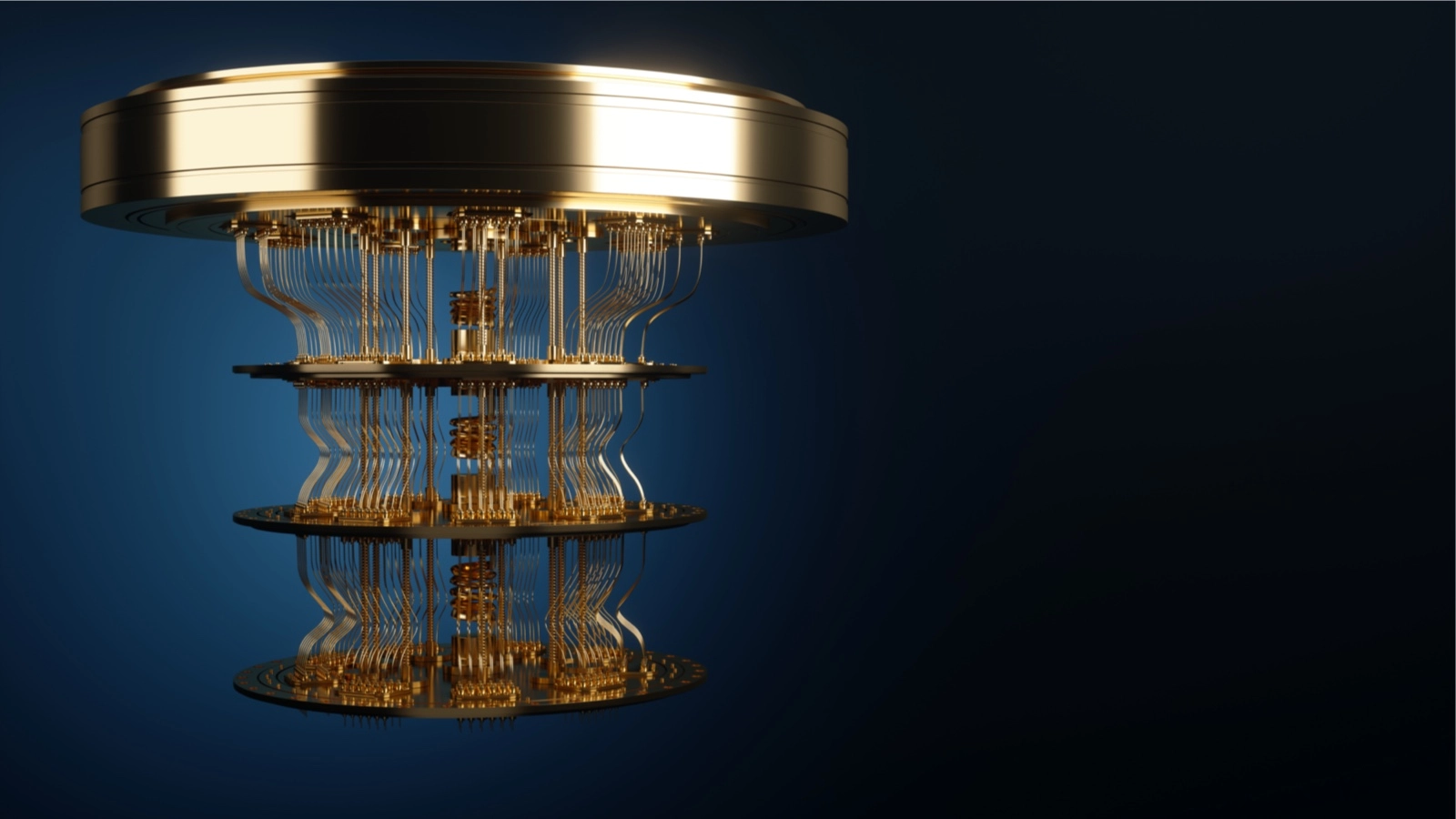
But it’s real. Companies like IBM, Google, and IonQ are already building these machines. They don't look like your laptop. They look like giant, golden chandeliers made of glass and copper wires, kept in refrigerators colder than outer space. We’re talking temperatures near absolute zero, or roughly $-273^{\circ}C$. If they get too warm, the whole thing stops working.
What is quantum computing in simple terms?
To get what’s happening here, you have to forget how regular computers work. Your phone uses "bits." A bit is a tiny switch that is either On or Off. 1 or 0. That’s it. Everything you’ve ever done on a screen—every meme you’ve liked, every Zoom call—is just a massive pile of billions of ones and zeros.
Quantum computers use qubits.
Thanks to a weird physics rule called superposition, a qubit can be a 1, a 0, or both at the same time. Think of a spinning coin. While it’s spinning on the table, is it heads or tails? It’s sort of both. It’s a blur of both states. That blur is where the magic happens.
Because qubits can hold so much more information than a regular bit, the power doesn't just double when you add more. It explodes. If you have two qubits, they can represent four states simultaneously. Three qubits can represent eight. By the time you get to 300 qubits, you have more states than there are atoms in the entire visible universe.
That is a level of math that our brains aren't really wired to understand. It’s why experts like Richard Feynman, a Nobel Prize-winning physicist, famously said that if you think you understand quantum mechanics, you don't understand quantum mechanics.
The "Spooky" stuff that makes it work
There are two main things that make a quantum computer go: Superposition and Entanglement.
We already touched on superposition—that’s the "both states at once" thing. But entanglement is even weirder. Albert Einstein called it "spooky action at a distance." Basically, you can link two qubits together so that they are perfectly synchronized, no matter how far apart they are.
If you have two entangled qubits and you measure one to be a "1," the other one instantly becomes a "1" too, even if it’s on the other side of the galaxy.
How does this help a computer? It allows the different parts of the processor to work in perfect harmony. In a regular chip, signals have to travel through wires, which takes time. In a quantum processor, the qubits are "talking" to each other through these invisible quantum links. This creates a massive shortcut for solving problems that would take a supercomputer thousands of years to finish.
Why do we even need this?
You might think, "My MacBook is plenty fast, why do I care?"
For most things, you don't. You aren't going to use a quantum computer to check your email or watch Netflix. In fact, a quantum computer would actually be slower at those tasks. They are specialized tools. Think of a regular computer like a hammer and a quantum computer like a particle accelerator. You don't use a particle accelerator to hang a picture frame.
But there are some things regular computers are just bad at.
One of those is simulating nature. If you want to design a new drug to cure a disease, you have to understand how molecules interact. Molecules are quantum. They’re messy. A regular computer has to guess how they fit together, which is why drug discovery takes ten years and billions of dollars. A quantum computer can "speak the language" of the molecule. It can simulate the chemistry perfectly because it operates on the same laws of physics that the molecule does.
Breaking the internet (The scary part)
We have to talk about encryption.
Almost everything on the internet is protected by a type of math called RSA encryption. It relies on the fact that regular computers are really bad at finding the prime factors of giant numbers. If I give you the number 15, you know it’s $3 \times 5$. Easy. If I give you a number with 500 digits, a supercomputer might take a trillion years to crack it.
A powerful quantum computer could do it in minutes.
This is what researchers call "Q-Day." It's the day quantum computers become strong enough to break current internet security. This is why the National Institute of Standards and Technology (NIST) is already rushing to create "quantum-resistant" encryption. We aren't there yet—the current machines are still too "noisy" and error-prone—but the threat is real enough that governments are pouring billions into it right now.
It’s not all sunshine and rainbows
There is a lot of hype in this industry. You’ll see headlines claiming we’ve reached "Quantum Supremacy." That’s a term Google used in 2019 when their Sycamore processor solved a specific math problem in 200 seconds that they claimed would take a supercomputer 10,000 years.
IBM later argued it would actually only take 2.5 days on a well-optimized supercomputer.
The point is, we are currently in the NISQ era. That stands for Noisy Intermediate-Scale Quantum. These machines exist, but they are incredibly sensitive. A tiny bit of heat, a stray radio wave, or even a slight vibration can cause the qubits to "decohere" and lose their quantum state. When that happens, the calculation fails.
It’s like trying to build a house of cards in the middle of a hurricane.
To make quantum computing truly useful for everyday life, we need better "error correction." We need to use hundreds of "physical" qubits just to make one "logical" qubit that stays stable. We are getting there, but it’s a slow, grinding engineering challenge.
Real-world impact: What happens next?
So, where will you actually see this first?
- Batteries: We are stuck with lithium-ion right now. Quantum computers could help us discover new materials for batteries that last ten times longer and charge in seconds.
- Traffic: Volkswagen has actually experimented with quantum algorithms to optimize traffic flow in Beijing. Imagine a world with zero traffic jams because every car’s route is perfectly calculated in real-time.
- Climate Change: We spend a massive amount of energy just creating fertilizer (the Haber-Bosch process). A quantum computer could help us find a more efficient way to pull nitrogen from the air, drastically cutting global energy consumption.
- Finance: Predicting the stock market is essentially a giant probability game. Quantum computers are the ultimate probability machines.
How to stay ahead of the curve
If you want to understand where this is going, stop looking for "The Quantum Laptop." It's not coming. Instead, look at the cloud. Companies like Amazon (Braket) and Microsoft (Azure Quantum) are already letting people rent time on quantum computers over the internet.
The revolution won't be a gadget you buy. It will be a silent shift in how the world's hardest problems get solved. New medicines will just start appearing. Fertilizers will get cheaper. Materials will get stronger.
To keep up, you don't need a PhD in physics. Just remember that the world isn't just ones and zeros. It’s more complex than that. We are finally building computers that are as complex as the universe they’re trying to understand.
Next Steps for the Curious:
- Check out IBM Quantum Learning: They have a free, interactive platform where you can actually run "Hello World" code on a real quantum computer in the cloud.
- Track NIST’s Post-Quantum Cryptography (PQC) standards: If you work in IT or security, this is the most immediate way quantum computing will affect your job.
- Look for "Quantum-Inspired" algorithms: Many companies are using the logic of quantum computing on regular chips to get better results today without waiting for the "perfect" quantum hardware.