You're standing in the dining room with a handful of heavy silverware and a stack of porcelain, feeling that weird, low-level panic. It’s just dinner. But if you're hosting someone you actually want to impress—or maybe just your mother-in-law who notices everything—the layout matters. Most people think a proper dinner table setting is some rigid, Victorian torture device designed to make guests feel small. It’s not. Honestly, it’s just a map. If you set the table correctly, your guests don’t have to think. They just reach, and the tool they need is right there. It’s about flow.
Let’s be real: we’ve all been at a wedding where there were four forks and nobody knew which one to touch first. That’s a failure of the host, not the guest. When you nail the placement, you're basically giving your friends a cheat sheet for the meal. It’s silent hospitality.
The Basic Logic You’ve Probably Forgotten
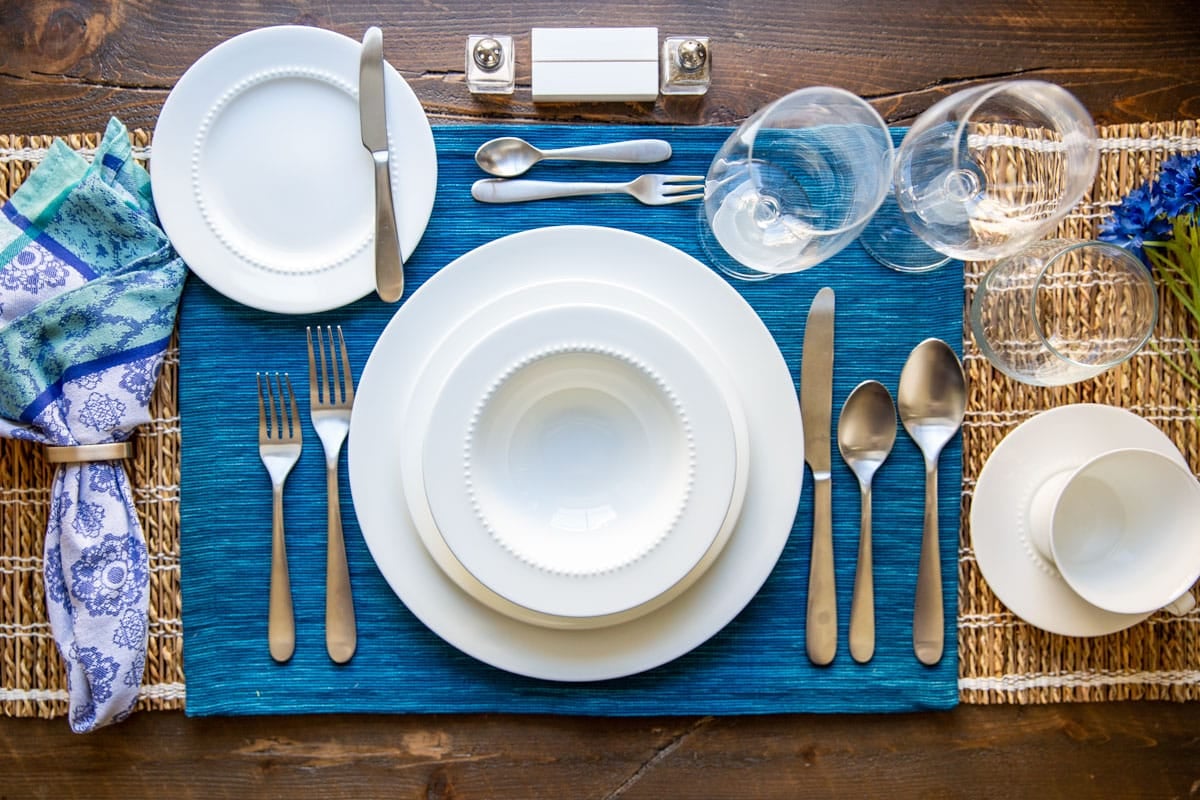
The golden rule is dead simple. Work from the outside in. That’s it. If you’re serving a salad first, the salad fork goes on the far left. If the soup comes next, the spoon is on the far right. You’re building a countdown to the main course.
Most people mess up the "BMW" rule. No, not the car. It stands for Bread, Meal, Water. Your bread plate is always on the left. Your meal is in the middle. Your water (and wine) is on the right. If you remember BMW, you’ll stop accidentally eating your neighbor's sourdough or sipping their Chardonnay. It happens more often than you’d think, even at high-end charity galas. I’ve seen CEOs get it wrong and then awkwardly shuffle plates mid-conversation.
The Fork Situation
Forks live on the left. Usually. There is one weird exception: the oyster fork. If you’re serving shellfish, that tiny little fork sits on the right side, nestled into the spoons. It’s the only fork allowed over there. For everything else, keep them on the left. The dinner fork—the big one—goes closest to the plate. The salad fork stays on the outside.
Don't overcomplicate it. If you aren't serving salad, don't put out a salad fork. Empty space is better than a useless tool. It makes the table feel less cluttered and more intentional.
Why Proper Dinner Table Setting Still Matters in 2026
We live in a world of paper plates and Uber Eats. So why bother? Because a set table signals that the meal is an event. It tells your guests, "I actually put effort into this because I value your time." It changes the energy of the room. When the table looks sharp, the conversation usually follows suit. It’s psychological.
Expert etiquette consultants like Myka Meier often point out that formal settings aren't about being "fancy." They’re about etiquette as a tool for social ease. If everyone knows where their water glass is, there are no awkward "oh, sorry, is this yours?" moments. It eliminates friction.
The Glassware Triangle
Glasses go on the right, above the knife and spoons. You should have a water glass—usually the biggest one—and then your wine glasses. If you’re doing it by the book, the water glass stays closest to the guest, just above the knife. The red wine glass goes to the right of that, and the white wine glass sits slightly below them, forming a little triangle.
Wait. Why two wine glasses?
Because white wine is usually served chilled and in smaller portions to keep it cold, while red wine needs a bigger bowl to "breathe." If you’re only serving one type of wine, just use one glass. Don’t be a hero.
Napkin Placement: The Great Debate
There’s a lot of noise about where the napkin goes. Some people swear it has to be on the left, under the forks. Others say it belongs in the center of the plate. Honestly? Both are fine. If you’re serving a first course that’s already on the plate when people sit down (like a pre-plated salad), put the napkin to the left. If the plate is empty, the napkin looks great right in the middle.
Just don't do those aggressive origami folds. You aren't on a cruise ship in 1994. A simple fold or a clean napkin ring is plenty. The goal is "refined," not "I spent three hours watching YouTube tutorials on how to make a linen swan."
The Most Common Mistakes (And How to Fix Them)
- Knives facing the wrong way: The sharp edge of the blade must always face the plate. Always. This started centuries ago so guests wouldn't feel threatened by a blade pointing at them. Now, it's just the standard.
- The Dessert Fork Hangout: Don't put the dessert spoon and fork on the sides. They live at the top of the plate, horizontal. The spoon handle points right, and the fork handle points left.
- Too Much Stuff: If your table is small, don't try to fit a five-course setting on it. Scale back. Use a "General" setting instead of a "Formal" one.
Setting the Stage for Different Vibes
Not every dinner is a state banquet. Sometimes you’re just having the neighbors over for pasta and a decent bottle of Chianti.
The Informal Setting
You just need a dinner plate, a fork, a knife, and a water glass. Maybe a wine glass if you’re feeling spicy. The napkin goes on the left. The fork goes on the napkin. Knife on the right. Done. It’s clean, it’s functional, and it takes thirty seconds.
The Formal Setting
This is where the bread plate and the butter knife come out. The butter knife stays on the bread plate, laid diagonally. You might have a soup spoon on the far right. Everything should be spaced about an inch from the edge of the table. Use a ruler if you’re feeling obsessive, but your thumb width is usually a good enough guide.
Dealing with the "Centerpiece Trap"
People love a big floral arrangement. I get it. But if I can’t see the person sitting across from me because there’s a massive forest of eucalyptus in the way, I’m going to be annoyed. Keep your centerpieces low. You want people to talk, not play hide-and-seek behind a vase.
Candles are great, but avoid scented ones on the table. Nobody wants their expensive ribeye to taste like "Midnight Jasmine" or "Pumpkin Spice." Stick to unscented tapers or pillars.
Actionable Steps for Your Next Dinner
If you want to master the proper dinner table setting without losing your mind, follow this workflow:
- Count your courses first. Don’t set a spoon if there’s no soup. Don’t set a small fork if there’s no salad.
- Place the plates first. This anchors the whole "station." Use them as your center point.
- Lay the "groundwork" utensils. Dinner fork on the left, dinner knife on the right (blade in!).
- Add the "extras" from the outside. Salad fork to the left of the dinner fork. Soup spoon to the right of the knife.
- Set the glasses. Water above the knife, wine to the right.
- The Final Check. Walk around the table. Is everything symmetrical? Is the "BMW" rule intact?
Hosting is a performance, sure, but the table setting is the stage design. When the stage is set correctly, the actors—your guests—can actually relax and enjoy the show. Go check your utensil drawer. Most of us have been doing this on autopilot for years, but a few small tweaks to your layout will make your next dinner party feel significantly more polished.
Start with the basics. Get the knife blade pointing the right way. Keep the water glass on the right. Once those habits are locked in, you can start worrying about where the fish knife goes.