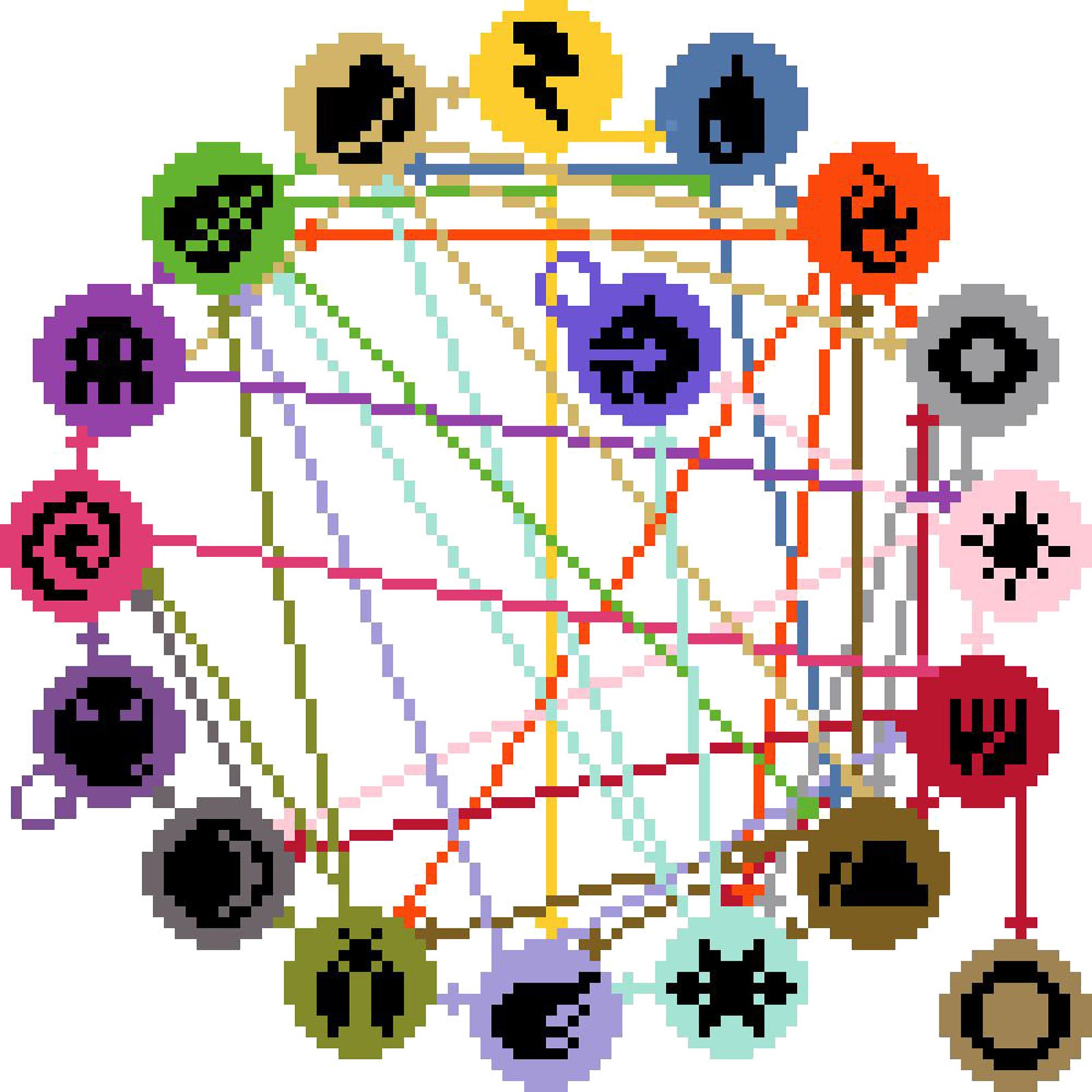
You've probably been there. You are staring down a Garchomp, your heart is racing, and you can’t remember for the life of you if Water moves actually hurt Ground types or if the Dragon half just cancels everything out. It’s the classic Pokemon dilemma. People look at a pokemon type strengths chart and see a wall of colorful boxes that look more like a periodic table than a game mechanic.
Honestly, the math isn't even the hard part. The hard part is the weird logic the game designers used back in the 90s that we’re still living with today.
Why the Chart Still Trips Everyone Up
Most players think they know the basics. Fire beats Grass. Water beats Fire. Easy, right? But then you get into the weeds. Did you know that back in Generation 1, Psychic types were actually immune to Ghost moves because of a programming glitch? That’s why old-school fans still get confused. Nowadays, Ghost is actually super effective against Psychic. It's supposed to represent a common fear—like how Bug and Dark are also strong against Psychic because people are afraid of spiders and the dark.
It’s psychological warfare, basically.
But then you have the Steel type. Steel is the absolute king of defense. It resists almost everything—ten different types, to be exact. If you’re looking at a pokemon type strengths chart to build a defensive wall, you start with Steel. But even Steel has its kryptonite. It gets melted by Fire, crushed by Fighting moves, and shaken apart by Ground.
The Dual-Type Headache
Single types are training wheels. The real game starts when you meet a Pokemon like Scizor. It’s Bug and Steel.
Normally, Fire deals 2x damage to Bug. It also deals 2x damage to Steel. When you combine them, those multipliers don't just add up; they multiply. Fire hits Scizor for 4x damage. One Ember and that metallic bug is toast. On the flip side, some dual types have amazing synergy. Look at Gastly’s line. Being Ghost and Poison means it’s one of the few things that can actually resist Fairy attacks while being immune to Normal and Fighting moves entirely.
What Most People Get Wrong About Immunities
Immunities are the "get out of jail free" cards of the Pokemon world. But people constantly forget the specific ones.
- Electric vs. Ground: This is the big one. Ground doesn't just resist Electric; it ignores it. No damage. No paralysis. Nothing.
- Ghost vs. Normal/Fighting: Ghosts can't be touched by physical "Normal" strikes. But don't forget that Normal types are also immune to Ghost moves. It’s a stalemate.
- Fairy vs. Dragon: This was the biggest meta shift in history. Before Fairy existed, Dragons were untouchable. Now, a tiny pink Jigglypuff can stare down a legendary Rayquaza and take zero damage from its strongest Outrage.
- Flying vs. Ground: You can’t hit what’s in the air with an earthquake.
Strategic Coverage: It's Not Just About Your Type
Winning doesn't mean just picking the strongest type. It's about "coverage." This is a fancy term competitive players use to describe having moves that hit the things you’re weak to.
If you have a Water type, you’re terrified of Grass types. So, you teach your Blastoise "Ice Beam." Now, when a Grass type switches in thinking they have the advantage, you hit them with a super-effective Ice move. You’ve just flipped the pokemon type strengths chart on its head.
The "New" Rules of 2026
If you’re playing the most recent games, you have to account for Terastallization or whatever the current gimmick is. This allows a Pokemon to literally change its type mid-battle. Imagine fighting a Fire type, you switch in your Water type to get that easy win, and suddenly the opponent turns into a Grass type.
You’re now the one in trouble.
This makes memorizing the chart more important than ever. You aren't just learning what Charizard is; you’re learning what Charizard could be. You have to think three steps ahead.
Actionable Tips for Mastering the Matchups
Don't try to memorize the whole 18x18 grid at once. Nobody does that unless they have no life. Instead, focus on the "pivots."
Learn the "Big Three" Defensive Types: Steel, Fairy, and Water. If your team has these, you can switch safely into most attacks. Water only has two weaknesses, which is why bulky Water types like Milotic are so annoying to deal with.
Identify 4x Weaknesses: Look at your team. Do you have a Landorus (Ground/Flying)? It dies to a snowball because of that 4x Ice weakness. You need to know these "one-shot" vulnerabilities before you enter a match.
Use the "Logic" Shortcuts:
- Natural Disasters: Ground beats Electric (grounding), Water beats Fire (extinguishing), Ice beats Ground (erosion/freezing).
- RPG Tropes: Dark/Ghost/Bug beat Psychic (fears), Fighting beats Steel/Rock/Ice (breaking hard objects).
The best way to actually get good at this is to stop looking at the chart and start playing. You’ll forget that Rock is weak to Steel until a Metagross Meteor Mashes your Tyranitar into the dirt. After that happens once, I promise you’ll never forget it again.
Go out there and experiment with a "Core." A Fire-Water-Grass core is the oldest trick in the book because they cover each other's weaknesses perfectly. Once you’ve got that down, try a Steel-Fairy-Dragon core. That's where the real power lies.
.png)