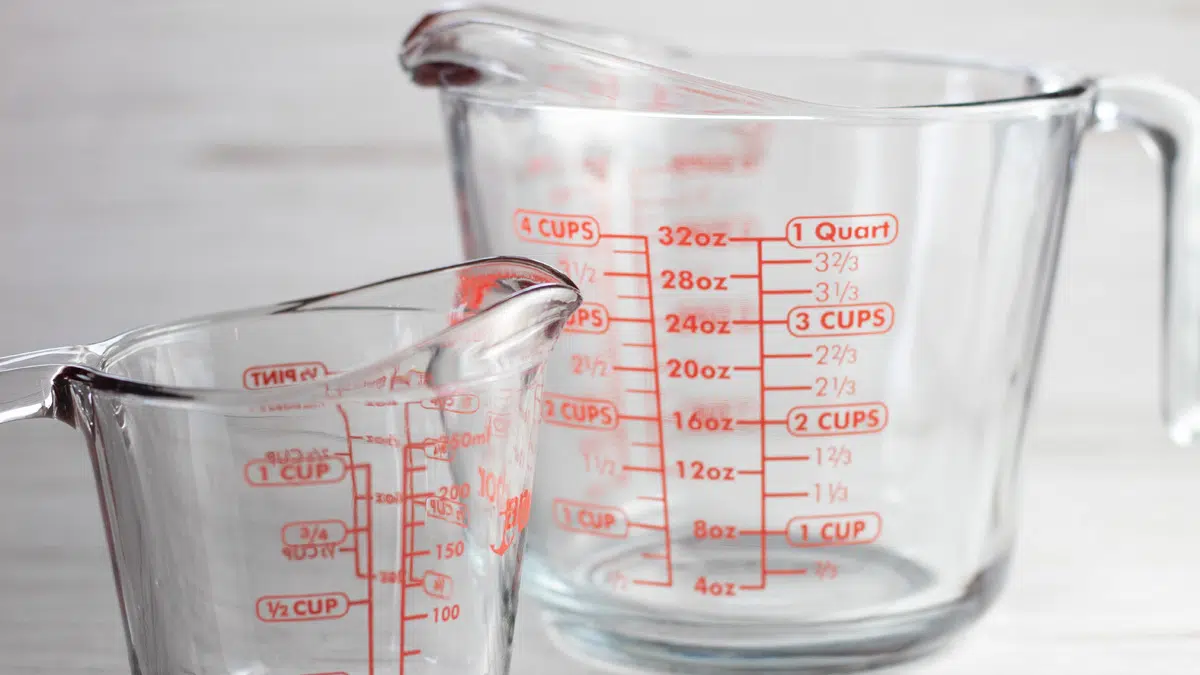
You're standing over a bubbling pot of chili, or maybe a batch of homemade vanilla ice cream, and the recipe suddenly demands a quart of chicken stock or heavy cream. You look at your measuring cups. You’ve got a 1-cup, a 1/2-cup, maybe a dusty 2-cup liquid pitcher. Panic sets in. How many cups are in a quart? It’s four. Just four. But if you think that’s the end of the story, you’re probably going to end up with a ruined cake or a soup that tastes like a salt lick.
Kitchen math is weird. It’s inconsistent. Honestly, the U.S. Customary System feels like it was designed by someone who really loved the number two but hated simplicity.
The Basic Math: One Quart in Cups and Why It Sticks
Let’s get the easy part out of the way. One quart equals 4 cups. That is the golden rule for most American kitchens. If you’re doubling a recipe that calls for two cups, you need a quart. If you’re quadrupling a single-cup serving, grab the quart jar.
Think of it like this. A gallon is the big boss. It breaks down into four quarts. Each of those quarts breaks down into two pints. And each pint? Two cups. It’s a cascading waterfall of "twos" until you hit the quart-to-cup jump, which is a factor of four.
- 1 Gallon = 4 Quarts
- 1 Quart = 2 Pints
- 1 Pint = 2 Cups
- Therefore: 1 Quart = 4 Cups
It sounds straightforward. It isn't.
Why? Because the "cup" you use for flour isn't necessarily the "cup" you should use for milk. If you use a dry measuring cup for a quart of water, you’re likely to spill half of it before it reaches the pot. Liquid measuring cups have that extra space at the top—the "headroom"—so you don't make a mess. Dry cups are meant to be leveled off with a knife. If you try to measure a quart of flour by dipping a 1-cup dry measure four times, you’ll likely pack the flour down, ending up with way more than a true quart by weight.
The British Problem: Why Your UK Recipes Are Lying to You
Here is where things get genuinely annoying. If you are following a recipe from a vintage British cookbook or a modern UK food blog, their "quart" is not your "quart."
The United States uses the U.S. Customary System. The UK uses (or used) the Imperial System. An American quart is roughly 946 milliliters. An Imperial quart? It’s about 1,136 milliliters. That is a massive difference. If you use four American cups to fulfill an Imperial quart requirement, your recipe will be too dry. You'll be short about 20% of your liquid.
Imperial cups are also larger. While an American cup is 8 fluid ounces, an Imperial cup is roughly 10 fluid ounces. It’s a mess. Most modern Brits have moved to grams and milliliters, which—let's be honest—is way smarter. But if you’re digging through Grandma’s old notes from London, remember that her quart is beefier than yours.
Fluid Ounces vs. Dry Weight: The Great Confusion
People often ask: "If a quart is 4 cups, and a cup is 8 ounces, is a quart always 32 ounces?"
Yes. And no.
It is 32 fluid ounces.
Fluid ounces measure volume. They measure how much space something takes up. Weight measures mass. This is why a quart of lead pellets weighs significantly more than a quart of popcorn kernels, even though they both occupy four cups of space.
In the world of professional baking, people like King Arthur Baking or the late, great James Beard, volume is often treated as a "suggestion." They prefer scales. Why? Because a "quart" of blueberries can vary in weight depending on how large the berries are and how much air is trapped between them. If you’re making jam, you want a quart of berries. If you’re making a precise tart, you want a specific number of grams.
Practical Kitchen Hacks for Measuring a Quart
What do you do if you don't have a quart-sized container? You improvise.
Most standard Mason jars—the ones used for canning—are exactly one quart. If you see "32 oz" marked on the side of a jar, you’ve found your quart. If you're using a standard 16.9-ounce water bottle (the kind sold in 24-packs), two of those are almost a quart. You'll be about two ounces short. It’s close enough for boiling pasta water, but don't try it with a souffle.
Check your blender. Almost every blender jar has markings on the side. Most go up to at least 48 or 64 ounces. If you need a quart, fill it to the 32-ounce line. It’s often the most accurate measuring tool in a standard kitchen because the wide base allows for a very clear meniscus—that little curve at the top of the liquid.
Common Mistakes When Measuring One Quart in Cups
- The "Heaping" Cup: When measuring dry goods to reach a quart, people often heap the flour or sugar. Four heaping cups is not a quart. It’s probably five cups. Use a straight edge to level it.
- The Eye-Level Error: When using a liquid measuring cup, you have to get down on the counter. If you look down at the cup from above, the "parallax effect" will trick you. You’ll think you have 4 cups (a quart), but you’ll actually be short.
- The Temperature Shift: Believe it or not, water expands when it’s hot. A quart of boiling water actually takes up more space than a quart of ice water. For most home cooking, this doesn't matter. If you're doing high-level chemistry or precision brewing, it actually does.
Real-World Applications: When Does This Matter?
If you’re changing the oil in your lawnmower, it probably needs about a quart. If you put in four cups and your "cups" are actually those oversized coffee mugs from your cupboard, you’re going to blow a gasket. A coffee mug is usually 12 to 14 ounces, not 8.
In gardening, many fertilizers require you to mix a certain amount of concentrate per quart of water. Over-diluting means your tomatoes don't grow. Under-diluting means you burn the roots.
Even in health, the old "drink eight 8-ounce glasses of water a day" rule is basically saying "drink two quarts of water." It sounds more manageable when you think of it as two large Mason jars rather than eight individual servings.
Moving Toward the Metric System
Honestly? The easiest way to handle the one quart in cups question is to look at the other side of the measuring cup. Almost all of them have milliliters (mL) or liters (L).
One quart is 0.946 liters. It’s just a hair less than a full liter. If you’re in a pinch and only have a metric scale or jug, just measure out 950 mL. For 99% of recipes, that 4 mL difference is completely invisible. It’s the weight of a few raindrops.
Baking is science. Cooking is art. When you're "cooking," you can eyeball a quart. Throw in four handfuls of chopped onions—it's probably close to a quart if you have big hands. But when you’re "baking," that quart of milk needs to be exactly 32 fluid ounces.
Quick Reference for the Hurried Cook
If you are in the middle of a recipe and just need the facts fast, here they are:
- 1 Quart = 4 Cups
- 1 Quart = 2 Pints
- 1 Quart = 32 Fluid Ounces
- 1 Quart = 1/4 Gallon
- 1 Quart = ~946 Milliliters
Stop guessing. If you're unsure, find a vessel with markings. Using a random drinking glass and assuming it’s "about a cup" is the fastest way to a culinary disaster. Most "pint" glasses at bars are actually 14 ounces, not 16, thanks to the thick glass bottom. Don't use them for measuring.
How to Verify Your Tools
If you don't trust your measuring cups, use a kitchen scale. Put your empty 1-cup measure on the scale, "tare" it to zero, and fill it with water. It should weigh 236.5 grams (or 8.34 ounces). If it’s way off, throw the cup away. It’s lying to you. Do this four times, and you have your quart.
To truly master your kitchen, stop thinking in terms of "cups" and start thinking in "ratios." A quart is a building block. It’s the base for a standard batch of soup for four people. It’s the amount of lemonade that fits in a small pitcher. Once you visualize a quart as 32 ounces or four standard blocks of volume, you stop needing to look it up every time the stove is on.
Next Steps for Your Kitchen:
Go to your cupboard right now. Take out your largest liquid measuring cup and a permanent marker. Find the 32-ounce / 4-cup mark. If it's hard to read, trace it. Then, find a large jar you use often and fill it with exactly 32 ounces of water. Mark that line. Now you have a "quart jar" ready for your next recipe without ever having to count to four again.