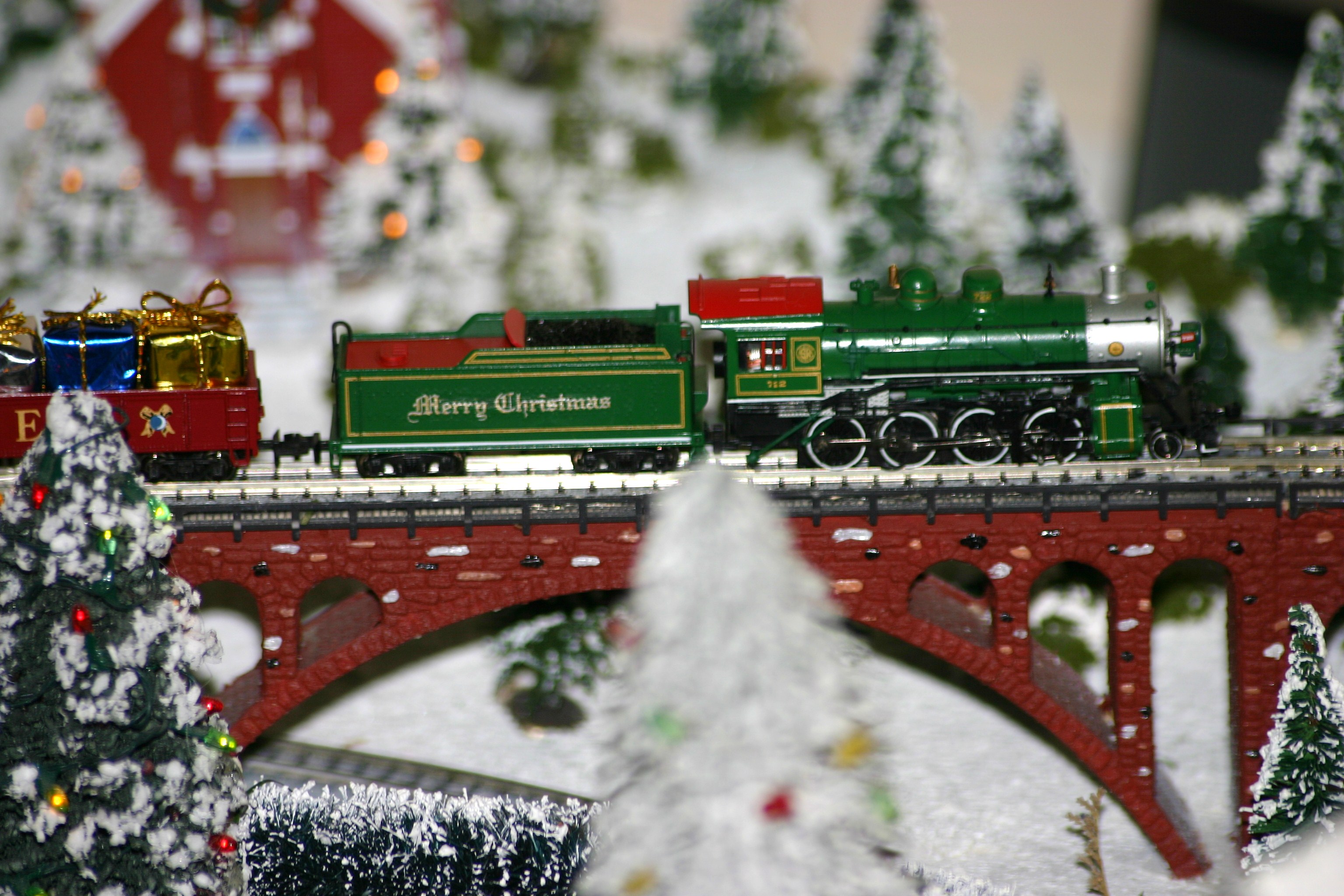
Big things usually get the spotlight during the holidays. You see the massive inflatable Santas and those floor-shaking O-gauge trains that sound like a real locomotive is crashing through your living room. But honestly? There is something incredibly special about n scale christmas train sets that most people just overlook. If you’ve ever tried to squeeze a traditional train around the base of a seven-foot Douglas fir in a tiny apartment, you know the struggle. It's a mess. N scale changes that dynamic completely. It’s about 1:160 the size of the real thing, which means you can fit an entire winter wonderland on a coffee table or a narrow mantle without moving a single piece of furniture.
It’s small. Really small.
But that’s the draw. People often think bigger is better for "wow factor," but the detail you find in modern N scale equipment from brands like Kato or Bachmann is actually pretty mind-blowing. You aren't just getting a plastic toy; you’re getting a precision-engineered machine that happens to look like it belongs in a North Pole postcard.
The Reality of Picking N Scale Christmas Train Sets
Most folks start their search looking for a "toy." That is a mistake. When you’re hunting for n scale christmas train sets, you are basically entering the world of model railroading, just with a festive coat of paint. If you buy a cheap, generic set from a big-box store that isn't a recognized hobby brand, you’re going to have a bad time. The wheels will jump the track. The engine will stutter. Your kids will get frustrated. You’ll end up tossing the whole thing in a bin by December 26th. Related insight on this trend has been shared by Vogue.
Stick to the names that modelers actually trust. Bachmann is the big player here. Their "Spirit of Christmas" set is basically the industry standard for an entry-level N scale holiday layout. It comes with a 0-6-0 steam locomotive, a couple of freight cars, and that iconic bright red caboose. It’s simple, but it works. If you want something that feels a bit more "magical" and less "industrial," look for the sets that feature the 4-4-0 American steam engines. They have that classic Victorian Christmas vibe that looks amazing alongside those ceramic village houses from Department 56 or Lemax.
Understanding the Size Constraint
Let's talk dimensions because that's why we're here. In N scale, a standard circle of track usually has a radius of about 9.75 inches. Do the math—that’s less than two feet across. You can put that on a nightstand. Try doing that with an O-gauge Lionel set; you’d need a dedicated plywood sheet and a prayer.
The downside? Because the pieces are so light, they are sensitive. If your floor is uneven or your Christmas tree skirt is too fluffy, the track will dip and the train will derail. You’ve gotta have a solid surface. A lot of experienced hobbyists actually build a "foam board" base that sits under the tree. You can paint it white, sprinkle some faux snow on it, and hide the wires. It makes the whole setup look professional rather than like something you just threw together after too much eggnog.
Digital vs. Analog: Does Your Holiday Train Need a Brain?
This is where things get slightly complicated. You’ll see two terms: DC and DCC.
Basically, DC (Direct Current) means you turn a knob, the power goes to the track, and the train moves. If you have two trains on the track, they both move at the same time. Simple. Reliable. For a tree-footer, this is usually all you need.
DCC (Digital Command Control) is the high-tech version. Each locomotive has a tiny chip. You can control the lights, the speed, and—most importantly for the holidays—the sound independently. Imagine your tiny train puffing out a realistic "chuff-chuff" sound and ringing a bell as it passes a miniature station. It’s cool. It’s also more expensive and requires a bit more technical tinkering. If you’re just looking for a festive loop, stick to DC. If you want to build a permanent winter layout that becomes a family heirloom, DCC is the way to go.
The Kato "Pocket Line" Secret
If you really want to go niche, look into the Kato Pocket Line. They have these little "Chibi" steam trains that are almost cartoonish but built with legendary Japanese engineering. They are incredibly reliable. They don't technically come in a "Christmas" box, but you can easily find festive freight cars to hitch to them. The reason people love Kato is the "UniTrack" system. It’s a snap-together track with a built-in roadbed. It is, hands down, the easiest track for beginners to assemble without losing their minds. It stays together even on carpet, which is a miracle in the N scale world.
Why People Get Frustrated with Tiny Trains
I’ve seen it a thousand times. Someone buys a beautiful N scale set, hooks it up, and... nothing. Or it flickers.
The enemy is dust. And "snow."
Those bags of loose, glittery fake snow you buy at the craft store? They are kryptonite for n scale christmas train sets. If one of those tiny plastic flakes gets into the gears or onto the rail, the electrical connection is broken. The train stops.
If you want the snowy look, use a white felt mat or paint your baseboard. Avoid the loose stuff like the plague. Also, keep a small rail cleaner or even just a Q-tip with a bit of isopropyl alcohol handy. Wiping down the tracks once a week during December will keep that little engine humming perfectly. It sounds like a chore, but it takes thirty seconds.
Mixing Brands and Scales
One of the weirdest things about holiday decorating is that nothing is ever perfectly to scale. Those popular ceramic villages? They are usually way too big for N scale. They are closer to O scale or S scale.
Does it matter? Honestly, no.
There is a concept in modeling called "forced perspective." If you put your N scale train in the foreground and the large houses in the back, it looks wonky. But if you put the N scale train behind the houses or slightly elevated, it makes your display look like it has more depth. It makes the world feel bigger.
You can also find N-scale specific buildings. Brands like Woodland Scenics make incredible pre-built structures. You can find little cabins with glowing LED lights inside that fit the 1:160 scale perfectly. When you match the scale of the buildings to the train, the realism jumps ten-fold. It stops looking like a decoration and starts looking like a living, breathing world.
The Cost of Entry
Let's be real about the budget. You can find "train-shaped objects" for $40. Don't buy them.
A quality n scale christmas train sets from a brand like Bachmann or Kato will run you anywhere from $120 to $250. That includes the engine, cars, track, and power pack. It’s an investment. But the difference is that a $200 Kato set will still be running perfectly in 2040, whereas the cheap toy will be in a landfill by February.
If you want to save money, buy a "starter set" that isn't Christmas-themed. You can usually find a basic freight set for $90. Then, just buy one festive car—like a "Season's Greetings" boxcar—separately. It’s a "hack" that gets you the high-quality gear without the "holiday markup" that some retailers tack on.
Maintenance and Storage
The biggest mistake people make is how they pack it away.
N scale locomotives have tiny, delicate details—handrails the size of a human hair, tiny coupling hooks. Don't just throw them in a shoebox with the ornaments. Keep the original packaging. The plastic "clamshell" inserts are designed to protect those specific parts.
And for the love of all things holy, take the batteries out of the controller if it uses them. Corroded batteries have killed more Christmas trains than any curious cat ever has.
Building a "Coffee Table" Layout
The ultimate N scale move is the coffee table layout. You buy a shadow-box style coffee table with a glass top. You build a permanent winter scene inside. You can have the train running while you're drinking cocoa, and you never have to worry about dust, cats, or kids touching the delicate parts.
It’s the peak of holiday nerdery, and it’s beautiful.
To do this, you'll need:
- A sheet of 1/2 inch extruded foam insulation (the pink or blue stuff from the hardware store).
- Scenery "flock" or white paint for the snow.
- Miniature pine trees (look for "bottle brush" trees for a vintage look).
- A basic N scale loop.
The beauty of N scale is that you can fit a mountain, a frozen pond, and a small town in a space the size of a large pizza box. It’s accessible. It’s manageable. It’s a hobby that doesn't demand you have a massive basement or a six-figure salary.
Actionable Steps for Your First Layout
If you’re ready to pull the trigger on a set this year, here is the move. Don't just go to a random big-box website. Go to a dedicated hobby site like TrainWorld or ModelTrainStuff. They actually know what they’re talking about and won't ship you a crushed box.
- Measure your space. If you have less than 24 inches of clearance, N scale is your only real option.
- Buy a "Starter Set." Look for the Bachmann "Spirit of Christmas" for value or a Kato starter set for pure reliability.
- Get a piece of "Homasote" or foam board. Do not put the track directly on a tree skirt. It needs a flat, hard surface to maintain electrical contact.
- Test it before you decorate. Set the track up on your kitchen table first. Make sure the engine runs smooth. It’s much easier to troubleshoot there than under a prickly tree.
- Clean the rails. Use a dry, lint-free cloth at the very least. Clean rails equal a happy train.
N scale might be small, but the impact it has on a room’s atmosphere is huge. It adds a layer of kinetic energy to your decorations that static figurines just can't match. You get the movement, the lights, and that nostalgic "clack-clack" sound, all without sacrificing your entire living room. It's the smart way to do a Christmas train. Just keep the glitter away from the tracks, and you’ll be golden.