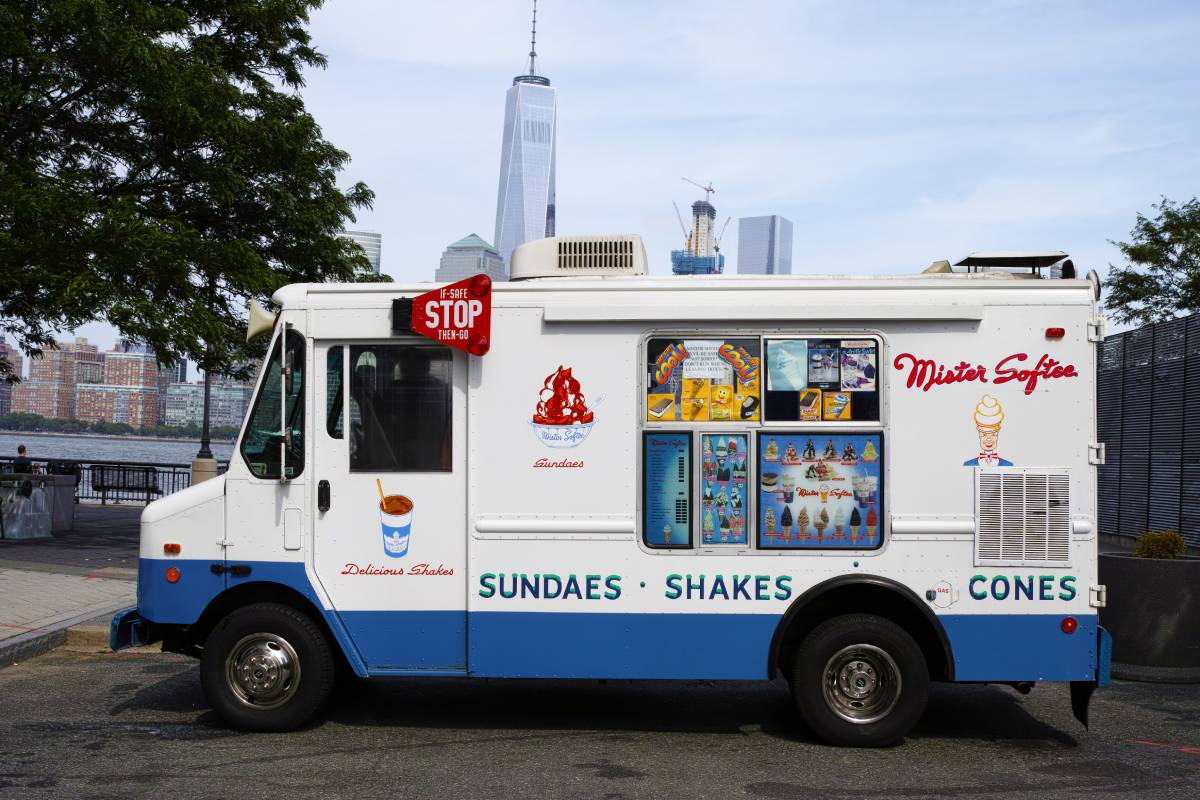
You know the sound. It’s that tinny, slightly off-key music box melody that somehow cuts through the humid buzz of a July afternoon. It’s the siren song of childhood. You hear it from three blocks away and suddenly you’re digging through the couch cushions for loose change. Most of us just hum along with a "da-da-da-da-da," assuming it’s just a wordless jingle designed to Pavlovian-trigger a craving for a vanilla cone with sprinkles.
But here’s the thing: those notes actually have words. Real, written-down mister softee song lyrics that were penned over sixty years ago.
Honestly, it’s kinda weird to hear them once you’ve spent decades just hearing the electronic "chime" version. The song wasn’t just a random tune picked out of a hat; it was a deliberate piece of mid-century marketing genius.
The Secret Words Behind the Chime
Most people think the song is "Turkey in the Straw" or some other public domain folk tune. That’s a common mistake. While many generic ice cream trucks use "Turkey in the Straw" (which has its own complicated, and frankly darker, history), Mister Softee is different. They own their song. As discussed in recent articles by Vogue, the effects are widespread.
The jingle, officially titled "Jingle and Chimes," was written in 1960. The man behind the curtain was Les Waas, a legendary Philadelphia ad man who supposedly wrote nearly 1,000 jingles in his lifetime. He’s the same guy who founded the Procrastinators' Club of America—no joke.
Anyway, here are the actual lyrics that were originally used for radio and TV commercials:
The creamiest, dreamiest soft ice cream,
You get from Mister Softee.
For a refreshing delight supreme,
Look for Mister Softee.
My milkshakes and my sundaes and my cones are such a treat,
Listen for my store on wheels ding-a-ling down the street.
The creamiest, dreamiest soft ice cream,
You get from Mister Softee.
For a refreshing delight supreme,
Look for Mister Softee.
S-O-F-T double-E, Mister Softee!
Short. Sweet. Effective. It’s basically a 30-second masterclass in brand reinforcement.
Why You’ve Never Heard the Lyrics on the Truck
It’s simple: the trucks don’t have vocalists.
In the early days, the trucks used mechanical music boxes with a drum and spindle, sort of like a giant version of those tiny hand-cranked music boxes you see in gift shops. Jim Conway, one of the co-founders of the company, once mentioned in an interview that after about a year of bouncing around in a truck, those spindles would get warped. The song would go completely out of tune.
It sounded haunting. "Demonic" is a word some people used.
Eventually, the company switched to solid-state electronic music boxes. These are more reliable, but they still play that same 1960 melody. Because the trucks are "stores on wheels," the music acts as a literal beacon. If they played the lyrics through a loudspeaker, it might actually be more annoying than the instrumental loop. Imagine a guy’s voice singing about "refreshing delight supreme" on a loop for eight hours a day in your neighborhood.
People would lose their minds.
The Les Waas Legacy
Les Waas passed away in 2016 at the age of 94. He was a staple of the Philadelphia advertising world. When he wrote the mister softee song lyrics, the company was just a small operation with a handful of trucks. Today, it’s a massive franchise.
The song is so ubiquitous that it’s become a point of legal contention. In New York City, former Mayor Michael Bloomberg famously tried to ban ice cream truck jingles in 2002 as part of a noise-reduction initiative. The city reached a compromise: the trucks could play the music, but only while they were actually moving. Once they stop to serve, the "ding-a-ling" has to cease.
It’s a weirdly specific rule that most New Yorkers just ignore because, let’s be real, no one is calling the cops on the ice cream man.
What Most People Get Wrong About the Tune
There’s a persistent myth that the Mister Softee song is based on "The Whistler and His Dog," a popular 1905 song by Arthur Pryor. If you listen to both, the "vibe" is similar—very jaunty, very 6/8 time—but they aren't the same. Les Waas’s composition is its own beast.
Another common misconception? That the song is meant to be annoying.
Actually, the frequency of the notes is specifically designed to carry. High-pitched, staccato notes travel through neighborhood noise better than a low-frequency bass. It’s science. Waas knew exactly what he was doing. He created an earworm that survived the transition from the radio era to the digital age without changing a single note.
Is There a "Dark Side" to the Lyrics?
Not really. Unlike "Turkey in the Straw," which has deep roots in 19th-century minstrelsy and racist parody lyrics from the 1910s, the Mister Softee song is pretty "squeaky clean." It was born in the 60s as a commercial product. The only "controversy" is usually from sleep-deprived parents or people who live right next to a popular parking spot for the trucks.
I’ve heard people joke that the lyrics are a form of mind control. Honestly, after hearing it for twenty minutes straight on a Saturday, it kinda feels like it.
Actionable Insights for the Nostalgic
If you want to actually "use" this knowledge next time the truck rolls by:
- Try singing the lyrics to your kids or friends when you hear the chime. It’s a great way to look like a weirdly well-informed fountain of useless trivia.
- Check the tempo. You’ll notice the trucks play it slightly faster or slower depending on the age of the music box. Most are in E-flat major, but they often sound a bit "sharp."
- Acknowledge the branding. Most local ice cream trucks use generic songs. If you hear the specific "Jingle and Chimes" melody, you know you’re getting the official Mister Softee soft serve, which usually has a higher butterfat content than the generic stuff.
The song is a piece of American folk history at this point. Even if you hate the repetition, those mister softee song lyrics represent a specific era of "Main Street" commerce that hasn't quite died out yet. Next time you hear that "ding-a-ling," you’ll know it’s not just a random tune—it’s a 60-year-old invitation to look for that "refreshing delight supreme."