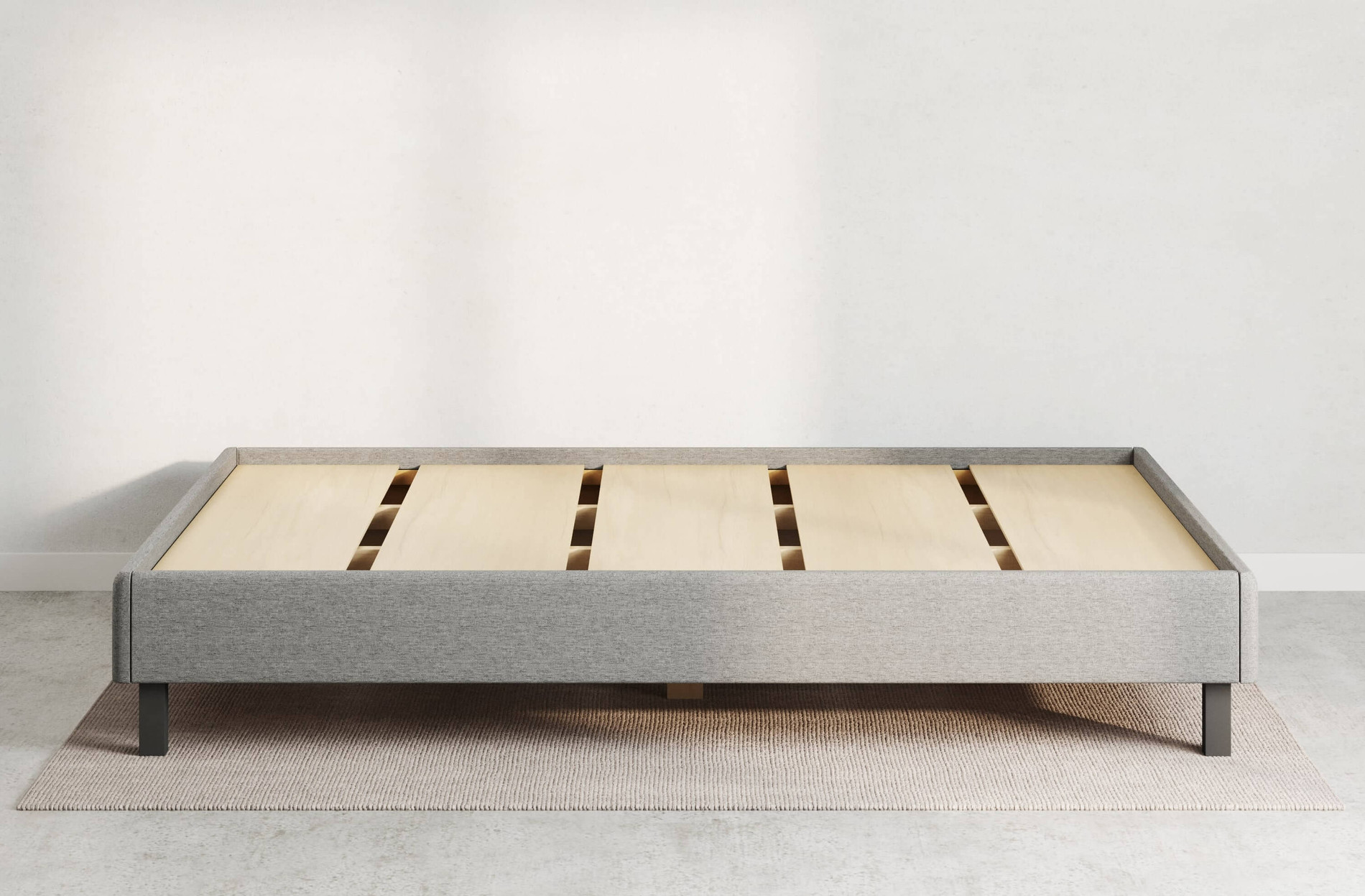
You’ve probably seen them everywhere. Those sleek, low-profile wooden or metal foundations that look like they belong in a Scandinavian design catalog. They're popular for a reason. But honestly, buying a mattress platform bed frame is one of those things where it’s incredibly easy to accidentally ruin your $2,000 mattress by trying to save fifty bucks on the base. People think a flat surface is just a flat surface. It isn't.
Most folks are switching from the old-school box spring setup. Why? Box springs are bulky, they squeak after three years, and they're basically just a giant cage of springs that doesn't actually offer "support" so much as it offers "bounce." A platform bed is different. It’s a self-contained unit. It provides the foundation and the aesthetic all in one go.
But here is where it gets tricky. If you put a heavy memory foam mattress—like a Tempur-Pedic or a Serta iComfort—on a cheap platform with slats that are five inches apart, you’re in trouble. The foam starts to sag through those gaps. Over time, that "dip" in the middle of your bed isn't the mattress failing; it’s the mattress literally escaping through the floor because your frame wasn't built for it.
Why Your Mattress Platform Bed Frame Might Be Killing Your Sleep
The physics of sleep is pretty straightforward, yet we mess it up constantly. Your mattress needs to breathe. When you sleep, your body loses about half a pint of moisture every single night. That moisture goes into the layers of the bed. If your mattress platform bed frame is just a solid sheet of unventilated plywood, that moisture has nowhere to go. It sits there. Eventually, you get mold. It’s gross, it’s a health hazard, and it’s remarkably common in humid climates.
This is why slats exist. But not all slats are created equal.
The industry standard used to be a 3-inch gap. Today, many high-end latex mattress manufacturers, like Avocado or Savvy Rest, actually mandate a gap of 2.75 inches or less to keep the warranty valid. Check your paperwork. If your slats are too wide, you might be voiding a ten-year warranty the second you lay down.
The Great Metal vs. Wood Debate
Metal frames are cheap. They’re easy to ship in a flat box. They’re also prone to what I call "the midnight groan." Metal expands and contracts with the temperature. Screws loosen. If you don't go back and tighten those bolts every six months, your bed is going to sound like a haunted house every time you roll over.
Solid wood? That’s the gold standard. But "solid wood" is a marketing term that gets abused. You’ll see "solid wood" in a listing, but it’s actually rubberwood or acacia. These are fine, but they aren't heirloom oak. Then you have MDF or particle board. Avoid those. They use glues containing formaldehyde, and honestly, they just don't handle the weight of a modern 150-pound hybrid mattress very well.
Think About the Height
Standard beds with a box spring sit about 25 inches off the ground. A mattress platform bed frame is often much lower—sometimes as low as 6 to 10 inches.
It looks cool. It feels modern. But if you have bad knees or you’re over 6 feet tall, crawling out of a "low-pro" bed at 6:00 AM feels like doing a deep squat before coffee. It sucks. Look for "high profile" platform frames if you want to actually sit on the edge of the bed to put your socks on.
The Support Gap Nobody Talks About
We need to talk about the center support leg.
On a King or Queen size frame, you cannot rely on just the four corners. You need a "fifth leg" (or more) in the center of the span. Without it, the frame will eventually bow. When the frame bows, the slats shift. When the slats shift, the mattress loses its alignment. You wake up with a sore lower back and blame the mattress. It’s not the mattress. It’s the $150 frame you bought on a whim because the pictures looked nice.
Look for a mattress platform bed frame that uses a reinforced center rail. Brands like Thuma or Tatami Room do this exceptionally well because they use Japanese joinery or heavy-duty hardware that doesn't rely on flimsy L-brackets.
The Weight Capacity Reality Check
Most people forget to do the math.
- Your weight.
- Your partner's weight.
- The mattress weight (Hybrids can be 120-180 lbs).
- The dog (optional, but likely).
If your frame is rated for 500 lbs and you've got a 150 lb mattress and two 200 lb adults, you are already over the limit. This leads to "decking" failure. The wood cracks. The metal bends. Always aim for a frame rated for at least 800-1,000 lbs of static weight. It sounds like overkill. It’s not. It’s insurance against the bed collapsing during a "vigorous" night of sleep.
Real Examples of What to Buy (And Avoid)
Let's get specific.
If you want the best-of-the-best, you’re looking at something like the Thuma "The Bed". It’s famous for its Pillowboard and the fact that it uses no tools. It’s solid wood. It’s quiet. But it’s expensive. You’re paying for the engineering.
On the budget end, you have the Zinus Shawn or similar metal frames. They are "functional." But they lack soul, and the slat spacing is often wider than recommended for foam beds. If you go this route, you might need to buy a "Bunkie Board"—a thin, fabric-covered piece of wood that sits on top of the slats to provide a flat, supportive surface without adding height.
Then there is the DIY route. I’ve seen people use shipping pallets. Please, don't do this. Shipping pallets are often treated with toxic pesticides like methyl bromide. You don't want to breathe that in while you're dreaming. Plus, they're full of splinters that will shred your $800 mattress cover.
The Impact on Your Mattress Warranty
I touched on this earlier, but it’s the most important factual detail you’ll ignore. Brands like Purple or Casper have very specific requirements for what constitutes a "firm, flat, non-spring surface."
- Purple: Requires slats no more than 3 inches apart.
- Casper: Recommends a platform or a specific foundation; warns against traditional box springs.
- Tempur-Pedic: Is notoriously strict. Using an unapproved frame can actually void the 10-year limited warranty.
If you’re unsure, take a photo of your mattress platform bed frame and email it to the mattress company's customer support. Get it in writing that the frame is acceptable. It takes five minutes and could save you thousands later.
Making the Final Call
So, what should you actually do?
First, measure your room. Platform beds often have a wider footprint than the mattress itself if they have a "lip" or a "floating" design. You don't want to be stubbing your toe on a wooden corner every night at 2:00 AM because the frame sticks out three inches further than your old one.
Second, check the slat material. Are they plywood? Or are they solid pine? Poplar? You want something that doesn't flex like a diving board. If you can push down on a slat with your hand and it bends more than half an inch, it’s too weak for a heavy mattress.
Third, look at the assembly. If the instructions have 40 different types of screws, the structural integrity relies on your ability to not strip a screw head. Frames with "interlocking" parts tend to stay quiet longer because they have fewer points of friction.
Actionable Steps for Your Bedroom Upgrade
- Measure your current mattress weight. Look it up on the manufacturer's site. Don't guess.
- Audit your slats. If you already have a platform bed and the gaps are wider than 3 inches, go to Home Depot, have them cut some 1x4 pine boards, and add them to the frame yourself. It’s a $30 fix.
- Check for a center support leg. If your Queen or King doesn't have one, buy a universal center support kit. It’s cheaper than a new bed.
- Tighten the bolts. Do this every time you rotate your mattress (which should be every 6 months). It prevents the metal-on-metal squeak before it starts.
- Verify the warranty. Read the "Foundation Requirements" section of your mattress warranty before you click "buy" on that trendy new frame.
A mattress platform bed frame is a foundational piece of furniture—literally. It’s the unsung hero of your sleep quality. Stop treating it like an afterthought and start treating it like the structural support system it is. Your back will thank you in five years. Your wallet will thank you when you don't have to replace a sagging mattress prematurely. Get the slats right, get the height right, and make sure that center leg is solid. Everything else is just decor.