You've probably seen that old trick question: which weighs more, a pound of lead or a pound of feathers? Most kids stumble and say lead, but you're smarter than that. You know they weigh the same. But here's the kicker—that joke is actually a secret lesson on mass volume and density. The reason our brains want to say "lead" is because lead is dense. It's packed. A pound of lead fits in your pocket, while a pound of feathers would basically fill up your entire car.
Density is the invisible hand that determines if an aircraft carrier floats or if a pebble sinks. It's not just some dusty lab concept. It’s the reason your oil separates from your vinegar in the salad dressing bottle. If you've ever wondered why some things feel "heavy for their size," you're already thinking about density.
The Big Three: Breaking Down the Definitions
Before we touch a calculator, we need to get the vibe right.
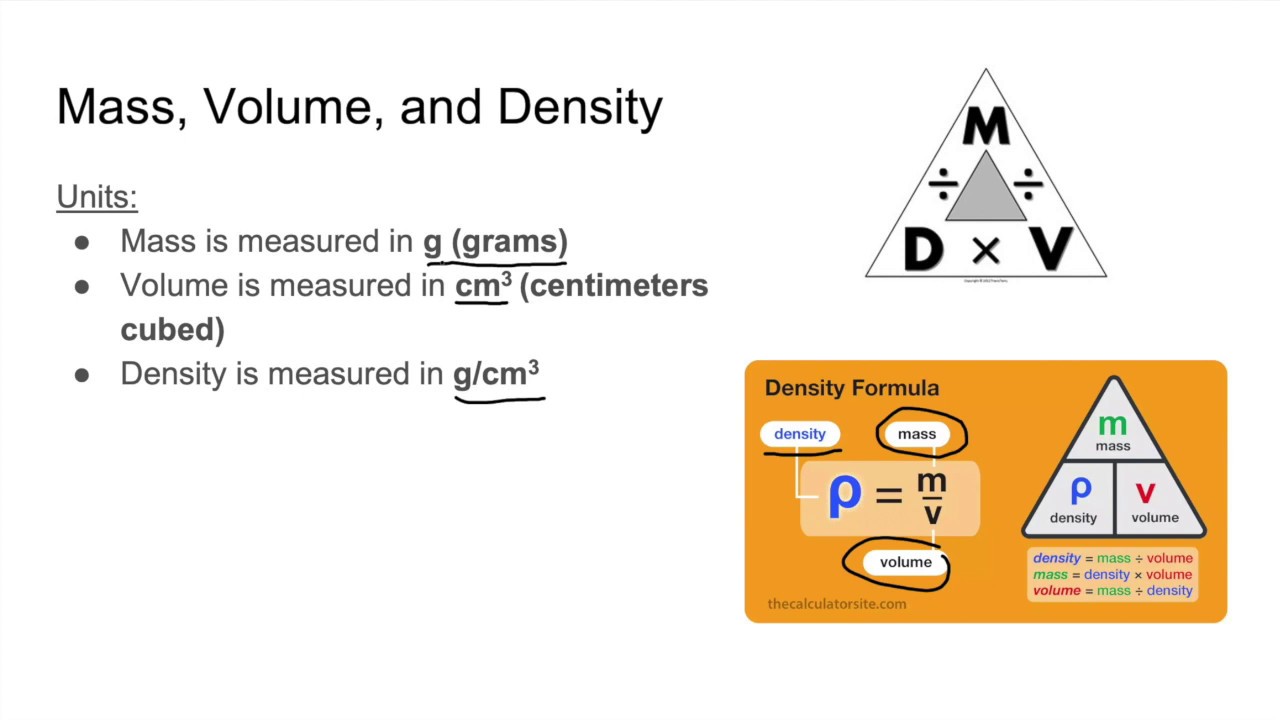
Mass is simply the amount of "stuff" in an object. It’s not weight. Weight changes if you go to the moon because gravity is weaker there, but your mass stays the same. You're still you, whether you're floating in orbit or standing on a scale in Ohio. Scientists usually measure this in grams (g) or kilograms (kg).
Volume is just space. How much room does it take up? Think of it like the size of a box. If you fill a bathtub, the water has a specific volume. We measure this in milliliters (mL), liters (L), or cubic centimeters ($cm^3$).
Then there's density. This is the ratio. It tells us how tightly that "stuff" is crammed into that "space."
The Magic Triangle Trick
If you’re like me, you probably hate memorizing three different versions of the same equation. There’s a shortcut. Imagine a triangle. Put "M" (Mass) at the top. Put "D" (Density) and "V" (Volume) at the bottom.
- Want Mass? Cover the M. You're left with D times V.
- Want Density? Cover the D. You've got M over V.
- Want Volume? Cover the V. You've got M over D.
It's foolproof. Honestly, it’s the only way I kept it straight in chemistry class.
How to Calculate Mass Volume and Density in the Real World
Let's get into the actual math. It’s simpler than it looks, but the units will trip you up if you aren't careful.
Finding Density First
The standard formula is:
$$Density = \frac{Mass}{Volume}$$
Say you have a weird metal cube. You put it on a digital scale and it reads 54 grams. That’s your mass. Then you measure the sides, and it’s a perfect 2 cm on each side. To get the volume, you do $2 \times 2 \times 2$, which is $8\text{ cm}^3$.
Now, divide. $54 / 8 = 6.75$.
So, your density is $6.75\text{ g/cm}^3$. Easy. But wait—is it actually metal? If you look at a standard density chart, you’ll see that pure aluminum is about $2.7\text{ g/cm}^3$, while zinc is closer to $7.1\text{ g/cm}^3$. Your mystery cube is probably an alloy.
Solving for Mass
What if you know what the object is, but you can't weigh it? Maybe it’s a massive gold statue and you don’t have a giant scale.
$$Mass = Density \times Volume$$
Gold is incredibly dense ($19.3\text{ g/cm}^3$). If that statue has a volume of $1,000\text{ cm}^3$ (about the size of a carton of milk), you just multiply $19.3 \times 1,000$. That statue weighs 19,300 grams, or 19.3 kilograms. That's about 42 pounds. Don't try to run off with it.
Calculating Volume
This one is the most practical for DIY projects. If you know you have 500 grams of a specific liquid and you know its density, you can figure out what size container you need.
$$Volume = \frac{Mass}{Density}$$
The Water Displacement Method (The Eureka Moment)
We have to talk about Archimedes. The guy was a genius. Legend has it he was tasked with figuring out if a king's crown was pure gold or if the jeweler had cheated and mixed in silver. He couldn't melt the crown down to measure its volume, because, well, the king would kill him.
He stepped into a bathtub, watched the water rise, and realized that the volume of the water displaced was exactly equal to the volume of his body.
If you have an irregular object—like a jagged rock or a wedding ring—you can’t just use a ruler. You use a graduated cylinder.
- Fill it with a set amount of water (say, 50 mL).
- Drop the object in.
- See where the water level is now (maybe 62 mL).
- The difference ($62 - 50 = 12$) is your volume. 12 mL.
It's elegant. It's simple. It works every time.
Why Temperature Ruins Everything
Here is where most people get it wrong. They assume density is a fixed, unchangeable number. It's not.
Density depends on temperature.
When things get hot, atoms start dancing around. They push away from each other. The object expands. The mass stays the same (you didn't add more atoms), but the volume gets bigger. Since you're dividing the same mass by a bigger volume, the density goes down.
Water is the weirdo exception. Most liquids get denser as they get colder. Water does that too, until it hits about 4°C. Then, it starts expanding. This is why ice floats. If water behaved like most other substances, ice would sink to the bottom of the ocean, and life on Earth probably wouldn't exist as we know it.
Common Mistakes to Avoid
Units. Units. Units.
If you use grams for mass and liters for volume, your density is g/L. If you use kilograms and cubic meters, it's $kg/m^3$. Don't mix them. If you're looking at a problem and one number is in milligrams and the other is in centimeters, you have to convert them first. Otherwise, your answer is gibberish.
Another big one? Significant figures. In a lab setting, you can't have an answer that's more precise than your measurements. If your scale only goes to the nearest gram, writing down a density of $2.458793\text{ g/cm}^3$ makes you look like an amateur.
Real-world nuance: Porosity
Not everything is a solid block. Think about a sponge. Its "bulk density" is very low because it's full of air. But the "material density" of the actual plastic or fiber it's made of is much higher. When you're calculating mass volume and density for construction or geology, you have to specify if you're counting the air pockets or not.
Essential Steps for Your Next Project
If you're trying to calculate these values for a school project, a 3D printing hobby, or even shipping logistics, follow this workflow:
- Zero your scale. Seriously. If the scale reads 0.2g before you put anything on it, your mass calculation is dead on arrival.
- Measure three times. Take the average. Even a slight tilt of the ruler can throw off your volume.
- Check the fluid. If you're using displacement, make sure there are no air bubbles sticking to the object. Those bubbles have volume, but almost no mass, and they will tank your density reading.
- Identify the material. Use a reputable database like the NIST Physical Reference Data to compare your results. If your "gold" ring has a density of $10.5\text{ g/cm}^3$, you've got silver with a gold plating.
The math is just a tool. The real skill is in the measurement. Precise inputs lead to reliable outputs. Whether you're brewing beer (where density/gravity tells you the alcohol content) or building a boat, these three numbers are the foundation of how stuff works.
Keep your units consistent, watch your temperature, and remember the triangle. You'll never get it wrong again.
Key Takeaway Reference
| To Find | Formula | Typical Units |
|---|---|---|
| Density | Mass divided by Volume | $g/cm^3$ or $g/mL$ |
| Mass | Density multiplied by Volume | $g$ or $kg$ |
| Volume | Mass divided by Density | $cm^3$, $mL$, or $L$ |
Get comfortable with the displacement method for anything that isn't a perfect cube or sphere. It's the gold standard for accuracy in any non-industrial setting.
Check your local atmospheric pressure if you're doing high-precision gas calculations, as gases are far more sensitive to environmental changes than solids or liquids. For most hobbyist or student applications, though, the standard formulas will serve you perfectly.