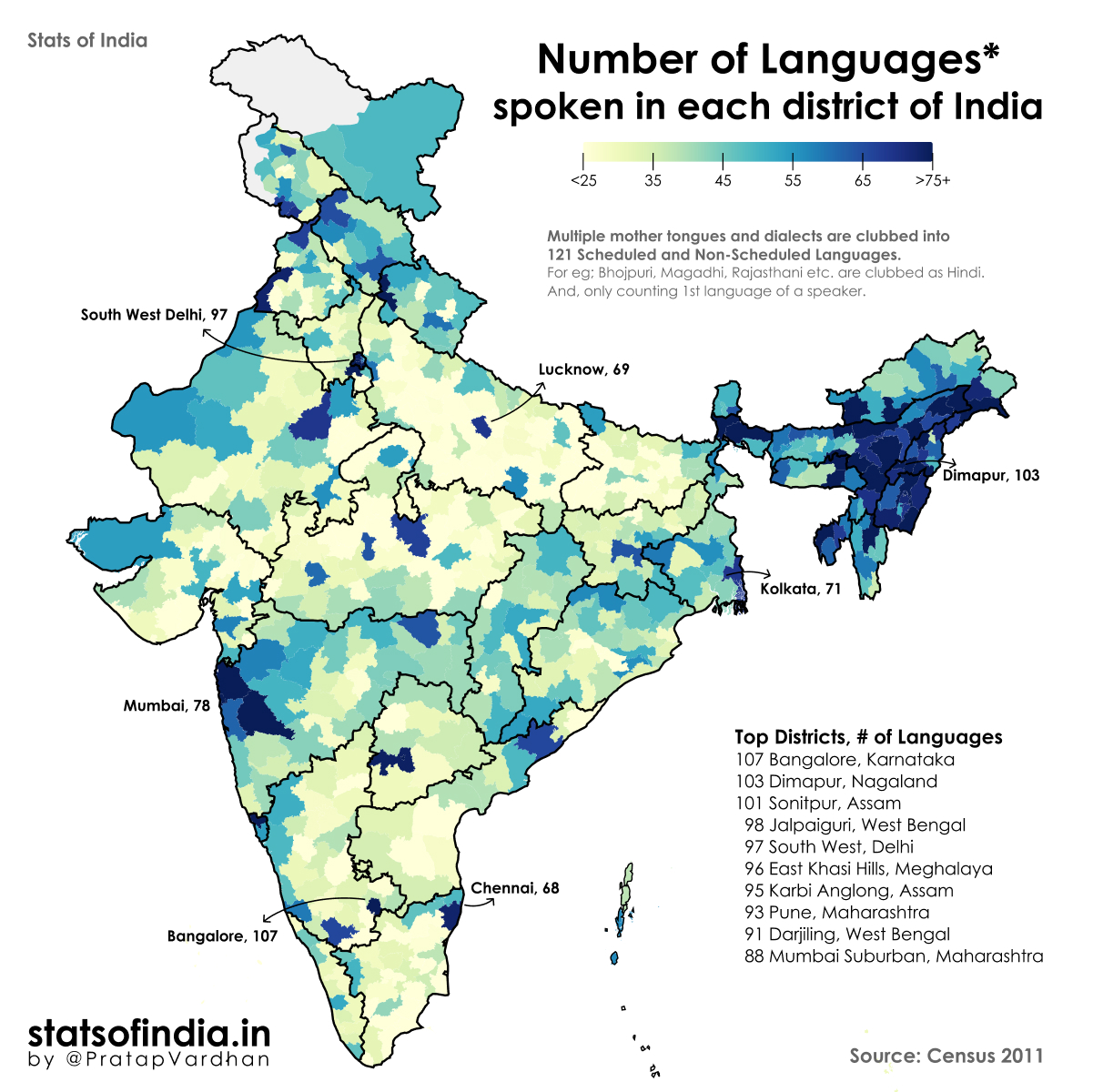
If you’ve ever walked through a train station in Mumbai or a market in Delhi, you already know the vibe. It’s loud. It’s chaotic. And honestly, it’s a linguistic jigsaw puzzle that even most locals don't fully piece together. You’ll hear a shopkeeper haggling in Marathi, a tourist asking for directions in English, and two friends arguing over a cricket score in Hindi.
India doesn't just have "a couple" of languages. It has hundreds.
There's this huge misconception that Hindi is the "national language" of India. You’ll see it on social media debates all the time. But legally? Factually? Nope. India actually has no national language. What it has is a complex, tiered system of official and scheduled languages that keep this massive democracy running.
The Big Two: Official Status vs. Reality
Basically, the central government operates using two "official" languages: Hindi and English. This was supposed to be a temporary setup back in 1950, but English proved too useful (and too politically neutral) to get rid of. Today, English is the glue for the corporate world, higher education, and the legal system.
But when we talk about the main languages in india, we’re usually looking at the Eighth Schedule of the Constitution. This is a list of 22 "Scheduled Languages" that get special recognition and support.
Think of it as an elite club. Inclusion means the government has to work to develop the language, and you can take major civil service exams in them.
The Heavy Hitters by the Numbers
Let's look at who’s actually speaking what. The data from the last major census (and recent 2025-2026 projections) tells a pretty clear story.
Hindi is the undisputed giant. Around 43.6% of the population claims it as their mother tongue. If you include people who speak it as a second or third language, that number jumps to over 57%. It dominates the "Hindi Belt" across the north and center of the country.
Bengali comes in second. It’s spoken by nearly 100 million people, mostly in West Bengal and Tripura. It’s poetic, it’s musical, and it has a literary history that’s honestly intimidating.
Marathi and Telugu are usually neck-and-neck for the third spot. Marathi is the powerhouse of Maharashtra, while Telugu is the dominant force in Andhra Pradesh and Telangana.
The North-South Divide and the Dravidian Family
You’ve probably heard people talk about the "Indo-Aryan" and "Dravidian" split. It's not just academic jargon. It’s the reason why someone from Punjab might find it easier to understand a bit of Bengali than a sentence of Tamil.
Most northern languages (Hindi, Punjabi, Gujarati, Marathi) come from the Indo-Aryan family, rooted in Sanskrit. But the south is a different world.
The four main Dravidian languages are:
- Telugu (The "Italian of the East" because almost every word ends in a vowel).
- Tamil (One of the oldest living classical languages on the planet).
- Kannada (The backbone of Karnataka and the tech hub of Bengaluru).
- Malayalam (Spoken in Kerala, known for its unique script and 100% literacy vibes).
Tamil deserves a special shout-out here. It’s not just a regional tongue; it’s a "Classical Language." To get that title, a language needs a recorded history of at least 1,500 to 2,000 years. Tamil has that in spades.
The Digital Explosion: Why Language Matters in 2026
Something massive changed over the last year. We’ve hit a point in 2026 where the "English-speaking internet" in India is no longer the main event.
Honestly, the real growth is in what we call the "Vernacular Web."
According to recent digital marketing trends, over 75% of Indian internet users now prefer consuming content in their native language. Brands are finally waking up to this. You’ll see Amazon or Flipkart interfaces in Hindi or Tamil because that’s where the "Next Billion" users are.
AI is playing a huge role too. Platforms like Bhashini, the government's AI-led translation system, are making it possible for a farmer in Odisha to access government services using voice commands in Odia. It’s pretty wild to see. We’re moving away from "one size fits all" and into a hyper-local era.
What Most People Get Wrong
People often assume Urdu and Hindi are totally different. In reality, when spoken on the street, they are so similar they’re often grouped as Hindustani. The main difference is the script—Hindi uses Devanagari (written left to right), while Urdu uses a version of the Persian-Arabic script (written right to left).
Another shocker? Sanskrit. While it’s the liturgical language of Hinduism, the 2011 census found only about 24,000 people who claimed it as their primary language. Yet, it’s still an "official" scheduled language because of its massive cultural weight.
Then there’s the tribal languages. There are over 100 "non-scheduled" languages spoken by millions. Bhili is a huge one, spoken by nearly 10 million people, yet it doesn't have the "scheduled" status of smaller languages like Sanskrit or Dogri.
Practical Insights for Navigating India's Languages
If you’re traveling or doing business in India, don't stress about learning 22 languages. You can't.
- In the North: Hindi will get you through 90% of situations. Most people in cities are bilingual anyway.
- In the South: Use English. Seriously. In states like Tamil Nadu or Karnataka, trying to use Hindi might actually be less helpful than just sticking to English, due to long-standing political sensitivities around "language imposition."
- For Business: If you’re targeting Tier 2 or Tier 3 cities, you must localize. A video ad in Marathi will perform twice as well as an English one in Pune. It’s about trust, not just translation.
- The "Hinglish" Factor: Don't be surprised to hear a mix. "Hinglish" (Hindi + English) is basically the default mode for India's youth and urban population. It’s not "bad grammar"—it’s a living, breathing dialect.
India's linguistic map is constantly shifting. With the rise of regional cinema (the "South Indian" film takeover) and localized social media, the pride in "mother tongues" has never been higher.
To truly understand India, you have to stop looking for a single thread and start appreciating the tapestry. It’s messy, it’s complicated, and it’s exactly what makes the country tick.
Next Steps for Deepening Your Knowledge:
- Check the Eighth Schedule: If you’re curious about the legal status of a specific region, look up the 22 languages listed in the Indian Constitution.
- Use Bhashini: If you're dealing with local documents, try the Bhashini app for real-time AI translation that actually understands Indian context.
- Watch Regional Content: To hear the difference, switch your Netflix audio to Malayalam or Bengali for ten minutes. The rhythms are entirely distinct.