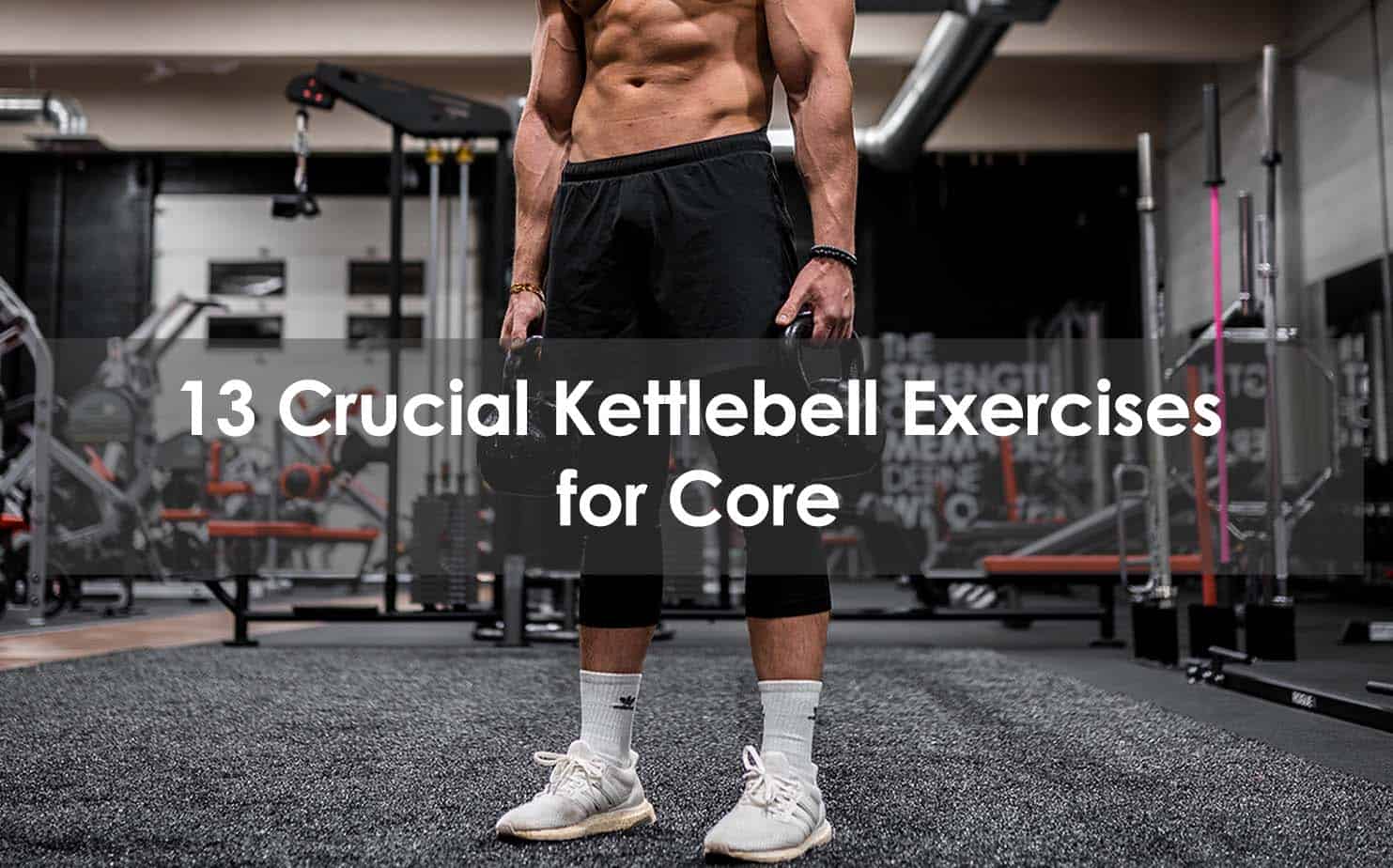
Most people treat their core like a finishing move at the end of a workout. They do a few sets of crunches, maybe a plank if they’re feeling ambitious, and call it a day. Honestly? It’s a waste of time. If you want a core that actually functions—meaning it protects your spine under load and looks athletic—you need to stop thinking about "abs" and start thinking about stability. This is where kettlebell core exercises change the game.
The magic of the kettlebell isn't just the weight. It's the physics. Because the center of mass is offset from the handle, the bell is constantly trying to pull you out of alignment. Every time you pick one up, your deep stabilizers—the transverse abdominis, the multifidus, and those tiny muscles along your spine—have to scream just to keep you upright.
Stop doing sit-ups. They’re fine for the superficial "six-pack" look, but they don't teach your body how to handle force. If you’ve ever felt your lower back tweak while picking up a heavy grocery bag, your core failed you. We’re going to fix that.
The Misunderstood Anatomy of a Kettlebell Core
We need to get one thing straight: your core isn't just that front panel of muscle you see in the mirror. It’s a 360-degree cylinder. It includes your lats, your glutes (yes, your butt is part of your core), and your pelvic floor.
Dr. Stuart McGill, arguably the world’s leading expert on spinal mechanics, often talks about "proximal stiffness for distal mobility." Basically, if your torso is a solid rock, your limbs can move faster and more powerfully. When you perform kettlebell core exercises, you are training that stiffness. You aren't just "burning fat." You are turning your midsection into a high-tension cable system.
Why the Offset Load Wins Every Time
Think about a barbell. It’s balanced. It’s predictable. Now think about a 16kg kettlebell in one hand while you're walking. The weight is trying to fold your ribs toward your hip on the weighted side. To counter this, the muscles on the opposite side of your body have to fire like crazy. This is called anti-lateral flexion.
It’s functional. It’s brutal. And it builds a level of "hidden" strength that crunches can't touch.
Beyond the Swing: The Moves That Actually Matter
Everyone knows the swing. It’s great. But for pure, unadulterated core stability, there are better options. Let's look at the stuff that actually works.
The Hardstyle Plank
This isn't your "scroll through Instagram while holding a position" plank. This is a 10-second max-effort contraction. You place a kettlebell between your feet. You grip the floor with your forearms. You pull your kneecaps up, squeeze your glutes until they cramp, and try to "pull" your elbows toward your toes. The goal isn't to hold it for five minutes. The goal is to be so exhausted after 15 seconds that you have to collapse. That is how you build true tension.
The Kettlebell Windmill
This is a mobility-stability hybrid. You press the bell overhead, hinge at the hips, and reach for the floor with your free hand. It looks like a circus trick. It feels like your obliques are being lengthened and strengthened simultaneously. Be careful here, though. If you have existing disc issues, the rotation under load can be spicy. Keep your eyes on the bell. It keeps your shoulder packed and your spine aligned.
The Suitcase Carry
Simple. Brutal. Effective. Pick up the heaviest kettlebell you can hold in one hand. Walk 40 yards. Don't lean. If you look like you're carrying a heavy bag of mulch and struggling, the weight is too heavy or your core is failing. You should look perfectly upright, as if the weight isn't even there. This trains the quadratus lumborum (QL), a deep muscle that is a common culprit for lower back pain when it's weak.
The Overhead Carry: A Secret Weapon
If you want to test your core integrity, put a weight over your head and walk. The longer the lever (your arm), the more work your midsection has to do to keep you from toppling over.
- Keep your bicep by your ear.
- Don't let your ribs "flare" out.
- If your lower back starts to arch, the set is over.
Why Your Current Routine is Failing
Most people fail with kettlebell core exercises because they use weights that are too light. You cannot "tone" your way into a strong core with a 5lb pink plastic weight. You need enough resistance to force a neurological adaptation.
Another mistake? Volume over intensity. Your core is designed to resist movement. Doing 100 repetitions of a Russian Twist with a light weight is just repetitive spinal friction. Instead, try doing 5 reps of a heavy Kettlebell Side Press. The difference in muscle recruitment is staggering.
The Role of Breathing
You've probably heard of "bracing." It’s not just sucking your stomach in. In fact, sucking your stomach in is the opposite of what you want for stability. You want to expand your belly with air and then "clamp down" on that air.
Imagine someone is about to punch you in the gut. That's the feeling. When you combine this "intra-abdominal pressure" with a heavy kettlebell movement, you create a natural weight belt that protects your spine from the inside out.
Real-World Results and Evidence
In a study published in the Journal of Strength and Conditioning Research, researchers found that kettlebell training significantly improved core strength and "trunk explosive power." This isn't just anecdotal "gym bro" talk. The ballistic nature of moves like the snatch or the clean forces the core to switch from "relaxed" to "rigid" in a fraction of a second.
This "on-off" switching is exactly what happens when you slip on ice or have to catch a falling child. It’s real-world insurance.
Common Misconceptions About "Abs"
- You can spot-reduce belly fat. You can't. You can do 1,000 kettlebell halos, but if your diet is a mess, those strong obliques will stay hidden under a layer of insulation.
- More is always better. Your core muscles need recovery just like your biceps. If you blast them every single day with heavy loads, you'll eventually see a drop in performance or, worse, an injury.
- Belts are for cheaters. Not really, but if you rely on a lifting belt for every kettlebell move, your internal stabilizers will get lazy. Use the belt for your 1-rep max, sure. But for your main kettlebell core exercises, let your muscles do the work.
Practical Programming: How to Start
You don't need a 45-minute "ab day." That's boring and mostly unnecessary. Instead, sprinkle these movements into your current lifting routine.
Start with the Bottoms-Up Carry. Flip the kettlebell upside down so the heavy part is pointing at the ceiling. Grip the handle tight. Now walk. The instability of the bell being top-heavy forces your forearm, shoulder, and core to work in perfect synchronicity. It’s impossible to cheat this move. If you lose tension, the bell flops over.
Monday: Strength Focus
- Heavy Suitcase Carries: 3 sets of 30 meters per side.
- Goblet Squats (holding the bell against your chest forces the anterior core to fire): 3 sets of 10.
Wednesday: Stability Focus
- Hardstyle Planks: 5 sets of 15 seconds (max tension).
- Kettlebell Halos: 3 sets of 8 reps per direction. Keep your hips totally still while the bell moves around your head.
Friday: Power Focus
- Single-Arm Swings: 5 sets of 10 per arm. The rotation resistance here is immense.
- Turkish Get-Ups: 2 reps per side. This is the king of all kettlebell core exercises. It moves you through every plane of motion while keeping a load overhead.
The Turkish Get-Up: A Masterclass in Tension
If you only had time for one exercise, it should be the Turkish Get-Up (TGU). It’s not a "move." It's a sequence. You start lying on the floor and end up standing, all while holding a kettlebell above your head.
It teaches your body to move as a single unit. There is no point in the TGU where your core isn't under significant stress. It improves shoulder health, hip mobility, and, obviously, midsection strength. It’s slow. It’s methodical. It’s honestly kind of frustrating to learn at first. But the payoff is a body that feels "bulletproof."
Limitations and Safety
Kettlebells aren't magic. They're tools. If you have a herniated disc or severe sciatica, some of these moves—specifically the windmill or heavy swings—might be provocative. Always consult with a physical therapist if you're working through an injury.
Also, form is everything. A "bad" swing is just a fast way to hurt your back. If you’re new, find a coach who understands the SFG (StrongFirst) or RKC (Russian Kettlebell Challenge) methodologies. They focus on the "grinds" and the "ballistics" with a level of precision that prevents the "cross-fit back" injuries people fear.
Final Actionable Steps
Stop searching for "new" exercises and start mastering the basics with heavier weights.
- Buy a heavier bell. If you can do 20 reps of a move easily, it’s no longer a core strength exercise. It’s cardio.
- Incorporate "Anti" movements. Focus on anti-rotation (don't let the bell turn you), anti-lateral flexion (don't let it bend you sideways), and anti-extension (don't let it arch your back).
- Record yourself. Your "straight" spine probably isn't as straight as you think. Use your phone to check your alignment during carries and overhead work.
- Focus on the "Exhale." Breathe out hard through pursed lips during the most difficult part of the lift. This "power breath" increases spinal stability by up to 20%.
True core strength is about being unshakeable. When you use kettlebells correctly, you aren't just building muscle; you're building a chassis that can handle whatever life throws at it. Stop the endless crunches and start moving some iron. Your back—and your mirror—will thank you.