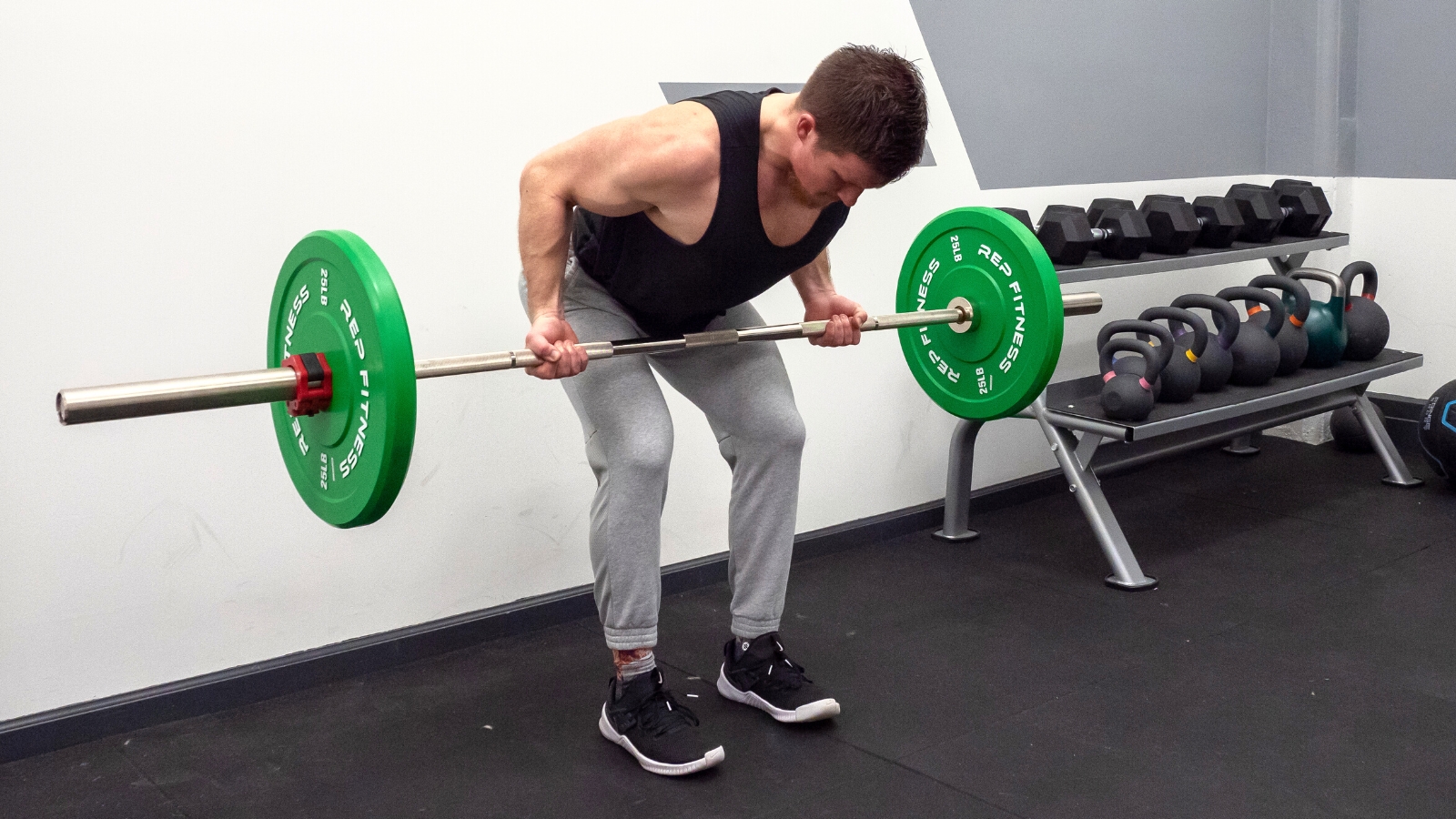
You’ve seen the guy in the corner of the gym. He’s bent over a barbell, but his palms are facing away from him. It looks a little weird, right? Most people stick to the standard overhand grip because that’s what they saw in a generic fitness magazine back in 2012. But the reverse grip bent over row—often called the Yates Row after the legendary six-time Mr. Olympia Dorian Yates—is arguably the most underrated tool for building a thick, powerful back.
It’s not just a subtle variation. It’s a completely different mechanical beast.
When you flip your hands, everything changes. Your elbows tuck closer to your ribs. Your biceps get invited to the party in a big way. Most importantly, you start hitting the lower lats in a way that the traditional grip simply cannot touch. If you’re struggling to feel your back working during your pull days, this might be the missing link.
Why the Underhand Grip Is a Game Changer
Physics doesn't lie. In a standard overhand row, your elbows tend to flare out. This puts a lot of the load on your upper traps, rhomboids, and rear deltoids. That’s great for "width" and that upper-back shelf, but it often leaves the lower portion of the latissimus dorsi looking a bit thin.
By using a supinated (underhand) grip, you’re forced into shoulder extension rather than just horizontal abduction.
Basically, your elbows stay tight to your body. This path of travel allows for a much greater range of motion for the lower fibers of the lats. Think about it. When your palms are up, you can pull the bar further back toward your hip crease. That’s the "sweet spot" for back thickness.
Also, let’s be real: you’re stronger this way.
The reverse grip bent over row utilizes the biceps brachii much more effectively than the overhand version. While some "purists" argue that you should take the biceps out of the movement to isolate the back, that’s usually a mistake for natural lifters. Using more muscle groups allows you to move heavier weight. Heavier weight, provided your form isn't total garbage, usually leads to more growth over time.
It’s a win-win. You get a massive back and some "accidental" bicep peaks.
The Dorian Yates Connection
We can’t talk about this move without mentioning Dorian Yates. He revolutionized bodybuilding in the 90s with his "High Intensity Training" (HIT) philosophy. He didn't do twenty sets of back. He did one or two "work" sets to absolute failure.
And his primary weapon? The underhand row.
Yates famously preferred a more upright torso angle—roughly $45^{\circ}$ to $60^{\circ}$—rather than being parallel to the floor. This is a crucial distinction. When you’re bent perfectly parallel to the ground (the Pendlay style), the lower back becomes a massive bottleneck. You’ll often find your spinal erectors giving out long before your lats do. By standing slightly more upright, you shift the center of gravity and allow the lats to take the brunt of the force.
However, there is a catch. Yates himself eventually suffered a high-profile bicep tear.
Critics often point to the reverse grip as the culprit. When the weight gets incredibly heavy—we're talking 400+ pounds—the bicep is under an immense amount of tension in a stretched position. For the average person lifting 135 or 225, this isn't a huge concern, but it's a reminder that form is non-negotiable.
How to Perform the Reverse Grip Bent Over Row Without Killing Your Back
Don't just walk up to the bar and yank. That's a one-way ticket to a physical therapist's office.
The Stance: Set your feet about shoulder-width apart. Grip the bar with your palms facing forward (upward). Your hands should be just outside your hips. If you go too wide, you lose the advantage of the tucked elbow.
The Hinge: This is where most people mess up. Push your hips back. Keep your spine neutral. You aren't "bending over" from your waist; you are hinging at the hips. Imagine there’s a wall behind you and you’re trying to touch it with your glutes.
The Angle: Aim for that $45^{\circ}$ angle. It’s the "Goldilocks" zone. High enough to save your lower back, low enough to keep the tension on the lats.
The Pull: Do not pull the bar to your chest. If the bar hits your nipples, you're using too much trap and bicep. Pull the bar toward your belly button or even your hip bones. Think about driving your elbows behind you.
The Squeeze: At the top of the rep, pinch your shoulder blades together. Hold it for a micro-second. Feel the muscle. Then, control the weight on the way down. Don't just let it drop. The eccentric (lowering) phase is where a lot of the muscle fiber damage—the good kind—happens.
Common Mistakes That Ruin Your Gains
Honestly, the biggest mistake is ego. People load up four plates and start "humping" the bar. If your torso is moving up and down like a see-saw to get the weight moving, you aren't doing a reverse grip bent over row. You're doing a weird, dangerous dance.
Keep your torso still. If you have to cheat, the weight is too heavy. Period.
Another issue is the "wrist curl." Because the grip is underhand, people tend to curl their wrists toward their forearms as they pull. This shifts the tension away from the lats and onto the forearm flexors. Keep your wrists straight and "stiff." Think of your hands as mere hooks. Your elbows are the actual drivers of the movement.
Then there's the neck. Stop looking at yourself in the mirror.
Looking up strains the cervical spine. It feels natural to watch your form, but it's better to keep your head in line with your spine, looking at a spot on the floor about five feet in front of you.
The Science of Muscle Activation
A study by Fenwick et al. (2009) looked at different rowing variations and their impact on the spine and muscle activation. While it didn't specifically isolate the "Yates" style against the "Pendlay" style in every metric, it confirmed that the bent-over row is one of the most demanding exercises for the entire posterior chain.
The reverse grip bent over row specifically increases the activation of the biceps brachii and the lower trapezius compared to an overhand grip with a wide flare.
Because the lats are a huge fan-shaped muscle, you can't "isolate" the bottom from the top perfectly, but you can certainly bias the fibers. The underhand grip creates a line of pull that aligns more closely with the vertical fibers of the lower lat. This is why people who switch to this grip often report "soreness in places they never felt before."
Incorporating It Into Your Routine
You don't need to do this every day. In fact, you shouldn't.
If you’re on a standard Push/Pull/Legs (PPL) split, the reverse grip bent over row should be your primary "heavy" pull for at least one of your pull days. Pair it with something that provides a different stimulus, like a wide-grip lat pulldown or a face pull.
- For Strength: 3 to 5 sets of 5–8 reps.
- For Hypertrophy (Muscle Growth): 3 sets of 10–12 reps.
One thing to consider is your grip strength. Because you’re pulling heavy, your grip might give out before your back does. Don't be afraid to use straps. Some people think straps are "cheating," but if your goal is a big back, don't let your small hand muscles be the limiting factor.
Is It Safe for Everyone?
Look, if you have a history of herniated discs or chronic lower back pain, any bent-over row is risky. You might be better off with a chest-supported row or a T-bar row where the machine supports your weight.
But for a healthy lifter? It’s perfectly safe if you respect the weight.
The bicep tear concern is real but often exaggerated. Most tears happen when people use "momentum" and "jerk" the bar at the bottom of the movement. If you keep the movement fluid and avoid "snapping" your elbows straight at the bottom, your tendons should be fine.
The Verdict on the Underhand Row
The reverse grip bent over row is a powerhouse. It builds the lats, thickens the mid-back, and gives your biceps some extra work. It’s the reason why bodybuilders from the Golden Era had that "3D" look from the side.
If your back progress has plateaued, stop doing the same three exercises you've been doing since high school. Flip your grip. Lean into the $45^{\circ}$ angle. Focus on pulling to the hip.
Actionable Next Steps
- Check your mobility: Before your next back session, make sure your hamstrings aren't too tight. If they are, you won't be able to hinge properly, and your lower back will round.
- Record your set: Set up your phone and film a set from the side. Are you actually at a $45^{\circ}$ angle, or are you standing almost vertical? Is your back flat?
- Start light: Even if you can overhand row 185 lbs, start with 135 lbs on the reverse grip. Get used to the feeling of the bar path hitting your lower lats.
- Mind-Muscle Connection: On the next rep, consciously think about pulling your elbows into your back pockets. That simple mental cue usually fixes 90% of form issues.
Don't overcomplicate it. Just get under the bar and pull.