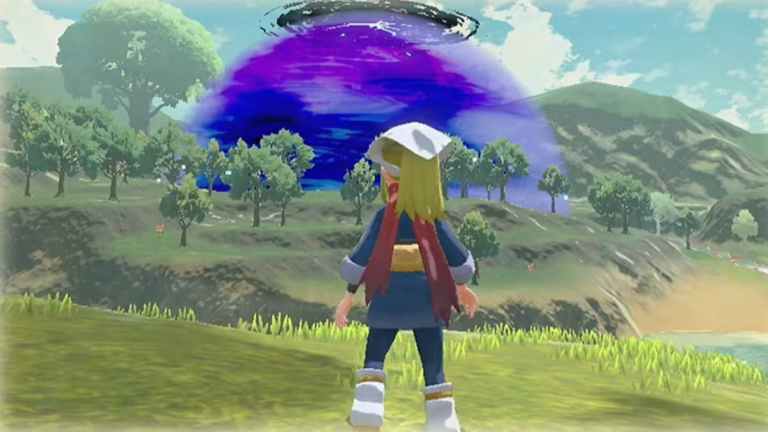
You're standing in the middle of the Crimson Mirelands, minding your own business while stalking a Shinx, when the sky suddenly turns a sickly, bruised purple. It’s unsettling. The music shifts into this frantic, rhythmic pulsing that makes your palms sweat. If you’ve played Pokémon Legends: Arceus, you know exactly what’s happening. A Pokémon Legends: Arceus space-time distortion is forming, and honestly, it’s the most stressful—and rewarding—part of the entire game.
Most people just run inside and hope for the best. That's a mistake. If you want to finish that Pokédex and actually find the rare items needed for evolution, you have to master the RNG behind these domes. It isn't just random luck. There is a specific internal clock ticking behind the scenes that determines when these rifts tear open the fabric of Hisui.
The Math Behind the Rift
The game doesn't tell you this, but the spawning of a Pokémon Legends: Arceus space-time distortion is tied directly to active playtime. I’m talking about minutes spent unpaused in a map area. You can't just sit in the village and wait. You have to be out in the field.
Internal data mining from the community, largely verified by researchers like Serebii and various technical breakdowns on platforms like Reddit, shows that the game checks for a distortion spawn at specific intervals. After five minutes, there's a tiny chance. At fifteen minutes, it jumps. If you hit forty minutes of active time in a single zone without returning to Jubilife Village, a distortion is almost guaranteed to trigger.
But here is the kicker: certain actions "pause" this invisible timer.
Talking to an NPC? Timer stops.
Engaging in a Pokémon battle? Timer stops.
Opening your map or satchel to check your berries? Yep, the timer stops there too.
If you’re wondering why you’ve been wandering the Cobalt Coastlands for an hour and haven't seen a single purple dome, it’s probably because you’ve spent half that time in menus or battling wild Buizel. To force a spawn, you basically need to just stand there. Or fly around. Just don't engage with anything that halts the game world's progression.
What Happens Inside the Dome
Once the bubble fully manifests, the game world changes. You’ll see rare items scattered on the ground—shards, stardust, and the coveted evolutionary items like Dubious Discs or Metal Coats. Then, the "waves" start.
There are three types of spawns inside a Pokémon Legends: Arceus space-time distortion. First, you have the "passive" spawns. These are the Pokémon that just hang out in the dome the whole time. Then you have the "active" spawns. These appear in groups of three, usually aggressive, and they'll hunt you down the moment they see you. Finally, there are the rare spawns.
Rare spawns are the reason we do this.
We’re talking Porygon in the Mirelands. Magnemite in the Coastlands. Fossil Pokémon like Cranidos and Shieldon in the Highlands. These don't show up anywhere else. If you miss them here, you're stuck waiting for the next RNG roll. It’s brutal, but it makes the catch feel like a genuine achievement rather than just another checklist item.
Why the Obsidian Fieldlands Distortions Feel Different
Have you ever noticed that the Fieldlands feels like it gives you nothing but Johtonian Sneasel? There's a reason for that. Each map has a specific "table" of rare spawns. While the common spawns—like Eevee or the various elemental stones—can show up almost anywhere, the heavy hitters are region-locked.
In the Obsidian Fieldlands, you’re looking for the Sneasel variant that isn't from Hisui. In the Alabaster Icelands, you might stumble upon Scizor or even a high-level Flareon. The variety is wild. But the danger is real. Being jumped by a level 65 Alpha Kadabra while you're trying to pick up a piece of Green Shard is a quick way to lose half your inventory.
The strategy here is movement. Don't stay in one spot. Use Wyrdeer or Sneasler to keep moving in a circle around the perimeter. The game refreshes the spawns based on your proximity. If you sit still, you're only seeing one small slice of what the distortion has to offer.
The Evolution Item Economy
Let’s talk about the items. Pokémon Legends: Arceus space-time distortions are essentially the game's way of bypassing the need for trading. In older games, if you wanted a Porygon2, you needed a friend and a link cable. Here, you just need to survive a rift.
The ground will be littered with:
- Red, Blue, and Green Shards (Used for crafting Star Pieces)
- Nuggets and Stardust
- Evolution stones (Fire, Water, Thunder, etc.)
- Link Cords (The holy grail for solo players)
- Specialized tech items (Electirizer, Magmarizer)
Honestly, if you're low on Poké Dollars, farming these distortions is faster than catching a hundred Bidoof. A single Star Piece sells for 5,000, and you can craft them easily once you have the recipe from the craftworks in town. It's the most efficient gold farm in the game, period.
Common Misconceptions and Failures
One of the biggest lies floating around the internet when the game launched was that sleeping in a tent resets the timer. It doesn't. Well, mostly. If you "rest" for a short time, the timer usually persists. However, if you change the time of day significantly (like sleeping until morning when it's currently night), you risk resetting the encounter table.
Another mistake? Ignoring the weather.
Severe weather conditions like intense sun, snowstorms, or thunderstorms can actually prevent a Pokémon Legends: Arceus space-time distortion from forming. If the weather is "locked" into a specific event for a story mission or a massive mass outbreak, the distortion might never trigger. You have to clear the atmosphere, literally and figuratively, before the rift will show up.
Dealing with the Aggression
Inside the dome, Pokémon are "extra" aggressive. They don't just notice you; they want you gone. You'll often find yourself in 3-on-1 battles. This is where the game's battle system really shows its teeth. If you aren't careful, the action economy will wreck you. They’ll use Agile Style moves to lap you, hitting you three times before you even get a turn.
I usually keep a high-HP "tank" like Blissey or Snorlax at the front of my party. Their job isn't to win; it's to survive long enough for me to throw a Lead Ball or a Jet Ball at whatever rare spawn just popped up.
Actionable Steps for Rift Farming
If you are serious about completing your Hisui journey, stop wandering aimlessly. Follow this flow to maximize your efficiency:
- Clear the Weather: Enter a zone and check the top left. If there’s a storm, rest at the camp until the weather is clear or cloudy.
- The AFK Method: Find a safe spot, like a high cliff or a camp. Leave your character standing there. Go make a sandwich. Check back every 10 minutes.
- The 15-Minute Rule: Most distortions trigger between the 10 and 20-minute mark. If you hit 40 minutes with nothing, leave the area and come back to reset the seed.
- Empty Your Satchel: You’re going to be picking up dozens of items. Don't be that person who has to drop a Sun Stone to make room for a Porygon.
- Focus the Rare Spawns: As soon as the "A space-time distortion is forming" message appears, get to the center of the circle. When it fully opens, look for the unique spawns first. The common ones (like Floatzel or Luxray) aren't worth your time or your Poké Balls.
There is a certain magic to these rifts. They feel like a glitch in the world, a reminder that the Hisui region is fundamentally unstable. But once you understand that they are just a predictable mechanic hidden behind a layer of purple fog, the game changes. You stop being a victim of the RNG and start being the one who exploits it. Go get those fossils.
.png)