Ever stood at the top of a high-dive platform and felt your stomach do a slow, agonizing somersault? That’s 10 meters. It looks like a short walk on flat ground, but once you tip that distance vertically, your brain starts screaming. Most people think they have a solid handle on metric measurements, but when you ask someone to actually visualize how far is 10m, they usually point to something either way too short or ridiculously long.
It’s about 32.8 feet. Roughly.
But numbers are boring and frankly, they don't help when you're trying to figure out if a new rug will fit in your living room or if you can park your truck in a specific spot. 10 meters is a foundational unit of "human-scale" distance. It’s the length of a large bus. It’s the height of a three-story building. If you’re a sports fan, it’s exactly the distance a platform diver falls before hitting the water at nearly 30 miles per hour.
Visualizing 10 Meters in the Real World
Let's get practical. If you walked out your front door right now, could you mark out 10 meters without a tape measure? Most of us can't. We live in a world of "about" and "sorta," but precision matters when you're talking about depth, height, or clearance.
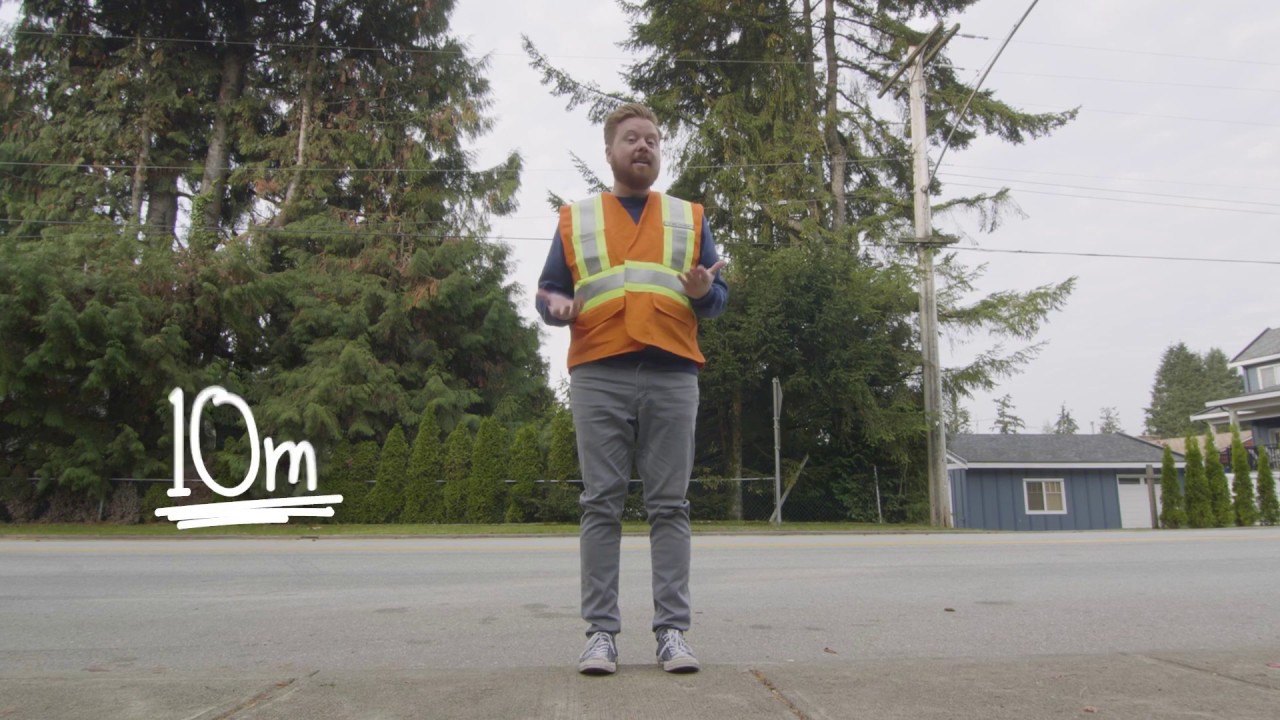
Think about a standard yellow school bus in the United States. While they vary, a full-sized Type D bus is usually around 10 to 12 meters long. So, if you see a big bus parked on the street, you’re looking at a 10m distance. Or, consider your average telephone pole. In many residential areas, those wooden poles are roughly 10 to 12 meters tall, with a bit of that buried underground for stability.
Then there’s the "three-story" rule. Generally, a single story of a house or apartment building—including the space for floor joists and ceilings—is about 3 to 3.5 meters. Stack three of those on top of each other, and you’re looking at a 10-meter vertical drop. It’s high. High enough that if you fall from it, the physics get very grim, very fast.
The Standard Parking Space Comparison
Parking spaces are a great reference because we see them every day. A standard parallel parking spot is usually about 6 meters long. So, 10 meters is almost exactly the length of one and a half parking spots. If you can picture two small compact cars parked bumper-to-bumper, you’ve actually overshot the mark by a little bit.
Why 10m Matters in Physics and Safety
There is a reason why 10 meters is a recurring number in science and safety regulations. It’s not just a round number; it’s a threshold.
In water, 10 meters is a massive deal. For every 10 meters you descend into the ocean, the pressure increases by approximately one atmosphere ($1 \text{ atm}$). This is the "10-meter rule" for divers. If you’re at sea level, you have the weight of the Earth's atmosphere pressing on you. Dive down 10 meters, and you now have the weight of that atmosphere plus the weight of the water above you. You’re under twice the pressure you were on the beach. Your lungs compress. Your ears need equalizing.
The "Rule of Tens" pops up in fall safety too. OSHA (Occupational Safety and Health Administration) and other global safety bodies often cite distances around this mark for critical fall protection. While they require protection at much lower heights—often starting at 6 feet in construction—the 10-meter mark is where the survival rate in an accidental fall drops off a cliff. Literally.
Radio Waves and Tech
If you’re a ham radio geek or into electronics, you know the "10-meter band." This refers to radio frequencies between 28.000 MHz and 29.700 MHz. The wavelength is approximately 10 meters long. This band is famous because it fluctuates wildly with the solar cycle. Sometimes you can talk to someone across the world with the power of a lightbulb; other times, the band is as dead as a doornail.
How Far is 10m in Competitive Sports?
Sports are perhaps the best way to "feel" a distance. We see these measurements every weekend on TV, yet we rarely connect them to the metric system if we grew up using imperial units.
- Diving: As mentioned, the 10m platform is the pinnacle of Olympic diving. Divers hit the water in about 1.4 seconds.
- Running: A 100m sprint is broken into ten 10-meter segments. An elite sprinter like Usain Bolt covers 10 meters in less than a second once he's at top speed.
- Swimming: Most short-course pools are 25 meters. 10 meters is less than half a lap. It’s basically two or three powerful strokes and a long glide for an expert swimmer.
- Shooting: 10m Air Rifle and 10m Air Pistol are Olympic staples. The bullseye is tiny. To give you an idea of the precision, the "10" ring on a 10m air rifle target is just 0.5mm wide. That's a dot.
Common Misconceptions About the Metric System
People often confuse 10 yards with 10 meters. They shouldn't. A yard is roughly 0.91 meters. So, 10 meters is actually 10.93 yards. In a game of football, that extra yardage is the difference between a first down and a turnover. If you're measuring for a construction project and you swap meters for yards, your foundation is going to be nearly a meter off. That’s a catastrophic error in the building world.
Another weird one? People think 10m is "about a block." No. Not even close. A standard city block in a place like Manhattan is about 80 meters by 270 meters. 10 meters is barely the width of a wide sidewalk and a bit of the street.
Hand-Measuring 10 Meters (The "Human Yardstick")
If you don't have a tool, use your body. This is how humans measured things for thousands of years before we had laser levels.
For the average adult, a long stride—not a casual walk, but a purposeful "reaching" step—is about one meter. If you take 10 big steps, you will be remarkably close to 10 meters. It’s a reliable way to estimate fence lines or the distance from your house to the curb.
You could also use your height. If you're roughly 1.7 or 1.8 meters tall (5'7" to 5'11"), imagine lying down head-to-toe six times. That's your 10-meter mark.
Why You Should Care About This Distance
Understanding 10 meters is about spatial awareness. It helps you judge if a tree is too close to your power lines. It helps you understand WiFi range—many routers start losing significant signal strength and speed after the 10-meter mark, especially if there are walls in the way.
It’s also the "social distance" of the animal kingdom. Many skittish animals, like deer or certain birds, have a "flight zone" that often triggers right around the 10 to 15-meter mark. If you stay further away, they watch you. Cross that 10m line, and they bolt.
Actionable Steps for Mastering Distance
To truly internalize how far 10m is, stop guessing and start calibrating your brain.
- The String Test: Take a piece of twine and cut it to exactly 10 meters. Lay it out in your backyard or a local park. Walk alongside it. Look at it from a distance. It’s almost always longer than you think it is.
- The Vehicle Count: Next time you’re stuck in traffic, look at the cars around you. Two average SUVs (about 4.8m each) parked end-to-end are almost exactly 10 meters.
- Digital Calibration: Use the "Measure" app on your iPhone or Android. Map out 10 meters in your hallway.
- Height Check: Look at a standard two-story house with a peaked roof. The tip of that roof is likely right around the 9 or 10-meter mark.
Once you see 10 meters as a "unit of life"—a bus, a three-story drop, or two SUVs—you stop seeing it as a boring number on a page. You start seeing it as a tangible part of the world around you.
Whether you're planning a garden, training for a race, or just trying to win a bar bet, knowing this distance by heart is a weirdly useful superpower. Stop thinking in abstract decimals and start looking for the school buses.
Practical Takeaway: 10 meters is the sweet spot of human scale. It is short enough to shout across, but long enough to be a serious fall. It is 1.5 parking spaces, one large bus, or three floors of a building. To measure it on the fly, take 10 exaggerated strides.
Safety Note: Always remember that while 10 meters feels "short" horizontally, it is a "deadly" distance vertically. Never estimate height when safety equipment or structural integrity is on the line; use a verified laser measure or a physical tape.