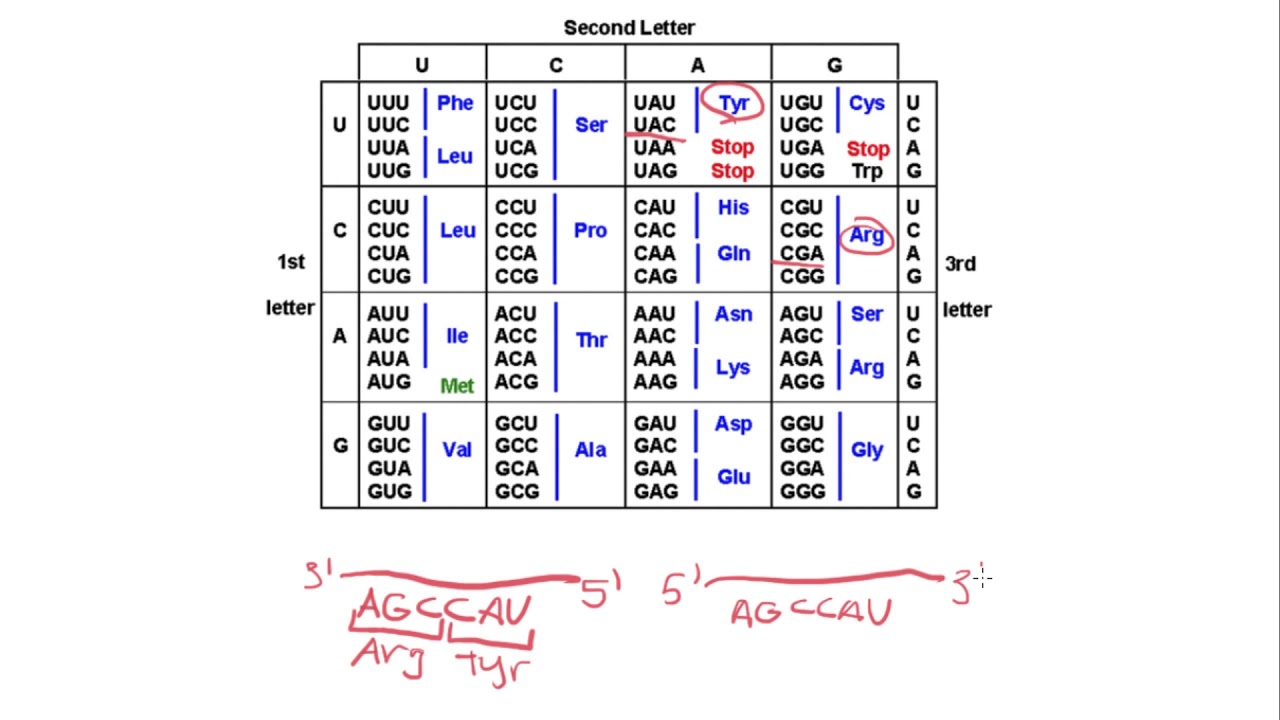
You're staring at a grid of letters—U, C, A, G—and it looks like a bad game of Scrabble. Honestly, the first time most people see a genetic code table, they feel like they’re trying to crack an Enigma code without a manual. But here’s the thing: nature is surprisingly organized. If you’ve ever wondered how your body knows how to turn a sandwich into muscle or skin cells, the answer is tucked away in those tiny three-letter sequences. Knowing how do you use a codon chart isn't just for passing a biology quiz; it’s basically the instruction manual for life itself.
DNA holds the blueprints, sure. But DNA is stuck in the nucleus like a precious library book that can't be checked out. mRNA is the photocopy that travels to the ribosome, the "protein factory." The codon chart is your dictionary to translate that photocopy into the actual building blocks of your body: amino acids.
The Secret Language of Three Letters
Why three? Why not two or four? It’s a math problem that evolution solved billions of years ago. If we used single letters, we’d only have four options (U, C, A, G). That’s not nearly enough to cover the 20 amino acids humans need to survive. If we used two-letter combos, we’d get 16. Close, but no cigar. By using three letters—a "codon"—we get 64 possible combinations.
This creates what scientists call "redundancy." It's nature's failsafe. For instance, if a mutation happens and a letter flips, there’s a decent chance the codon will still code for the same amino acid. It’s like having multiple nicknames that all refer to the same person.
Reading the Grid Like a Pro
Most students and hobbyist geneticists use the square grid version of the chart. It looks intimidating, but it follows a very specific "Outside-In" or "Left-Top-Right" logic.
- Find the First Base: Look at the left side of the chart. This represents the first letter of your triplet. If your codon is AUG, you start in the row labeled "A."
- Find the Second Base: Now look at the top. Find the column for "U." Where that "A" row and "U" column intersect, you’ll find a small box containing four possible amino acids.
- Find the Third Base: Look at the right-hand side of that specific box. Locate the "G." Slide your finger across, and you’ll see that AUG corresponds to Methionine.
It’s basically the world’s tiniest game of Battleship. Instead of sinking a carrier, you’re building a protein.
The Circular Chart: A Different Beast
Some textbooks use a circular codon chart. Personally? I think they're way more intuitive, though they look like a psychedelic dartboard. You start at the very center of the circle with the first letter of your codon. Then, you move outward to the second ring for the second letter, and finally to the outermost ring for the third.
The result is the same. It’s just a different way of visualizing the flow of information. If you’re a visual learner, the circle usually makes the "branching" logic of genetics click much faster than the spreadsheet-style grid.
Why Some Codons are "Special"
Not every codon just stands for an amino acid. Some are the punctuation marks of the genetic world.
Think about it. If the ribosome just kept churning out amino acids forever, you’d end up with a giant, tangled mess of protein that doesn’t do anything. You need a "Start" and a "Stop."
The Start Codon (AUG): This is the "Once upon a time" of every protein sequence. Almost every single protein in your body starts with AUG, which codes for Methionine. It tells the cellular machinery, "Hey, start building here!"
The Stop Codons (UAA, UAG, UGA): These are the "The End." They don't code for an amino acid at all. Instead, they signal the ribosome to release the newly formed protein chain so it can go off and do its job, like carrying oxygen in your blood or fighting off a virus.
Real-World Stakes: When the Chart Changes
While we say the genetic code is "universal," meaning a bacteria and a blue whale use the same chart, there are weird, tiny exceptions. Mitochondria—the "powerhouse" organelles in your cells—actually have their own slightly tweaked version of the codon chart.
This is where things get nuanced. In human mitochondria, the codon UGA isn't a "Stop" signal; it actually codes for Tryptophan. This tiny deviation is a huge piece of evidence for the endosymbiotic theory, the idea that mitochondria were once independent bacteria that got swallowed by larger cells eons ago.
Common Mistakes to Avoid
When learning how do you use a codon chart, it’s easy to trip over the "T" versus "U" problem. DNA uses Thymine (T), but the chart is designed for mRNA, which uses Uracil (U). If you’re looking at a DNA strand that says "TAC," you have to transcribe it to "AUG" before you even touch the chart.
Another pitfall? Forgetting the direction. Ribosomes read mRNA in the $5' \to 3'$ direction. If you try to read it backward, you’re going to get a completely different protein—or more likely, a non-functional pile of molecular junk.
Practical Steps for Mastering the Code
Mastering this isn't about memorizing 64 combinations. Nobody does that unless they're trying to win a very specific type of nerd trivia.
- Practice with Insulin: Look up the DNA sequence for human insulin. Try transcribing a small segment and using the chart to find the amino acids. It makes the abstract concepts feel real when you see how a hormone is actually "spelled."
- Color-Code Your Chart: If you’re using a printed grid, highlight the Start codon in green and the Stop codons in red. Our brains respond to color cues much faster than text.
- Use Online Simulators: Sites like the Concord Consortium offer interactive tools where you can drag and drop bases to see the protein build in real-time. It’s much more engaging than a static piece of paper.
- Double-Check the "Wobble": Remember that the third position in a codon is the most flexible. If you're looking at a mutation and only the third letter changed, check the chart—you might find the amino acid stayed exactly the same.
The beauty of the codon chart is that it bridges the gap between digital information and physical reality. We are, quite literally, programmed. Understanding how to read that program is the first step in understanding the future of gene editing, CRISPR, and personalized medicine.
Next Steps for Mastery
To truly internalize this, grab a blank sheet of paper and try to draw a simplified 4x4 grid. Fill in just the "Start" and "Stop" positions first. Once you have those anchors, pick a random sequence like GCA-UUC-GAG and map it out. You'll find that after about five or six tries, the "coordinates" of the chart become second nature, and you'll no longer need to hunt for the letters. Focus on the transition from DNA to mRNA first, as that is where 90% of errors occur.