You probably remember these from the back of the bus or during a boring math class in third grade. It’s a square of paper, some messy handwriting, and the absolute certainty that if you pick the number seven, you’ll find out which classmate "likes" you. Honestly, it’s one of the few pieces of "ancient" technology that hasn't been replaced by an app. People still ask, how do you make fortune tellers? It’s a fair question because even though the folds are simple, if you mess up that first square cut, the whole thing ends up looking like a crumpled napkin rather than a mystical device.
Paper folding, or origami, is actually pretty technical if you get into the weeds of it. But these things—often called "cootie catchers" depending on where you grew up—are the entry-level drug of the paper-folding world. They’ve been around for decades. Some researchers, like those documenting traditional children's games, suggest they appeared in England and the United States as early as the 1920s, though they were originally used as salt cellars or little stands for incense. Somewhere along the way, kids realized they could hide secrets under the flaps.
Getting the Paper Right (Don't Skip This)
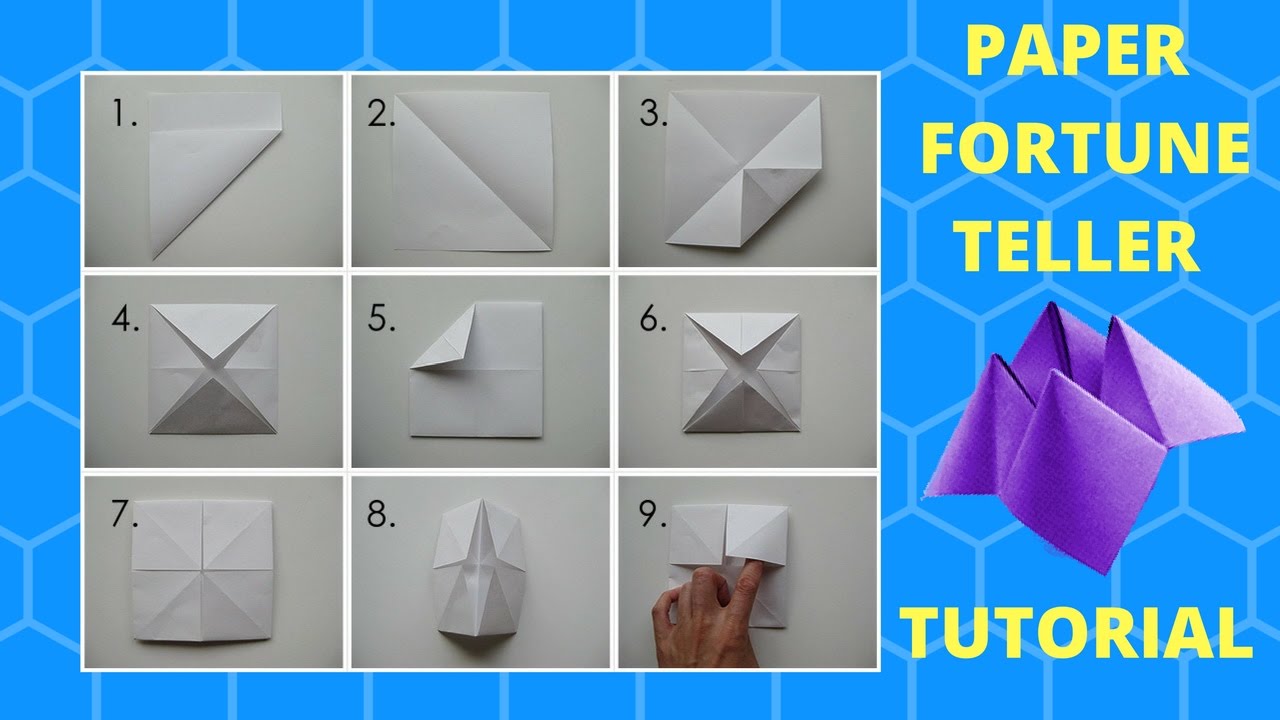
If you start with a standard piece of printer paper, you're already in trouble. It’s a rectangle. Fortune tellers require a perfect square. If you try to wing it with a rectangle, the corners won't meet, and the "beak" of the fortune teller won't open.
Here is what you do. Take the top right corner and fold it down to the left edge. You’ll see a triangle and a leftover strip of paper at the bottom. Cut that strip off. Throw it away. Or make a tiny paper airplane. Now, when you unfold that triangle, you have a perfect square with a diagonal crease. This is your foundation.
Most people use 8.5 x 11 paper because it’s what’s lying around near the printer. But honestly? Construction paper is too thick. It cracks at the seams. Origami paper is okay, but it's often too thin and flimsy for the aggressive "pinching" motion required to operate the fortune teller. Standard copy paper or even a page from a notebook—if you’re careful with those messy perforated edges—works best.
The First Set of Folds
Lay your square flat. You already have one diagonal crease. Fold it the other way to get an "X" crease across the middle. This finds your center point. If you don't find the center, your fortune teller will be lopsided.
Now, "Blintz" it. That’s a real origami term, by the way. Fold each of the four corners into that center point. It should look like a smaller square or an envelope. Crease these hard. Use your fingernail. Professional folders often use a "bone folder" tool to get these edges crisp, but your thumb works just fine.
Turning the Corner
Flip the whole thing over. You should see a smooth surface with four faint lines meeting in the middle. Repeat the process. Fold those new corners into the center again. This is where the paper starts to get a bit stiff. You’re layering the paper on top of itself, and if you aren't precise, the center where all the points meet starts to get crowded and messy.
Once you’ve folded those corners in, you have a very small square. Fold it in half to make a rectangle. Crease it. Unfold it. Fold it in half the other way. Crease it. This "breaks in" the paper so it moves easily.
Putting it Together
Slip your thumbs and index fingers into the four pockets underneath. Gently push the corners toward the center. The flaps should pop up. It takes a second of wiggling to get the shape right. If it resists, don't force it—just re-sharpen those creases you made earlier.
The Art of the Reveal
The mechanism is only half the battle. Now you have to write the content. This is where most people get stuck. There’s a specific hierarchy to how these are labeled.
- The Outside Flaps: These are usually colors. Red, Blue, Green, Yellow.
- The Inside Flaps: When you open the teller, you see eight triangles. These are numbers.
- The Fortunes: Underneath the number flaps, you write the actual "answers."
Why numbers and colors? It’s about the "count." If someone picks "Blue," you spell it out: B-L-U-E. For every letter, you move the fortune teller back and forth. Then they pick a number. You move it that many times. Finally, they pick a second number, and that’s the flap you lift.
What to Write Under the Flaps
Honestly, you can go classic or weird with this.
- Classic "Schoolyard" Style: "You will get an A on your test," "You will marry a millionaire," or the dreaded "You have cooties."
- The Decision Maker: Use it to decide what’s for dinner. Pizza, Tacos, Salad (yikes), or Burgers.
- The Truth or Dare: Write a "truth" on four flaps and a "dare" on the other four.
One thing to watch out for: make sure you use a pen that doesn't bleed through the paper. There’s nothing worse than a fortune teller where you can see "YOU WILL BE A LOSER" through the back of the paper before the game even starts.
The Math Behind the Paper
There is actually some pretty cool geometry happening here. When you fold the corners to the center, you’re essentially dividing the area of the square by half each time. This is a practical application of symmetry. Mathematicians often use these shapes to explain "tessellation" and how flat surfaces can be transformed into three-dimensional objects.
In some educational settings, teachers use them to teach vocabulary. One side has the word, the flap has the definition. It’s a tactile way to learn. It turns a boring rote memorization task into a game.
Common Mistakes
If your fortune teller won't open or feels like it's going to rip, check your center points. If the corners overlap in the middle, they’ll catch on each other when you try to operate the device. You want the points to almost touch, but leave a hair of breathing room—maybe a millimeter.
Also, watch the "grain" of the paper. Most paper has a grain based on how the fibers were laid down during manufacturing. It folds easier in one direction than the other. If you find the paper is cracking, you might be working against the grain.
Making It Last
Most paper fortune tellers have a lifespan of about twenty minutes before they get crushed in a pocket. If you want a "pro" version, you can use cardstock, though you'll need to score the lines with a dull knife first to get them to fold.
Some people use "Washi" paper, which is a Japanese paper made from long fibers. It’s incredibly strong and won't tear at the corners even after hundreds of uses. It’s also beautiful, which helps if you’re using these as wedding favors or dinner party place cards—a trend that’s actually picking up steam in the DIY event world.
Moving Toward Advanced Folding
Once you've mastered the question of how do you make fortune tellers, you’ve actually learned the "Blintz Base." This is a fundamental starting point for much more complex origami. From here, you’re only a few steps away from a paper crane or a flapping bird.
It’s about the folds. Precise, sharp, intentional.
Practical Next Steps
Ready to actually build one? Grab a sheet of paper right now. Don't worry about being perfect on your first try.
- Step 1: Create your square. Fold that corner over and trim the excess.
- Step 2: Mark your center by folding both diagonals.
- Step 3: Fold all corners to the center. Flip it. Fold all new corners to the center.
- Step 4: Number your triangles from 1 to 8.
- Step 5: Write your fortunes underneath the flaps. Make them specific—generic fortunes are boring.
- Step 6: Color the four outside squares.
Experiment with different sizes. Tiny ones made from Post-it notes are surprisingly difficult but look cool. Huge ones made from newspaper are hilarious but tend to flop over. Just keep folding. The more you do it, the more your muscle memory takes over, and soon you'll be able to fold one under a desk without even looking.