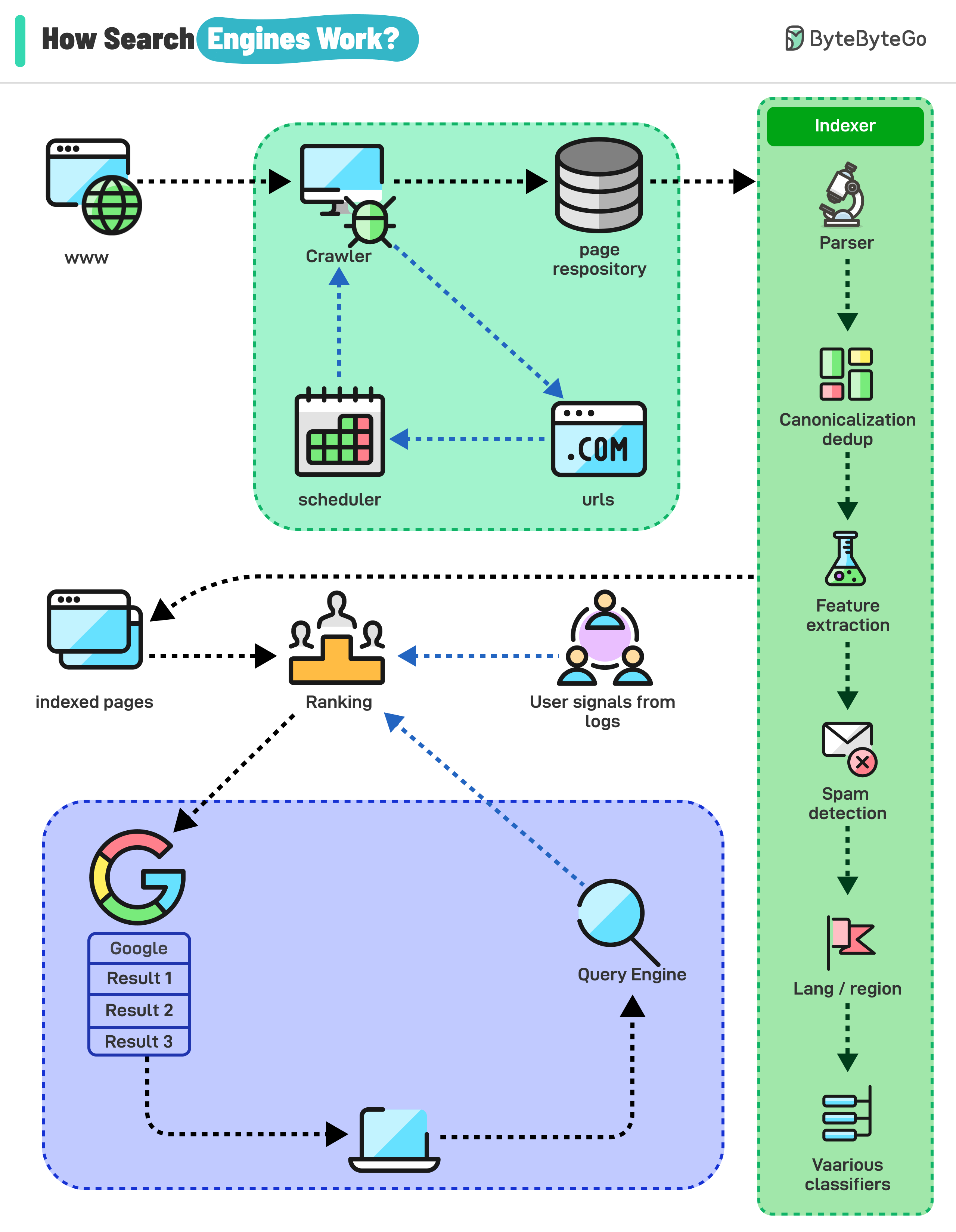
You type a word. You hit enter. In about 0.2 seconds, you’re looking at ten blue links that seem to know exactly what was in your head. It feels like magic, honestly. But behind that search bar is a massive, noisy, and incredibly expensive machine that’s basically trying to organize the entire history of human thought in real-time.
People talk about "the algorithm" like it’s a single, sentient brain sitting in a server room in Mountain View. It isn't. It’s a mess of different systems—crawlers, indexers, and rankers—all tripping over each other to decide if your blog post about sourdough starter is actually better than the 50 million others out there. Understanding how do search engines work isn't just for tech geeks anymore. If you have a business, a brand, or just a curiosity about why you keep seeing the same three websites at the top of every search, you have to look under the hood.
The Spider in the Web: How Discovery Actually Happens
Before Google can show you a result, it has to know it exists. This is the "crawling" phase. Imagine a digital spider—software called Googlebot—that never sleeps. It spends every second of every day clicking every link it can find. It’s a chain reaction. It finds Page A, follows a link to Page B, then discovers Page C through a footer link.
If your site isn't linked to from anywhere, Google might never find it. Seriously. It’s like a party where you only get in if you’re on the guest list of someone already inside. This is why "backlinks" are such a huge deal in the SEO world. They aren't just "votes" for your content; they are the physical paths the crawlers take to discover you.
But here’s the kicker: search engines don’t crawl everything. They have a "crawl budget." Google isn't going to spend its precious electricity and server power on a site that hasn't updated since 2012 or a page that takes ten seconds to load. If your site is slow, the spider gets bored and leaves. It’s brutal.
The Index: A Library With No Shelves
Once the crawler finds a page, it doesn't just "save" it. It parses it. This is where the indexer comes in. Think of the Index as a massive database—the largest library in human history. But instead of organizing books by author, it organizes them by every single word on every single page.
When you ask how do search engines work, you’re really asking how they retrieve information from this index. When Google indexes a page, it’s looking at:
- The HTML code.
- The headers ($H1$, $H2$, etc.).
- The metadata (those snippets you see on the results page).
- The "alt-text" on images (because Google still struggles to "see" images like humans do).
It’s all about signals. If you mention "blue shoes" fifty times, the indexer marks that page as being highly relevant to blue shoes. But it also looks for semantic cues. It knows that if you're talking about "blue shoes," you might also be interested in "sneakers," "footwear," or "Nike." It’s building a map of meaning, not just a list of words.
Ranking: The 200-Ingredient Secret Sauce
This is the part everyone cares about. Ranking is the process of sorting the billions of pages in the index to find the "best" one for your specific query. Google uses hundreds of ranking factors. Nobody knows all of them—not even the engineers at Google, because many of these factors are now handled by machine learning systems like RankBrain and SpamBrain.
The Big Three: Content, Links, and RankBrain
For a long time, we thought we had it figured out. High-quality content + lots of links = Number 1 spot. That’s still mostly true, but it’s gotten way more complicated.
Content Quality (E-E-A-T)
Google’s latest obsession is E-E-A-T: Experience, Expertise, Authoritativeness, and Trustworthiness. This is why you’ll notice that for medical searches, you almost always see Mayo Clinic or WebMD. Google doesn't want to rank a random blog post about heart surgery written by a teenager. They want to see that the author actually knows what they’re talking about. They check for credentials. They check if other reputable sites cite you.
The Link Economy
Backlinks are still the "currency" of the internet. But not all links are equal. One link from the New York Times is worth more than 10,000 links from random, spammy directories. Google’s Penguin update years ago essentially killed the "link farm" industry, yet people still try to game the system. Don't. Google is very good at spotting "unnatural" link patterns. If a thousand Russian bot sites suddenly link to your local bakery, Google knows something is up.
RankBrain and Intent
This is where it gets spooky. RankBrain is Google’s AI system that helps it understand the intent behind a search. If you search for "apple," do you want the fruit, the tech company, or the record label? RankBrain looks at your location, your search history, and what other people clicked on when they searched the same thing. If most people who search "apple" in September are looking for the new iPhone, Google will prioritize tech news over fruit recipes.
Why Speed and Mobile Matter More Than You Think
Back in the day, we did all our searching on clunky desktops. Now? It’s all phones. Google moved to "mobile-first indexing" a while ago. This means Google looks at the mobile version of your website to decide where to rank you, even if someone is searching from a desktop.
If your mobile site is a mess—if the text is too small, if buttons are too close together, or if it takes forever to load on a 4G connection—you’re going to get buried. The "Core Web Vitals" are a set of metrics Google uses to measure this "page experience." They’re looking for things like "Largest Contentful Paint" (how fast the main stuff loads) and "Cumulative Layout Shift" (whether things jump around while the page is loading).
Nobody likes a website that jitters. Google knows this. User experience (UX) is no longer a "nice-to-have"; it’s a core part of how do search engines work in the modern era.
The Myth of "Freshness"
There’s a common misconception that you need to post every day to stay relevant. That’s not quite how it works. Google does have a "Query Deserved Freshness" (QDF) algorithm. If you search for "breaking news," Google will prioritize pages published in the last ten minutes.
However, for "evergreen" topics—like "how to tie a tie"—a well-written article from 2018 might still be the #1 result because it’s comprehensive and has accumulated years of trust. You don't need to chase the clock unless you're in the news business. You need to chase the "answer."
A Note on Local Search
If you search for "pizza near me," the algorithm shifts entirely. It stops looking at global authority and starts looking at "proximity, prominence, and relevance." It uses your GPS data and your Google Business Profile. This is a separate "map pack" algorithm that works alongside the main web search. It's why a tiny pizza shop with 500 five-star reviews can outrank Dominos in a local search.
The Future: Generative AI and Search
We can't talk about how do search engines work in 2026 without mentioning AI Overviews. Google is no longer just a list of links; it’s becoming an "answer engine."
Using large language models (LLMs), Google now summarizes the web for you. This has caused a lot of panic among creators. "If Google gives the answer on the search page, why would anyone click my link?" It’s a valid question. The reality is that search is shifting toward "zero-click" results.
To survive this, content has to be more than just facts. Facts can be summarized by AI. But personal experience, unique opinions, and deep, nuanced reporting cannot. The sites that are still winning are the ones that provide "information gain"—that is, they say something that isn't already in the top five results.
Actionable Steps for Navigating Search Today
Understanding the theory is fine, but if you're trying to actually rank, you need a plan. The "game" hasn't changed as much as people think, but the barrier to entry is higher.
- Audit your "crawlability." Use Google Search Console. If Google is reporting "Indexed, though blocked by robots.txt" or "Crawl anomaly," you have a technical problem that no amount of good writing will fix.
- Solve for "Search Intent." Before you write a single word, Google your target keyword. Look at what’s already ranking. If the top results are all videos, you probably shouldn't write a 2,000-word essay. If the results are all "how-to" guides, don't try to rank a product page. Give Google what it clearly thinks the user wants.
- Optimize for People, Not Spiders. Write for the person who is stressed, in a hurry, or looking for a laugh. Use short sentences. Use bold text. Make it easy to skim. Google tracks "dwell time" and "pogo-sticking" (when someone clicks your link and immediately hits the back button). If people hate your page, Google will too.
- Build a "Topic Cluster." Don't just write one article about a topic. Write ten. Link them together. This shows Google that you aren't just a one-hit-wonder; you’re a topical authority.
The internet is getting louder. Every day, millions of new pages are indexed. The way search engines work is designed to filter out the noise and find the signal. If you want to be the signal, you have to be useful, fast, and trustworthy. There are no shortcuts left. Just better ways to be helpful.