You’re bored. You’ve got five minutes before a meeting, or maybe you're just hiding from a sink full of dishes. You open a tab, search for a free basic solitaire game, and suddenly, twenty minutes have vanished. It’s the ultimate digital fidget spinner. But honestly, have you ever wondered why this specific arrangement of 52 virtual cards has survived every tech revolution from Windows 3.1 to the smartphone era? It’s not just about killing time. It’s about that weirdly specific dopamine hit you get when a red six snaps onto a black seven.
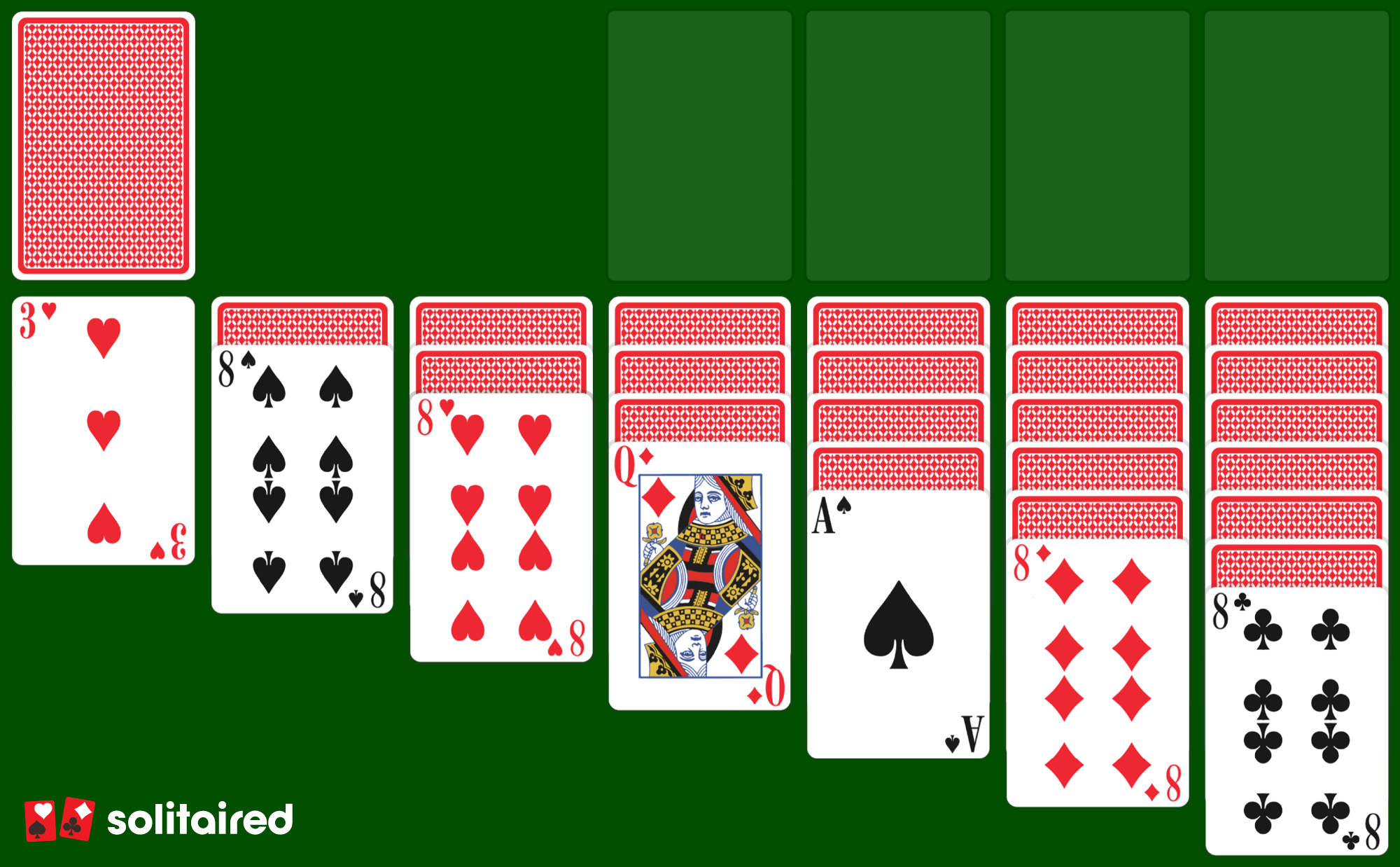
Solitaire isn't actually one game. It's a massive family of "patience" games, but when most people go looking for a basic version, they want Klondike. That's the gold standard. It’s the version where you deal out seven piles and hope to heaven you don't get a block of four Kings right at the start.
The Microsoft Effect and Why We’re Still Hooked
Most of us got our first taste of a free basic solitaire game because of Wes Cherry. He was an intern at Microsoft back in 1988 who coded the version that eventually shipped with Windows 3.0. Interestingly, Microsoft didn’t include it just to be nice. They had a hidden agenda. They needed to teach people how to use a mouse. Back then, "drag and drop" wasn't a natural human instinct; it was a new technical skill. By forcing people to move virtual cards around, Microsoft sneakily trained an entire generation of office workers to navigate a graphical user interface.
It worked too well.
The game became so ubiquitous that it started causing actual productivity crises in the 90s. In 2006, New York City Mayor Michael Bloomberg famously fired a city employee after seeing a game of solitaire open on the man's computer screen during a literal office walkthrough. It’s that addictive. Even now, with high-definition VR and ray-traced shooters, a simple deck of cards remains the most-played genre on the planet.
How a Basic Game Actually Works (The Math is Brutal)
Don't let the "basic" label fool you. The math behind a free basic solitaire game is actually kind of terrifying. In a standard Klondike game, there are $8 \times 10^{67}$ possible ways to shuffle a 52-card deck. That’s an eight followed by 67 zeros.
Is every game winnable?
Short answer: No. Long answer: It’s complicated. Mathematicians have spent a ridiculous amount of time trying to figure out the "win rate" of Klondike. Persi Diaconis, a famous mathematician and former professional magician at Stanford University, has actually studied the randomness of card shuffling extensively. While we don't have a perfect "winnability" number for every single shuffle, researchers generally estimate that around 80% to 90% of games are theoretically winnable if you play perfectly. But since we can't see the face-down cards, our actual win rate usually hovers around 10% to 15%.
The Draw-1 vs. Draw-3 Debate
This is where the community gets heated. If you’re playing a free basic solitaire game online, you’ll usually see an option to draw one card at a time or three.
- Draw-1 is basically "Easy Mode." It’s relaxing. It’s what you play when you want to feel like a genius without trying.
- Draw-3 is the real deal. It limits your choices and forces you to think three steps ahead. If you pull a card you need, it changes the order of the entire deck for the next pass.
Most purists argue that Draw-3 is the only "real" way to play because it requires actual strategy rather than just clicking until you win. If you’re looking to improve your brain health—which many people do with these games—Draw-3 is the version that actually makes your neurons sweat a little.
Why "Free" Isn't Always Free
If you’re searching for a free basic solitaire game today, you have to be careful. The App Store and Google Play are littered with versions that are basically delivery systems for ads. You move a card, you watch a 30-second clip of a fake kingdom being flooded. It ruins the flow.
The best versions are the ones that stay out of your way. Google actually has a built-in version if you just type "solitaire" into the search bar. No download, no fluff. Many people also flock to sites like Solitr or the World of Solitaire. These sites have stayed popular for decades because they understand the assignment: green felt, clear card faces, and a "New Game" button that works instantly.
Does it actually help your brain?
There’s a lot of talk about "brain training" apps, but basic card games are arguably just as good. A study published in the Journal of Gerontology suggested that engaging in cognitively demanding leisure activities—like card games—can help maintain cognitive function in older adults. It's about pattern recognition. You’re scanning for colors, numbers, and suits while simultaneously planning a sequence of moves. It’s a low-stakes way to keep the mental gears greased.
Strategies That Actually Move the Needle
Stop just moving cards because you can. That's the biggest mistake people make in a free basic solitaire game. You see a red five, you see a black six, you click. Wait.
Look at your columns first.
The goal isn't to move cards; it's to uncover the face-down cards. If you have a choice between moving a card from the deck or moving a card from a pile to uncover a hidden one, always choose the pile. You need information. You need to know where those Kings are hiding.
Another tip: Don't empty a spot unless you have a King ready to move into it. An empty column is a wasted resource if it stays empty. It’s basically a graveyard for your momentum.
The Future of the Deck
Even in 2026, we’re seeing "Solitaire 2.0." Developers are adding RPG elements, leveling systems, and battle passes to what used to be a quiet solo experience. But honestly? The "basic" part of free basic solitaire game is what people actually want. We don't need loot boxes. We just want to see that fountain of cards bouncing across the screen when we finally clear the board.
It’s a digital comfort food. It’s reliable. In a world of complex, high-stress gaming, the simple logic of a deck of cards is a relief.
Actionable Steps to Level Up Your Game
If you want to move past mindless clicking and actually start winning more consistently, follow these specific rules of thumb:
- Expose the large piles first. If you have a choice of which face-down card to uncover, go for the pile that has the most cards in it.
- Don't build your foundations too fast. It’s tempting to shove every Ace and Two up to the top immediately. Don't. Sometimes you need those low cards to move other piles around on the main board. If you lock them away too early, you might get stuck.
- Target the 5s, 6s, 7s, and 8s. These are the "pivot" cards. They are the most versatile for building stacks.
- Play the Draw-3 version for 10 minutes a day. If you’re using the game for mental sharpness, the Draw-3 variant forces higher-level pattern recognition that Draw-1 simply doesn't require.
- Use the "Undo" button sparingly. If you want to actually get better, live with your mistakes. It forces you to think more carefully about your next opening.
The next time you open a free basic solitaire game, remember you're participating in a tradition that spans hundreds of years, from French aristocrats to Microsoft interns. It’s a perfect loop of problem-solving and payoff. Just try not to get fired by the Mayor while you're at it.
.png)