You’re sitting there at 11:00 PM with a half-empty energy drink and a PDF open that claims it’s a "full-length exam." But something feels off. The questions are a little too easy, or maybe the rhetorical analysis prompt feels like it was written by someone who hasn't seen a College Board update since 2012. It’s frustrating. Honestly, most of what you find when you search for an ap language practice test is total filler. It’s either outdated content or generic "SAT-lite" questions that don’t capture the actual grind of the AP English Language and Composition exam.
The stakes are real. If you land a 4 or a 5, you’re looking at skipping freshman comp in college, which saves you thousands of dollars and dozens of hours of repetitive "how to write a thesis" lectures. But you can't get there by just reading. You have to do. You need reps.
Getting your hands on high-quality practice material is basically the only way to calibrate your brain for the way the College Board thinks. They have a very specific, almost clinical way of asking how a writer’s syntax contributes to their tone. If you aren't practicing with the right material, you're essentially training for a marathon by playing Wii Fit. It's not the same thing.
Why Your AP Language Practice Test Might Be Lying to You
Not all practice tests are created equal. In fact, many of them are downright predatory. You'll see sites offering a "Free AP Language Practice Test" only to find out it’s a ten-question quiz designed to get your email address. Real practice requires the full 2 hour and 15 minute commitment for the free-response section and the intense 60-minute sprint for the 45 multiple-choice questions.
The biggest problem? The 2019-2020 curriculum overhaul. The College Board fundamentally shifted how they categorize questions. They moved toward "Big Ideas" and specific "Unit Guides." If your practice test is still asking about obscure rhetorical terms like synecdoche or metonymy in every other question, it’s a relic. Modern exams care way more about the function of the writing—how a claim is supported—rather than just naming the tool the author used.
You need to look for exams that mirror the current "Course and Exam Description" (CED). This document is the bible for AP teachers. It dictates that multiple-choice questions now fall into two camps: reading questions and writing questions. The "writing" questions are the ones that really trip people up. They ask you to "revise" a draft, which is a relatively new addition to the format. If your practice material doesn't have these "Composition" style questions, toss it in the digital trash.
The Gold Standard: Released Exams
Nothing beats the real thing. The College Board occasionally releases full, previously administered exams. These are the "Operational" exams. Because they were actually used in May of previous years, the difficulty scaling is perfect. You can find the 2012 and 1987 released exams floating around online, but be careful. While the reading passages are still great for practice, the format is prehistoric.
Instead, lean on the "Progress Checks" in AP Classroom. If your teacher hasn't unlocked these for you, beg them. These are the most accurate ap language practice test modules in existence because they are written by the same people who write the actual May exam. They use the same interface, the same timer, and the same logic.
Cracking the Multiple Choice Without Losing Your Mind
The multiple-choice section (MCQ) is a beast. 45 questions. 60 minutes. That’s roughly 1 minute and 20 seconds per question, but that doesn't account for the time you spend actually reading the dense, academic passages. Most students fail here because they read too slowly or they "over-interpret."
Here is the truth: the answer is always in the text.
It sounds simple, but it’s not. The College Board loves "distractors." These are answer choices that are partially true but contain one word that makes the whole thing wrong. If an answer choice says the author "condemns the audience's apathy," but the author was actually just "mildly critiquing" it, that answer is wrong. Tone is everything. You have to be a detective, not a philosopher.
Try this next time you take an ap language practice test: read the questions first. Not all of them—just the ones that point to specific line numbers. It gives your brain a "Search and Destroy" mission. You aren't just reading a 19th-century essay about the ethics of labor; you're looking for why the author used a semicolon in line 42. It makes the reading active rather than passive.
The "Composition" Questions: The New Frontier
About 45% of the MCQ now focuses on your ability to "think like a writer." These questions present a draft of an essay and ask you to improve it.
- Which version of the underlined text best introduces the main argument?
- The writer wants to add a transition... which one works best?
- Should the writer delete this sentence?
These are actually easier than the reading questions if you know the rules. They test "Coherence" and "Development." Basically, they want to see if you understand how to move from a claim to evidence without sounding like a robot. If you're practicing with an old 2015 prep book, you're missing this entire section. You're effectively leaving points on the table.
The FRQ Triple Threat: Synthesis, Rhetorical Analysis, and Argument
The second half of the exam is where the "Language" part of AP Lang really happens. You have three essays to write in roughly two hours. It's a marathon for your wrists.
The Synthesis essay is the one everyone likes. It’s like a DBQ (Document-Based Question) for history nerds. You get 6-7 sources and have to argue a position. The trick? Don’t let the sources run the show. You are the conductor; the sources are just the instruments. Use them to support your point. If you find yourself just summarizing what Source A said, you're headed for a 2 on the rubric.
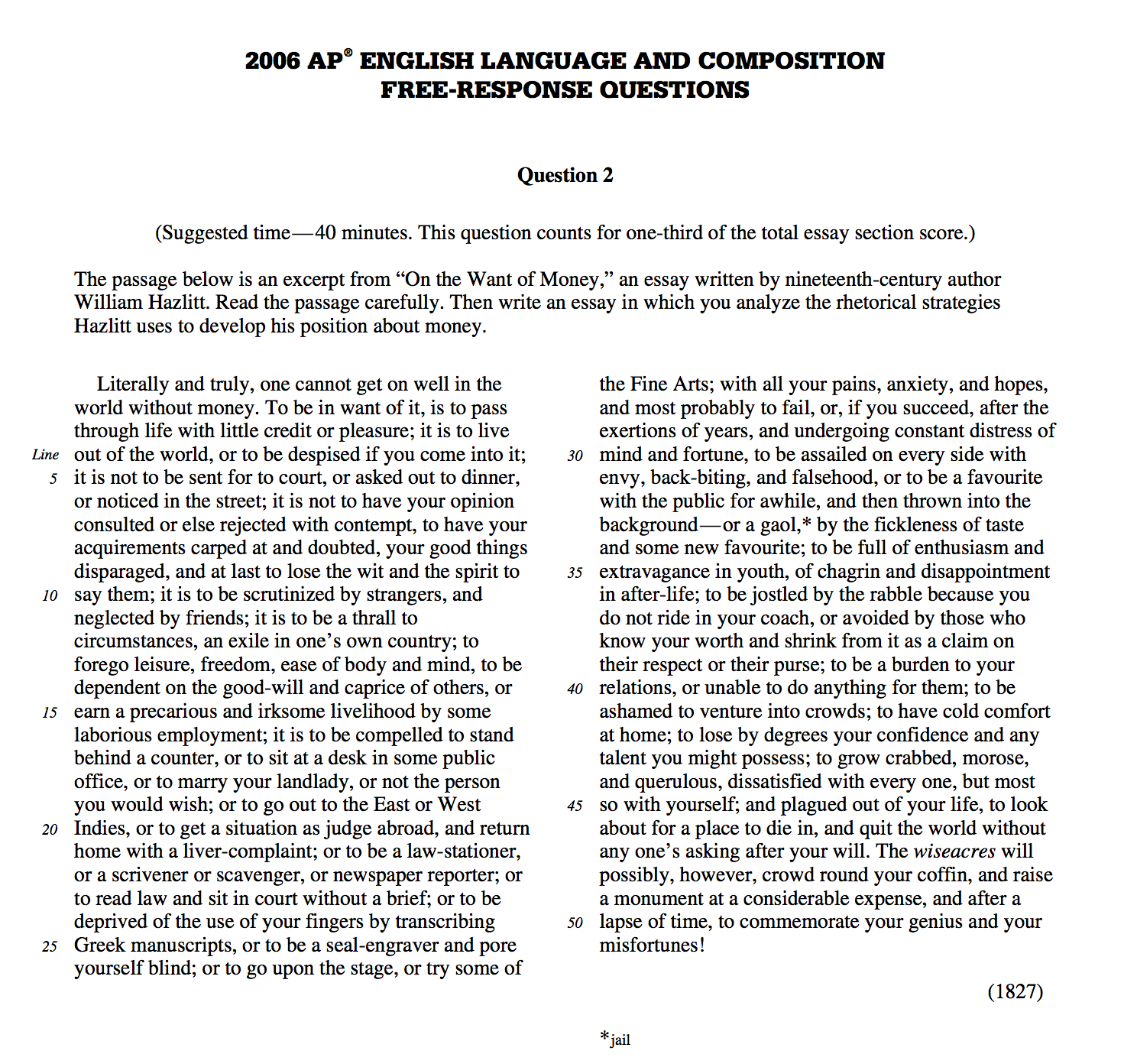
Then there’s Rhetorical Analysis (Q2). This is the "Why" essay. You are analyzing how a writer's choices—diction, structure, anecdotes—work to persuade a specific audience. You have to understand the "Rhetorical Situation." Who is the speaker? What is the exigence (the spark that made them write)? Who is the intended audience? If you can't answer those three things, your essay will be shallow.
Finally, the Argument essay (Q3). This is pure freedom, which is why it’s terrifying. You get a prompt, and you have to argue a position using your own knowledge. No sources. Just your brain. You can use history, current events, literature, or personal experience. But please, for the love of your score, don't use "The Great Gatsby" as your only example for every single prompt. It’s a cliché that AP readers see thousands of times a day. Use specific, nuanced examples from real life or history. Think about the ethical implications of AI or the psychological impact of social media.
Where to Find Quality Practice Materials Today
So, where do you actually go? If you want a legitimate ap language practice test, you have to be picky.
- The College Board Website: They have "Sample Questions" and "Scoring Comps" for every year. Look at the 2023 and 2024 samples. Read the student responses that earned a 6 (the highest score on the 6-point rubric). Understanding why a student got the "Sophistication Point" is better than any textbook explanation.
- CrackAP: It’s an old-school looking site, but they have a massive repository of MCQ sets. They are broken down by category, which is great for targeted practice.
- Albert.io: This is usually a paid service schools buy, but their free tier has some decent practice questions. Their explanations for why an answer is wrong are top-tier.
- Barron’s and Princeton Review: These are the "Old Guard." They are fine, but their practice tests are often slightly harder than the real thing. If you’re scoring a 3 on a Barron’s test, you’re probably looking at a 4 on the real exam. Don't let their difficulty discourage you.
Avoiding the "I'll Just Read It" Trap
The biggest mistake students make with an ap language practice test is reading the questions and thinking, "Yeah, I would have gotten that."
You wouldn't.
Under the pressure of a ticking clock, your brain does weird things. You start second-guessing your ability to identify a metaphor. You forget how to spell "rhetorical." You have to simulate the environment. Put your phone in another room. Use a timer. Use a black or blue pen for the essays. If you don't practice the physical act of writing for two hours straight, your hand will cramp by the middle of the second essay in May.
Scoring Your Own Work: The Hard Truth
Taking the test is only 50% of the work. The other 50% is scoring it. This is easy for multiple choice—you're either right or wrong. But scoring your own essays is incredibly difficult because we all think our writing is better (or worse) than it actually is.
Use the official 6-point holistic rubric.
- 1 Point for Thesis: Is it defensible? Is it an opinion, or just a fact?
- 4 Points for Evidence and Commentary: This is the meat. Do you explain how the evidence supports the thesis? Or do you just drop a quote and move on?
- 1 Point for Sophistication: This is the "Unicorn Point." You get it for having a particularly vivid prose style or for exploring the complexities and tensions of the prompt. Don't obsess over this point; focus on getting the 4 in evidence.
If you can, find a "study buddy." Swap essays and score each other’s work using the rubric. Being a "grader" for someone else's work actually makes you a better writer because you start to see the common mistakes people make—like "floating quotes" or circular reasoning.
Turning Practice into Progress
Don't just take practice tests. Analyze your failures. If you keep missing questions about "Claims and Evidence," go back and study the logical fallacies. If your rhetorical analysis essays are consistently getting a 2 in evidence, work on your "line of reasoning."
The AP Language exam isn't an IQ test. It’s a "How Well Do You Understand How Language Works" test. It’s a skill. And like any skill—whether it’s shooting free throws or playing the cello—it requires boring, repetitive, high-quality practice.
Stop scrolling and start a timer.
Actionable Steps to Boost Your Score Now
- Download the 2024 Free Response Questions (FRQs): These are available on the College Board site. Don't write the whole thing yet. Just spend 15 minutes outlining a thesis and three main points for the Synthesis prompt.
- Master the "Verb of Analysis": Stop saying the author "shows" or "uses." Start using words like juxtaposes, elucidates, lionizes, disparages, or advocates. Precise verbs lead to precise analysis.
- The 10-Minute Reading Rule: For the Synthesis and Rhetorical Analysis sections, spend a solid 10-15 minutes just reading and annotating. If you start writing too early, you'll run out of things to say by page two.
- Audit Your Multiple Choice: Take a 20-question practice set. For every one you got wrong, write down exactly why the correct answer is better than yours. If you can't explain why you were wrong, you haven't learned anything.
- Simulate the "Composition" Section: Find a practice test specifically updated after 2020. Focus on the questions that ask you to "add a sentence to provide a transition between the second and third paragraphs." These are the easiest points to pick up if you understand paragraph flow.
The path to a 5 isn't through a "miracle" study guide. It’s through the dirt. It’s through the frustration of a 55% on an ap language practice test in March so that you can hit an 85% in May. Get to work.