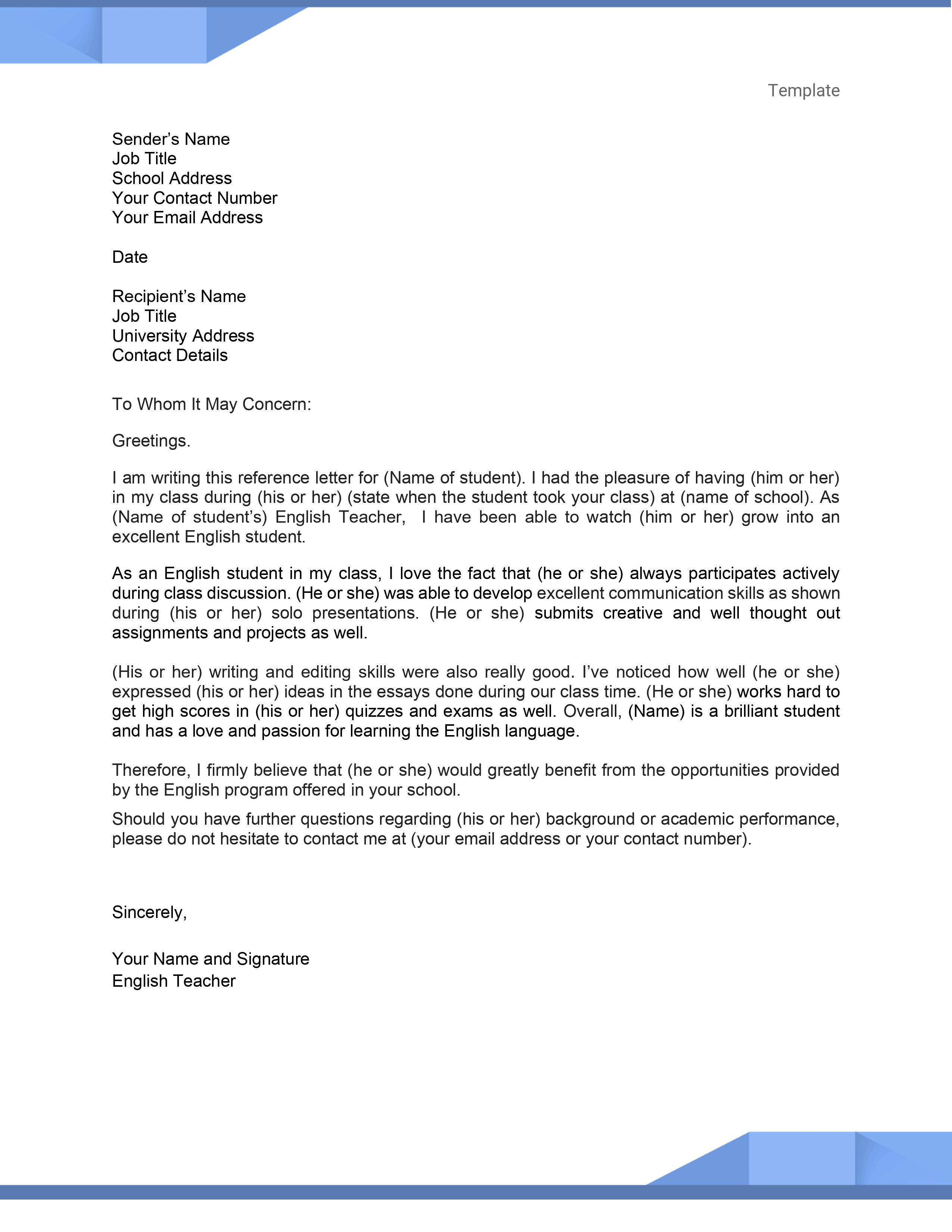
You're sitting there staring at a blinking cursor, trying to figure out how to condense a human being's entire academic potential into three paragraphs. It's tough. Whether you're a professor who has written a thousand of these or a supervisor who just got asked for a favor, the pressure is real. A bad letter is just a piece of paper, but a great one? That's a golden ticket. Honestly, most people look for a reference letter example for student applications because they want to see the "secret sauce" that makes an admissions officer stop scrolling.
The truth is, most examples online are garbage. They’re stiff. They sound like a robot wrote them in 1995. If you want a student to actually stand out for a scholarship or a competitive Master’s program, you have to ditch the clichés. "Hardworking" is a dead word. "Team player" is white noise. You need specifics.
Why the Standard Reference Letter Example for Student Use Usually Fails
Let’s be real for a second. Admissions committees at places like Harvard or even the local state college read hundreds of these every week. They can smell a template from a mile away. If your letter looks exactly like the first three results on a Google search, you’re basically telling the committee that the student is "average."
Most templates rely on what I call "hollow praise." This is when you say a student is "diligent" but don't explain the time they stayed until 9:00 PM to recalibrate a microscope. Or you say they have "leadership skills" without mentioning how they managed a chaotic group project when two members ghosted the team. Specificity is your best friend here. If you can't picture the student doing the thing you're writing about, the letter isn't finished.
The impact of a strong letter is massive. According to data from the National Association for College Admission Counseling (NACAC), while grades and test scores are king, "teacher and counselor recommendations" consistently rank as a top-tier moderate-to-high importance factor for admissions. For private colleges, that importance jumps even higher.
The Anatomy of a Letter That Works
You don't need a formal "Dear Sir or Madam" anymore. "To the Admissions Committee" works just fine. You want to start with a hook. Not a "I am writing to recommend" hook—everyone does that. Try starting with a moment. "In my twelve years of teaching Organic Chemistry, I have rarely seen a student approach a failed experiment with the level of curiosity shown by [Student Name]."
That's a hook. It shows the student's character right away.
Then, you move into the meat of the letter. This is where you talk about the "Academic vs. Personal" balance. A lot of people think a reference letter example for student success should just be a list of grades. Wrong. The transcript already shows the grades. Your job is to tell the stories the transcript can't. Talk about their intellectual grit. Talk about how they handle criticism.
A Realistic Illustrative Example for a High-Achieving Student
Let’s look at how this actually translates to the page. Imagine you’re writing for a student named Alex who is applying for a competitive internship or a grad program.
"Alex didn't just sit in the front row of my Advanced Macroeconomics class; they essentially acted as a secondary facilitator. During a particularly dense lecture on fiscal policy, Alex asked a question that shifted the entire classroom's understanding—connecting a theoretical model to a local economic crisis that had happened just months prior. This wasn't just 'participation.' It was an exhibition of a mind that refuses to see data in a vacuum."
See what happened there? We didn't say Alex is "smart." we showed Alex being smart. We showed Alex being engaged.
What if the student is just "okay"?
This is the awkward part. Sometimes you're asked for a letter by a student who was... fine. Not a superstar, but not a disaster. You don't want to lie. Never lie. If you find yourself looking for a reference letter example for student use because you’re struggling to find something nice to say, focus on growth.
Focus on the "Distance Traveled." Maybe they started the semester with a C and fought their way to a B+. That shows more character than the kid who walked in with an A and stayed there without trying. Admissions officers love a "growth arc." Use it.
The Logistics Most People Forget
- The Letterhead Matters: If you have official university or company letterhead, use it. It adds a layer of "this is official" that a plain Word doc lacks.
- The Signature: If possible, scan a real signature. It looks more personal than a typed name in a script font.
- The Contact Info: Always include your direct line or email. It signals that you’re willing to stand by your words if they have questions.
I’ve seen letters that were literally two sentences long. "Sarah was in my class. She got an A. I recommend her." Honestly? That’s worse than no letter at all. It tells the reader that you couldn't be bothered to think of a third sentence. It’s a "soft no" in the eyes of an admissions officer.
Dealing with the "Draft it for me" request
Sometimes a student will ask, "Can I write a draft and you just sign it?"
This is common. It’s also a trap.
While it saves you time, students are usually terrible at writing about themselves. They either sound too arrogant or too humble. If you go this route, use their draft as a "fact sheet." Take the dates and project names they give you, but rewrite the sentiment in your own voice. Your voice is what the university is looking for. They want the "expert" perspective.
Key Phrases to Avoid (And What to Use Instead)
We need to kill the "Inspiration Porn" style of writing. Avoid saying a student is an "inspiration to all who meet them." It's cheesy. It sounds fake.
Instead of: "He is a natural leader."
Try: "He has a knack for delegating tasks without making his peers feel sidelined."
Instead of: "She is very organized."
Try: "She managed three different lab schedules while maintaining her own research deadlines without a single lapse."
Instead of: "They are a pleasure to have in class."
Try: "Their presence in the seminar consistently raised the level of discourse among their peers."
The Final Check Before You Send
Before you hit "save as PDF" on that reference letter example for student draft you’ve been working on, read it out loud. Seriously. If you stumble over a sentence, it's too long. If you get bored reading your own writing, the admissions officer definitely will.
Check for the "Three Pillars":
- Context: How do you know them? (I taught them for 2 years).
- Evidence: What did they do? (The specific project or moment).
- Future Casting: Why will they succeed there? (Because their work ethic fits your rigorous curriculum).
Actionable Steps for the Letter Writer
- Request the Resume: Ask the student for their latest CV and a "brag sheet." This gives you the raw material so you don't have to hunt for dates or specific titles.
- Ask for the "Why": Ask the student why they want this specific program. If you know their "why," you can tailor your letter to match the program’s values (e.g., focusing on research vs. focusing on community service).
- Set a Hard Deadline: Tell the student you need at least two to three weeks' notice. Rushed letters are bad letters.
- Be Honest if You Can't: If you don't feel comfortable recommending someone, it is better to say "I don't think I'm the best person to write this for you" than to write a lukewarm, vague letter that hurts their chances.
Writing a reference is an act of advocacy. It's you putting your professional reputation on the line for someone else’s future. It doesn't have to be a literary masterpiece, but it does have to be human. Use the stories, name the accomplishments, and keep the "fluff" to a minimum. That's how you write a letter that actually opens a door.
Next Steps for Reference Writers
- Gather the "Artifacts": Before writing, look at a piece of work the student actually turned in. Mentioning a specific paper title or a specific lab result adds instant credibility.
- Verify the Submission Portal: Many schools use systems like Common App or Interfolio. Don't just email a PDF to the student; check if you need to upload it directly to remain "confidential," which carries more weight with admissions boards.
- Draft the "Character Moment": Think of the one time this student surprised you. Write that down first. That’s your H2 or your second paragraph, and it’s the most important part of the whole document.