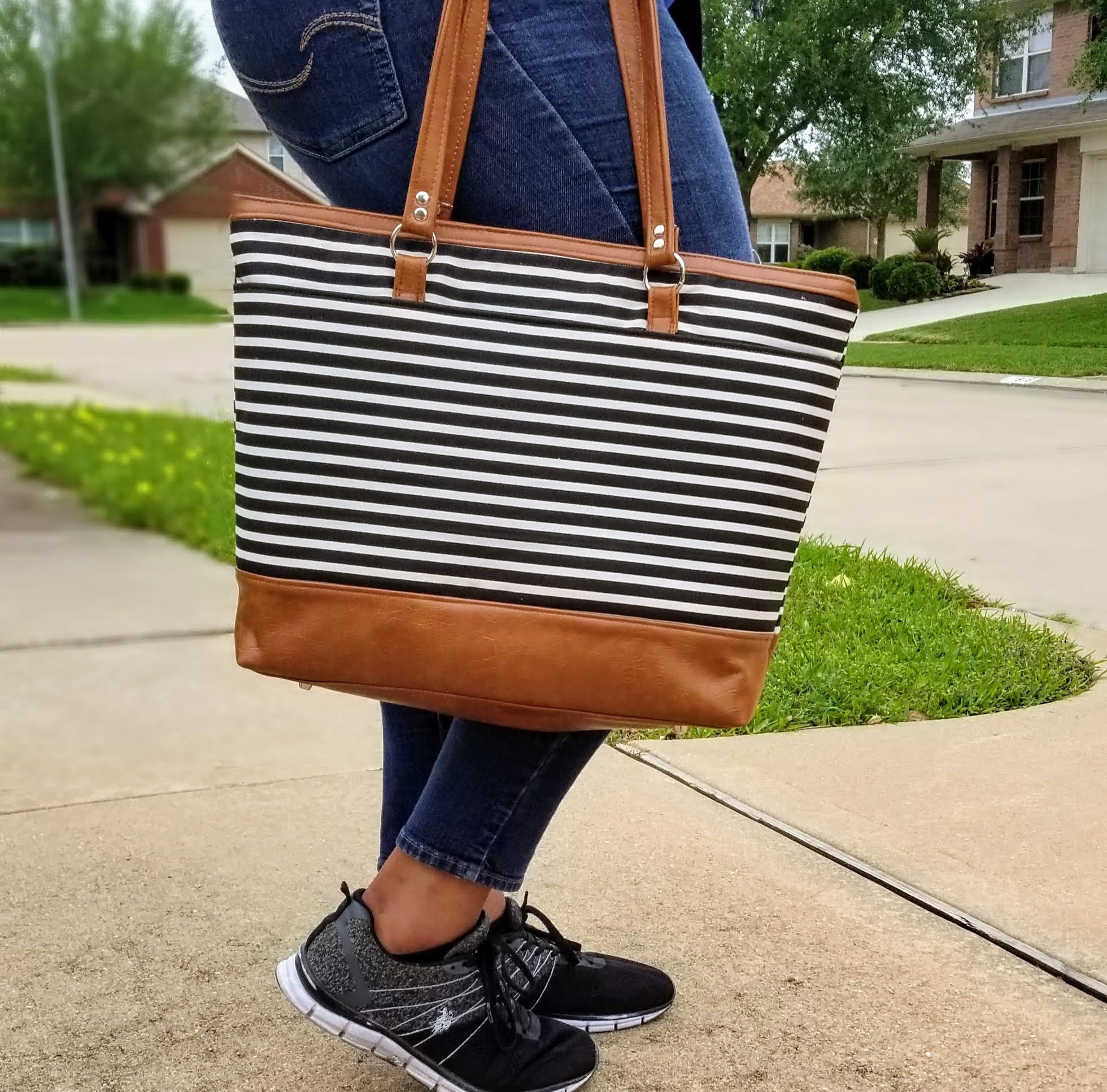
Honestly, most "work bags" are a joke. You’ve seen them—those stiff, tiny leather rectangles that look great in a boardroom but can’t even fit a lunch container alongside a laptop. If you’re a woman who actually works, moves, commutes, and maybe hits the gym or a happy hour, you know the struggle. You need a large women's work tote. Not just any bag, but a cavernous, structural masterpiece that doesn’t make you look like you’re running away from home.
It’s about volume. It’s about weight distribution.
Most people think "bigger is better" and end up buying a massive canvas sack. Huge mistake. A bag without structure becomes a black hole where keys go to die and your laptop screen gets scratched by a stray pen. I’ve spent years testing these, and the difference between a $50 "fast fashion" tote and a high-quality investment piece usually comes down to the reinforced base and the strap drop length.
The Physics of the Overstuffed Tote
Let's talk about your spine. Carrying a heavy laptop, a charger brick (why are they still so heavy?), a water bottle, and your "just in case" makeup kit adds up. We are talking ten, maybe fifteen pounds. If your large women's work tote has thin, spaghetti straps, you’re looking at a chiropractor appointment by Tuesday.
The best totes use a flat strap, at least an inch wide. Look at the Cuyana Tall Structured Leather Tote. It’s a classic for a reason. They use heavyweight Italian leather that holds its shape even when it’s empty. That matters because a floppy bag is harder to dig through when you’re standing on a crowded subway train or trying to find your badge at the security gate.
But here is the catch: leather is heavy.
If you are already carrying a 16-inch MacBook Pro, adding a three-pound leather bag on top of that is a recipe for disaster. This is why high-end nylon has made a massive comeback. Brands like MZ Wallace or Lo & Sons have basically engineered the modern commute. The MZ Wallace Metro Tote Deluxe is essentially a cloud with handles. It’s quilted, which gives it structure without the weight of animal hide. Plus, it has those tiny "feet" on the bottom. Never buy a work bag without feet. You don’t want your expensive investment touching the floor of a public restroom or a sticky coffee shop.
Why Your Current Bag Is Failing You
Is it the organization? Probably.
Most large totes are just one big empty bucket. You toss everything in, and five minutes later, it’s a chaotic mess. You need compartments, but not too many. If a bag has twenty pockets, you’ll never remember where you put your AirPods.
The sweet spot is a dedicated, padded laptop sleeve, one interior zip pocket for valuables, and two "slide" pockets for your phone and sunglasses. Anything more is overkill.
Consider the Dagne Dover Allyn Tote. It’s famous in the tech world for its internal neoprene bottle holder. It keeps your cold S'well bottle from sweating on your important documents. That’s a real-world solution. Most designers don't think about condensation. They think about "aesthetic." But if you’ve ever had a soggy contract because your water bottle tipped over, you know that a dedicated holder is a godsend.
Material Science: Leather vs. Synthetic
- Full-Grain Leather: It smells amazing. It lasts twenty years. It develops a patina. But it’s heavy and hates the rain. If you live in London or Seattle, rethink this.
- Saffiano Leather: Think Prada or Michael Kors. It’s treated with a wax coating and cross-hatch pattern. It’s nearly indestructible and water-resistant. It feels a bit "plastic-y" to some, but for a daily driver, it’s arguably the smartest choice.
- Ballistic Nylon: Originally used for flak jackets. If it can stop shrapnel, it can handle your commute. It’s professional but leaning towards "tech-bro" chic.
- Vegan Leather: Usually just polyurethane (PU). It looks great for six months, then it starts to peel at the edges. Honestly? Just buy real leather or high-quality fabric. PU is a waste of money in the long run.
What Most People Get Wrong About "Professional" Bags
There’s this weird myth that a work bag has to be black. Why?
A deep burgundy, a forest green, or even a rich navy is just as professional as black but shows much more personality. More importantly, dark interiors are a curse. If the inside of your large women's work tote is black, you are looking into a dark abyss every time you need a pen. Light-colored linings—beige, light grey, even soft pink—make it infinitely easier to see your belongings.
Also, size matters, but proportions matter more. If you are 5’2”, a 19-inch wide tote is going to look like you’re carrying a suitcase. Look for "Tall" versions of totes rather than "Wide." The Cuyana version I mentioned earlier is a vertical orientation, which keeps the weight closer to your center of gravity and doesn't bump into people as you walk down the aisle of a bus.
The "Laptop Test"
Before you commit to a bag, check the specs. Don't just look at the bag's dimensions; look at the internal laptop sleeve dimensions.
Many bags claim to fit a 15-inch laptop, but they are measuring the diagonal of the bag, not the actual sleeve. A 16-inch MacBook Pro is wide. A Dell Precision is thick. If you have to force your laptop in, the zipper will eventually fail.
And check the zipper quality. A plastic zipper on a large tote is a red flag. You want YKK metal zippers. They are the gold standard. If the bag doesn't have a top zipper at all, it’s a "shopper" tote, not a "work" tote. Without a zipper, your stuff is an easy target for pickpockets, and if you have to slam on your brakes in the car, everything will fly onto the floorboard.
Real Talk on Price Points
You don't need to spend $2,000 on a Saint Laurent Sac de Jour to look like an expert. In fact, most ultra-luxury bags are surprisingly heavy and lack the functional pockets a real worker needs.
The $200 to $500 range is the "Goldilocks" zone. This is where brands like Senreve, Leatherology, and Bellroy live. You're paying for quality materials and ethical labor, not just a logo. Leatherology’s Belmont Cabin Bag or their Kira Moto Tote are examples of incredible leatherwork without the "luxury tax."
If you go cheaper, say under $100, you’re usually sacrificing the straps. Cheap straps stretch. They crack. They hurt. If you’re on a budget, look for a high-quality nylon bag rather than a cheap leather one. A $90 Longchamp Le Pliage will outlast a $90 "leather" bag from a big-box store every single time.
Maintaining Your Investment
A large women's work tote is a workhorse, but it isn't invincible.
Clean it. Once a month, take everything out. Shake out the crumbs—how do they even get in there?—and wipe down the lining. If it’s leather, use a conditioner. Bickmore Bick 4 is the industry secret because it doesn't change the color of the leather or leave it greasy.
And for the love of all things holy, don't overstuff it. Just because it can fit your laptop, your gym shoes, a hair dryer, and a baguette doesn't mean it should. Stressing the seams day after day will eventually cause the handles to tear away from the body. If you consistently carry more than 15 pounds, it’s time to switch to a backpack or a rolling briefcase. Your body will thank you.
Actionable Steps for Your Next Purchase
First, measure your laptop. Don't guess. Use a ruler.
Second, decide on your "dealbreakers." Do you absolutely need a trolley sleeve to slide over your suitcase handle for business trips? If so, your options narrow down to travel-centric brands like Away or Tumi. Do you need it to stand upright on its own? Look for structured leather or reinforced bases.
Third, look at the strap drop. A 9-inch drop is the minimum for most people to comfortably wear a tote over a winter coat. Anything less, and you’ll be fighting to keep it on your shoulder.
Finally, buy for the job you have and the life you lead. If you walk two miles a day, prioritize weight and weather resistance. If you go from a car to an elevator, prioritize aesthetics and organization. The perfect large women's work tote exists; you just have to stop looking at it as a fashion accessory and start looking at it as a piece of equipment.
Invest in your shoulder health. Get a bag that works as hard as you do. Then, actually use the pockets. Put your keys in the same spot every single day. It sounds simple, but it’s the difference between a seamless morning and a frantic five-minute search at your front door.