You’ve seen them gathering dust in the corner of the gym or shoved into a junk drawer at home. Those colorful, stretchy pieces of latex. Most people treat resistance bands like a secondary thought—a warm-up tool or something you use only when the "real" weights are taken. But honestly? If you’re trying to build a thick, detailed back without wrecking your joints, an exercise band back workout might actually be superior to heavy iron in some very specific, science-backed ways.
It’s not just about pulling on a rubber string.
The physics of a resistance band is fundamentally different from a dumbbell. When you lift a weight, the resistance is constant—gravity doesn't change halfway through the rep. Bands use "variable linear resistance." This means the further you stretch them, the harder they get. For back training, this is a game-changer because your back muscles are actually strongest at the end of the movement when your shoulder blades are squeezed together.
The Science of the Squeeze
Most lifters struggle with "mind-muscle connection" when training their lats and traps. You've probably felt your biceps taking over during a row. It happens to everyone. Because bands increase tension as you reach the "peak contraction," they force those deep back muscles to fire more intensely than a cable machine ever could. Dr. Jim Stoppani, a leading voice in exercise physiology, has often pointed out that resistance bands allow for a "linear increase in tension," which matches the strength curve of most pulling exercises. This isn't just bro-science; it’s mechanical advantage.
Think about the latissimus dorsi. It’s a massive, fan-shaped muscle. To really grow it, you need to emphasize the stretch and the squeeze.
Stop Treating Bands Like Toys
One of the biggest mistakes people make is using a band that’s too light. If you can do 50 reps, you aren't building muscle; you're just vibrating. To trigger hypertrophy—that’s the fancy word for muscle growth—you need to get close to failure. Usually within the 8 to 15 rep range.
You’ve got to anchor these things properly. Use a sturdy door frame, a heavy table leg, or even your own feet. If the anchor point is flimsy, your brain subconsciously holds back because it doesn't want a piece of rubber snapping back into your face. Safety first, seriously.
Designing a High-Impact Exercise Band Back Workout
You don't need twenty different moves. You need four or five that cover different angles. The back is a complex 3D landscape of muscles including the rhomboids, infraspinatus, teres major, and the spinal erectors.
The Low Row for Thickness
Sit on the floor with your legs extended. Loop the band around your feet. Now, here is the trick: don't just pull with your hands. Think about driving your elbows into the wall behind you.
Keep your chest up. If you slouch, your shoulders take the load. Pull until your hands are at your hips. Hold it for two seconds. Feel that burn in the middle of your back? That’s your rhomboids finally waking up. Most people find that a "neutral grip" (palms facing each other) feels most natural here. It keeps the shoulder joint in a safe position and lets you move more weight.
The Face Pull (The Posture Fixer)
This is the king of "pre-hab" exercises. If you spend all day hunched over a laptop, your rear delts and upper back are likely weak. Attach the band at eye level. Grab it with both hands, palms facing each other or facing down. Pull the band towards your forehead, pulling the ends apart as you get closer to your face.
You should look like you’re showing off your biceps in a double-bicep pose at the end. Jeff Cavaliere of Athlean-X often calls this the most important exercise for shoulder health. It fixes that "gamer lean" and pulls your shoulders back into a proud, healthy position.
Banded Lat Pullovers
Straight-arm pullovers are legendary for widening the back. Usually, people do these with a cable or a dumbbell, but bands are actually better. Why? Because the resistance is highest at the bottom where the lat is fully contracted.
- Anchor the band high up.
- Step back until there’s tension even when your arms are above your head.
- Keeping your arms almost straight, sweep them down to your thighs in a big arc.
- Don't let the band snap your arms back up. Control the return.
The "eccentric" phase—that’s the way back up—is where a lot of muscle damage (the good kind) happens. If you let the band win, you’re losing half the workout.
Single Arm Rows for Symmetry
Humans are asymmetrical. Your right side is likely stronger or more coordinated than your left. This is why "unilateral" training is vital.
Step into a staggered stance, like a lunge. Loop the band under your front foot. Row with the opposite hand. This forces your core to stabilize your spine against the rotation. It’s basically a back workout and an ab workout in one. Plus, it lets you focus entirely on one side of the back, ensuring you aren't leaning on your dominant side to move the load.
Why "Micro-Loading" is the Secret Sauce
In a traditional gym, you go from a 20lb dumbbell to a 25lb dumbbell. That’s a 25% jump. It’s huge. With an exercise band back workout, you can increase the weight by just moving six inches further away from the anchor point.
This is called micro-loading.
It allows for "Progressive Overload," which is the only way muscles grow over time. If you do the same workout every week with the same tension, your body stays exactly the same. You have to give it a reason to change. Move back an inch. Add one more rep. Slow down the tempo. These tiny tweaks are what separate the people who get results from the people who just "exercise."
Understanding Band Types
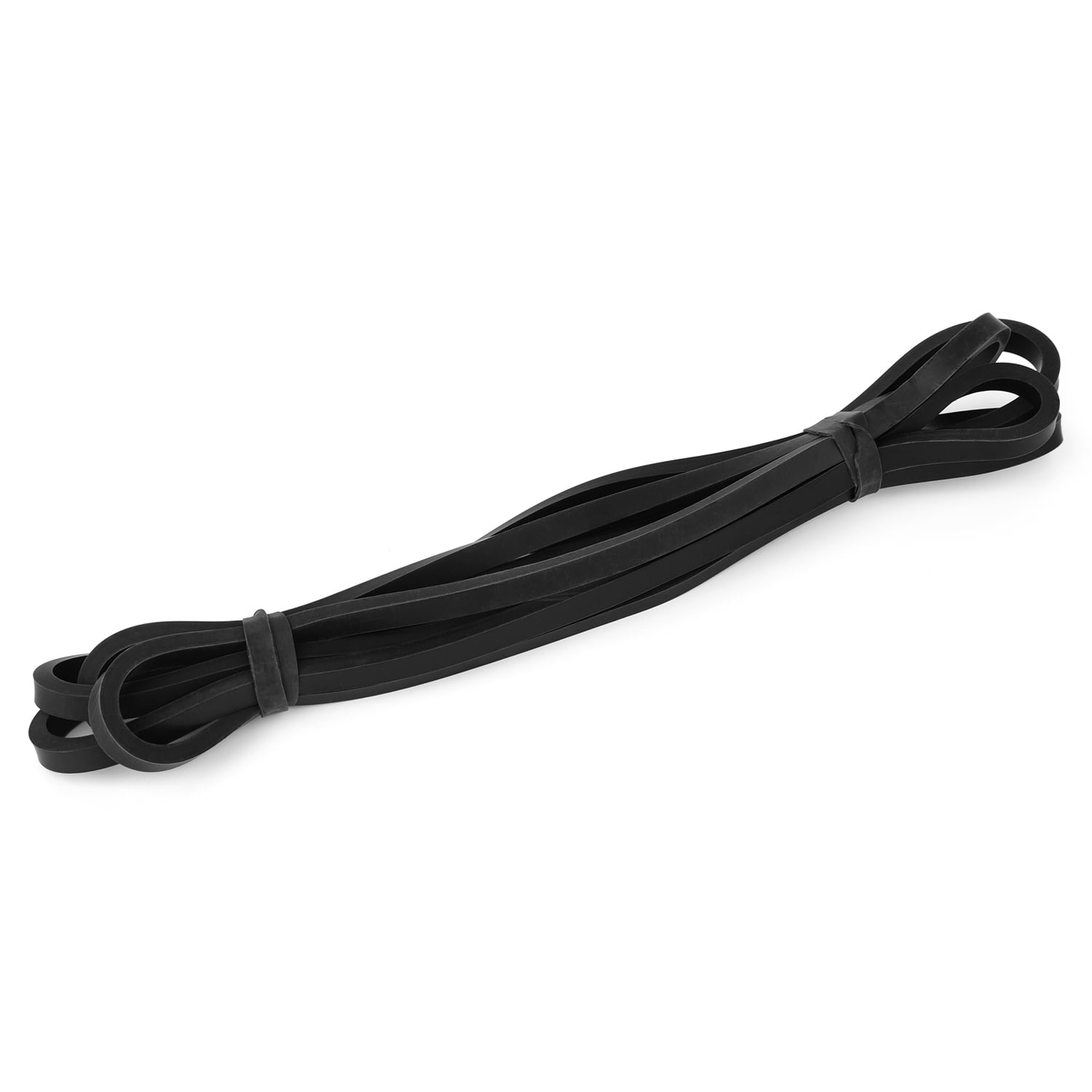
Not all bands are created equal. You have the flat "Thera-bands" (mostly for physical therapy), the tube bands with handles, and the "Power" loop bands.
- Tube Bands: Great for rows and pulldowns because the handles are comfortable.
- Loop Bands: Best for heavy lifting. They are harder to break and offer much higher resistance levels.
- Mini-Bands: Mostly for glutes, but you can use them for "pull-aparts" to hit the rear delts.
If you’re serious about a back workout, get a set of heavy-duty loop bands. They last longer and don't feel "snappy" like the cheap tubes do.
Common Pitfalls to Avoid
The biggest ego-killer is the "snap-back." People pull the band, then just let it fly back to the start. You're cheating yourself. The "negative" portion of the lift is just as important as the pull.
Another issue? Range of motion. Because bands get harder as you stretch them, many people stop short. They do "half-reps" because they can't handle the tension at the end. If you can't get a full squeeze, the band is too heavy. Drop down a level. Form is everything. A 2021 study published in the Journal of Sports Science and Medicine found that resistance band training can produce similar strength gains to conventional weights, but only if the intensity and volume are matched.
Texture and Grip
Sweaty hands and rubber bands are a recipe for a bad time. If you're using loop bands, consider wearing gloves or using a small towel to improve your grip. A slipping band doesn't just ruin your set; it can actually be dangerous. If you're doing a heavy row and the band slips off your foot, it’s coming back at you fast.
The "Time Under Tension" Factor
Hypertrophy isn't just about weight. It's about how long the muscle is working. With bands, because there's no "dead spot" in the movement (unlike dumbbells where gravity can sometimes give you a break), your muscles are under constant stress.
Try the "3-1-3" tempo:
- 3 seconds to pull.
- 1 second to squeeze at the top.
- 3 seconds to slowly release.
Doing 10 reps this way feels like doing 30 reps of a standard workout. Your back will be on fire. This constant tension is particularly effective for the "sarcoplasmic hypertrophy"—the fluid buildup in the muscle that gives you that "pump" and contributes to overall muscle size.
Real World Example: The "Hotel Room" Hero
I knew a guy, a traveling consultant, who built a physique better than most gym-rats using nothing but two loop bands in hotel rooms. He didn't have a rack or a bench. He used the bed frame as an anchor. He used the door. His secret wasn't some magical exercise; it was the fact that he treated those bands with the same respect he'd give a 400lb barbell.
He tracked his sets. He pushed for more reps. He focused on the contraction.
Is This Enough for a "Thick" Back?
Let’s be real. If your goal is to look like a professional bodybuilder, you'll eventually need some heavy iron. But for 90% of people—those who want to look fit, have great posture, and be strong—an exercise band back workout is more than enough.
In fact, for older trainees or people with history of lower back pain, bands are often safer. They don't place the same "axial loading" (downward pressure) on the spine that a heavy barbell row does. You get the muscle stimulation without the joint inflammation.
Actionable Next Steps
If you're ready to start, don't overcomplicate it. Consistency beats intensity every single day of the week.
- Audit your gear: Get a set of 3-5 loop bands of varying thicknesses. Avoid the ones that look like thin ribbons.
- Find a "High" and "Low" anchor: A door anchor attachment is a cheap ($10) investment that turns any door into a cable machine.
- Pick 4 moves: One vertical pull (lat pulldown), one horizontal pull (seated row), one rear-delt move (face pull), and one straight-arm move (pullover).
- Schedule it: Do this twice a week. Give your back 48 hours to recover between sessions.
- Log it: Write down how many reps you did. Next time, try to add one rep or move two inches further from the door.
Stop thinking of bands as a "substitute" for a real workout. When used with intention, they are the real workout. Your back doesn't know if you're pulling on a $5,000 machine or a $20 piece of rubber; it only knows tension. Give it enough tension, and it has no choice but to grow.