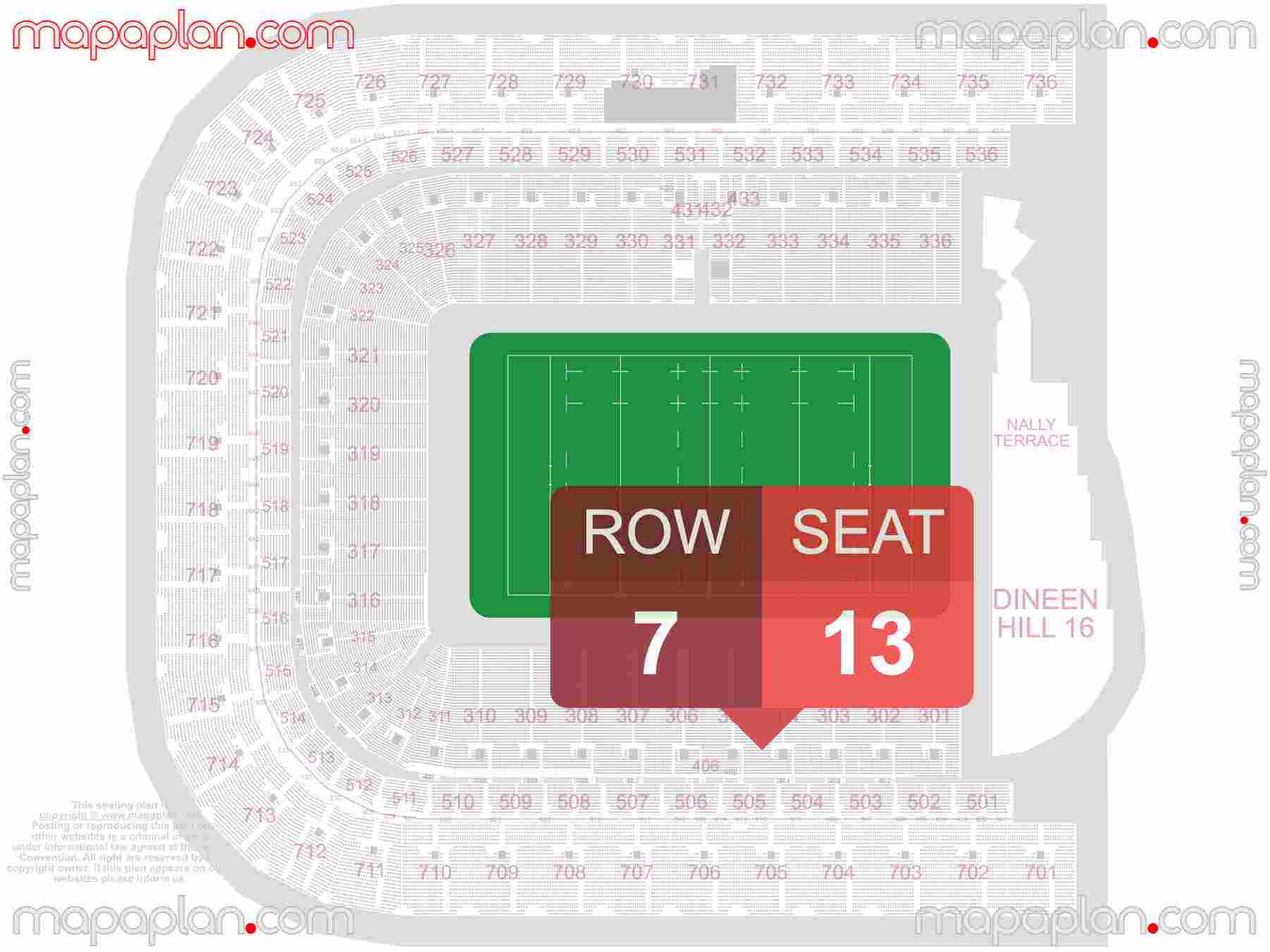
Ever walked into a stadium and felt like you needed a master's degree in geometry just to find your seat? Honestly, Croke Park can feel a bit like that if you’re staring at a ticket with a bunch of random numbers on it. You've got stands named after historical figures, levels that skip numbers, and a "hill" that isn’t really a hill anymore.
It’s the fourth largest stadium in Europe. That’s huge. We're talking 82,300 people when it's at full throttle for an All-Ireland final. If you're heading there for the first time—or even if you’re a regular who usually just follows the crowd—getting your head around the croke park seating chart is the difference between a stress-free day out and wandering around Jones' Road looking lost.
The Big Three: Hogan, Cusack, and Davin
Basically, the stadium is a massive "U" shape of seated stands with one terrace at the open end.
The Hogan Stand is the VIP of the bunch. It’s on the west side (the Jones' Road side). This is where the presidential box is, where the trophies are presented, and where the players come out of the tunnel. If you want to see the "prestige" side of things, this is it. It’s also great because the sun is at your back in the afternoon. No squinting through a whole hurling match.
Opposite that is the Cusack Stand. Named after Michael Cusack, the man who started the GAA. It’s the sun-trap. If it’s a rare sunny day in Dublin, bring the shades. This stand is massive and usually where the most "ordinary" fans (if there is such a thing) end up.
Then you’ve got the Davin Stand (formerly the Canal End). It’s behind one of the goals. It’s actually an extension of the Cusack design. If you're here, you're looking straight down the pitch. It’s a unique perspective, especially for seeing the tactical movement of the full-forward line.
Understanding the Levels
The levels can be confusing because they don't go 1, 2, 3.
- Level 3: This is the lower tier. It’s closest to the pitch. Rows usually go from A (front) to Z, and then jump into double letters like AA to YY.
- Level 4: This is mostly for wheelchair access and premium suites. It's the "middle" but not a full public seating deck.
- Level 5: The Premium Level. This is for the "prawn sandwich" brigade, as some fans jokingly call it. You get padded seats, better bars, and a bit more legroom.
- Level 6: More suites and media boxes.
- Level 7: The Upper Tier. It is high. Like, really high. If you have vertigo, maybe stick to the lower deck. But the view is incredibly clinical. You see the whole game develop like a chess match.
Why Hill 16 Is a Different Beast
Then there's the Hill. It's technically the Dineen Hill 16 terrace.
It’s standing only. No seats. No croke park seating chart applies here because you just find a patch of concrete and stay there. It’s where the most "vocal" supporters live—usually the Dublin fans (the Dubs). It’s cheap, it’s loud, and the atmosphere is electric.
The Hill was actually built using rubble from the 1916 Easter Rising. There’s a lot of history in that concrete. If you’re looking for a relaxing afternoon with a clear view of the far goal, don't go here. If you want to be in the middle of a sea of jerseys and chanting, it’s the only place to be.
Finding Your Specific Block and Row
Your ticket will have three main things: a Section, a Row, and a Seat.
Sections in the 300s (like 304 or 330) are Lower Tier. Sections in the 700s (like 712 or 725) are Upper Tier.
One thing people always get wrong: Row A is at the front. As you go further back, the letters go up. In the lower stands, the "covered" area—the part that keeps you dry when the Irish weather does its thing—usually starts around Row EE. If you’re in Row C, you’re getting soaked if it rains. Pack a poncho.
Accessibility is a big deal here, too. Croke Park was actually the first "Age Friendly" stadium in the world. Wheelchair spaces are mostly on Level 4 in the Cusack and Davin stands. Access is via the A2 gate at the Cusack side or the premium entrance at the Hogan side. They have a specific "Accessibility Team" in blue bibs who are honestly legends at helping people get to where they need to go.
Tips for Concerts vs. Matches
When a big act like Coldplay or Oasis (for their 2025/2026 runs) comes to town, the croke park seating chart shifts.
The pitch becomes "Standing" or "Pitch Seating." If you have pitch seating, they lay down a special floor over the grass. Block numbers will change, and they’ll usually have a massive stage at the Davin Stand end. This means the Davin Stand itself is often closed or has a restricted view.
Always check if your ticket says "Restricted View." Sometimes it’s just a small wire in the way, but sometimes you're literally behind a speaker tower.
Practical Steps for Your Visit
Don't just wing it.
- Check the gate: Your ticket will tell you which color-coded route to take (Red, Blue, Green, etc.). Stick to it. Jones' Road is narrow and gets packed fast.
- Download the map: The official Croke Park website has an interactive map where you can actually see the "photo view" from your exact section. It's a lifesaver.
- Bags: Keep them small. A4 size or smaller. Security is tight, and they won't let you in with a rucksack.
- Timing: For big games, the "Artane Band" usually performs before throw-in. It’s part of the tradition. Aim to be in your seat 45 minutes before the start time.
The beauty of Croke Park isn't just the size; it's the fact that there isn't really a "bad" seat in the house. Even at the very back of the upper Hogan, you can see the numbers on the players' jerseys. Just make sure you know which level you're on before you start climbing those stairs.
Once you find your spot, just sit back (or stand up on the Hill) and take it in. There’s nothing quite like the roar of the crowd when the ball is thrown in. Now that you know the layout, you can spend less time looking at your ticket and more time looking at the game.