You’re staring at your bedroom floor, wondering how on earth you're supposed to build a "V-taper" without a pull-up bar or a set of heavy dumbbells. It feels impossible. Most fitness influencers make it seem like if you aren't doing 400-pound deadlifts or weighted chin-ups, your posterior chain is destined to remain as flat as a pancake. That’s just not true. Honestly, the biggest hurdle to effective back workouts without equipment isn't the lack of iron; it's a fundamental misunderstanding of biomechanics and the "mind-muscle connection."
The back is a massive, complex landscape of muscle. You've got the latissimus dorsi (the "wings"), the rhomboids (between your blades), the traps, and that crucial erector spinae group running down your spine. Without a heavy bar to pull, you have to get creative with how you create tension. It’s about isometric holds, floor-based friction, and gravity.
The Gravity Problem: Why Back Training at Home is Hard
Pushing is easy. The floor is right there for push-ups. Gravity provides the resistance. But pulling? Pulling usually requires something to grab onto. This is why many people give up on home back training. They try a few "supermans," feel a slight pinch in their lower back, and decide it's not working.
The secret lies in "towel physics" and floor slides. You have to find ways to mimic the pulling motion by using your own body weight as the anchor. It’s weird at first. You'll feel silly sliding across a hardwood floor on your stomach, but your lats won't think it's funny when they're screaming the next morning.
The "Floor Lat Pulldown" is a Game Changer
If you have a hardwood or tile floor and a couple of hand towels, you have a gym. Lay face down. Reach your arms out in front of you, hands on the towels. Now, press your palms firmly into the floor and pull your elbows down toward your hips, sliding your entire body forward.
This isn't just a stretch. It’s a closed-kinetic chain movement. Because you are moving your body toward your hands (rather than pulling an object toward your body), you recruit more motor units. It’s essentially a horizontal pull-up. Focus on the squeeze. If you don't feel it, you aren't pressing down hard enough. The downward pressure creates the friction that provides the resistance.
Understanding the "Mind-Muscle" Connection (It's Not Bro-Science)
In a 2018 study published in the European Journal of Applied Physiology, researchers found that focusing on a specific muscle during exercise can actually increase its activation. This is vital for back workouts without equipment. When you have 200 pounds on a bar, the weight forces the muscle to work. When you're lying on your rug doing "Y-W" raises, you have to force the muscle to work.
Try this: hold your arm out like you’re doing a row. Now, instead of just moving your hand back, imagine there's a walnut between your shoulder blades and you're trying to crush it. Feel that? That's the rhomboid firing.
Why the "Superman" is Overrated (and how to fix it)
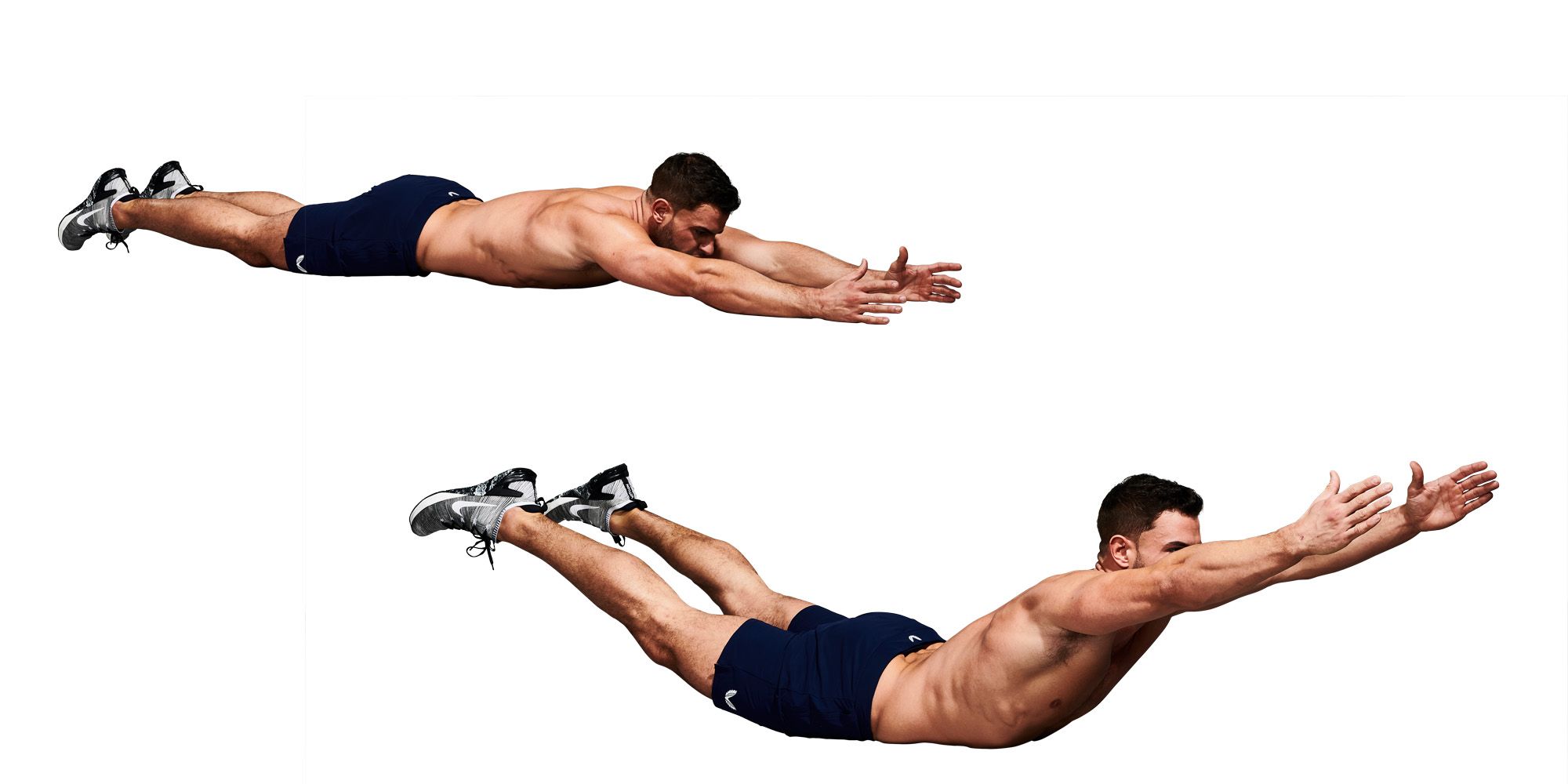
Almost every "no equipment" guide tells you to do the Superman. You know the one—lying on your belly, lifting arms and legs like you're flying. It’s fine, I guess. But for many, it just results in localized lower back strain because they're hyperextending the lumbar spine rather than engaging the thoracic (upper) back.
Instead, try the Prone Contralateral Raise.
- Lift your right arm and left leg only an inch or two off the ground.
- Hold for three seconds.
- Focus on lengthening your body rather than height.
- Keep your gaze at the floor to maintain a neutral neck.
This targets the multifidus and erector spinae—the deep muscles that protect your spine—without the "crunching" feeling of a standard Superman. It's subtle. It's boring. It works.
The Architecture of the Upper Back
We can't talk about back training without mentioning the Trapezius. Most people think "traps" are just those bumps next to your neck. Wrong. The traps are huge, diamond-shaped muscles that extend all the way down to the middle of your back.
Scapular Wall Slides
Stand with your back against a wall. Your butt, upper back, and head should touch the surface. Bring your arms up into a "goalpost" position, with elbows and the backs of your hands touching the wall. Now, slowly slide your hands up toward the ceiling without letting your back or arms lose contact with the wall.
It sounds easy. It’s actually a nightmare if you have tight shoulders or a weak upper back. This move hits the lower traps and helps counteract the "tech neck" we all get from staring at phones. If you can’t keep your hands on the wall, your chest is likely too tight.
The "Inverted Row" with a Table
Okay, technically a table is "furniture," not "equipment," but it's a lifesaver. Ensure your table is sturdy. Please. Don't sue me because you flipped a coffee table onto your face.
Lie under the table, grab the edge, and pull your chest to the underside. This is the gold standard for back workouts without equipment. It’s the closest thing to a barbell row you can get. If your table is too low, bend your knees to make it easier. If it's too high, keep your legs straight.
Managing Volume and Frequency
Since you aren't using heavy external loads, you need to increase two things: volume and time under tension (TUT).
Instead of doing 10 reps and stopping, do reps until you literally cannot maintain form. Then, on the last rep, hold the "contracted" position for 10 seconds. Shake. Repeat. Because bodyweight back exercises are generally less taxing on the Central Nervous System (CNS) than a 500-pound deadlift, you can do them more often. Three to four times a week is usually the sweet spot for hypertrophy in a home setting.
The Myth of the "Pull-Up Requirement"
I love pull-ups. They are arguably the best upper body exercise. But if you can't do one, or don't have a bar, you aren't doomed to a weak back. The "Back Bridge" (borrowed from gymnastics and wrestling) provides incredible posterior chain strength.
Start with a "Bridge March."
- Lie on your back, knees bent, feet flat.
- Lift your hips until there’s a straight line from knees to shoulders.
- Lift one foot off the floor, then the other, without letting your hips sag.
This builds the "glute-ham-back" tie-in that is so often missing from standard gym routines.
Specificity and the "Towel Row"
If you have a door, you have a row machine. Take a long towel, tie a knot in the middle, and drape it over the top of a door. Close the door (make sure it closes toward you so you don't pull it open). Grab the ends of the towel, lean back, and row.
The thicker the towel, the harder your grip has to work. This hits the brachioradialis and the lats simultaneously. It’s a functional movement that builds real-world "pulling" power.
Why Consistency Trumps Intensity at Home
At the gym, it’s easy to get motivated because the environment is designed for work. At home, your bed is five feet away. The biggest failure in back workouts without equipment isn't the exercises themselves; it's the fact that people do them half-heartedly for a week and then quit because they don't look like a pro bodybuilder.
Hypertrophy (muscle growth) requires progressive overload. If you did 15 floor slides today, do 16 on Thursday. Or do those 15 slides slower. Control the "eccentric" (the way down). That’s where the micro-tears happen that lead to growth.
Addressing the Lower Back: The Foundation
We focus so much on the lats that we forget the "basement" of the back. A weak lower back leads to injury. Period.
Dr. Stuart McGill, a world-renowned expert on spine biomechanics, emphasizes the "Big 3" exercises for back health. One of them, the Bird-Dog, is a staple for a reason. Get on all fours. Extend your right arm and left leg. Hold. The key isn't just holding it; it's bracing your core as if someone is about to kick you in the stomach. This "co-contraction" creates a natural corset of muscle around your spine.
Practical Steps to Start Today
Don't overcomplicate this. You don't need a 12-week PDF. You just need to move.
- Step 1: Test your "Floor Slide." Grab two towels or wear socks on a smooth floor. Can you pull your body weight forward five times? If not, start with "Scapular Shrugs" on your elbows to build the initial strength.
- Step 2: Clear a space against a wall. Spend three minutes doing Wall Slides. It will feel like your shoulders are on fire. That’s good.
- Step 3: Find your "Anchor." Whether it's a sturdy table or a towel over a door, find one "heavy" pulling movement you can do for sets of 8-12.
- Step 4: Audit your posture. If you're doing these workouts but then slouching over a laptop for eight hours, you're treading water. Pull your shoulders back and down. Make it a habit.
The reality of back workouts without equipment is that they require more mental effort than gym workouts. You have to be your own resistance. You have to visualize the muscles contracting. But for those who master it, the result is a functional, resilient back that doesn't need a monthly membership to maintain.
Start with the floor slides tonight. Focus on the squeeze, keep your spine neutral, and don't rush the tempo. Building a strong back is a marathon of small, high-tension movements, not a sprint of sloppy reps.