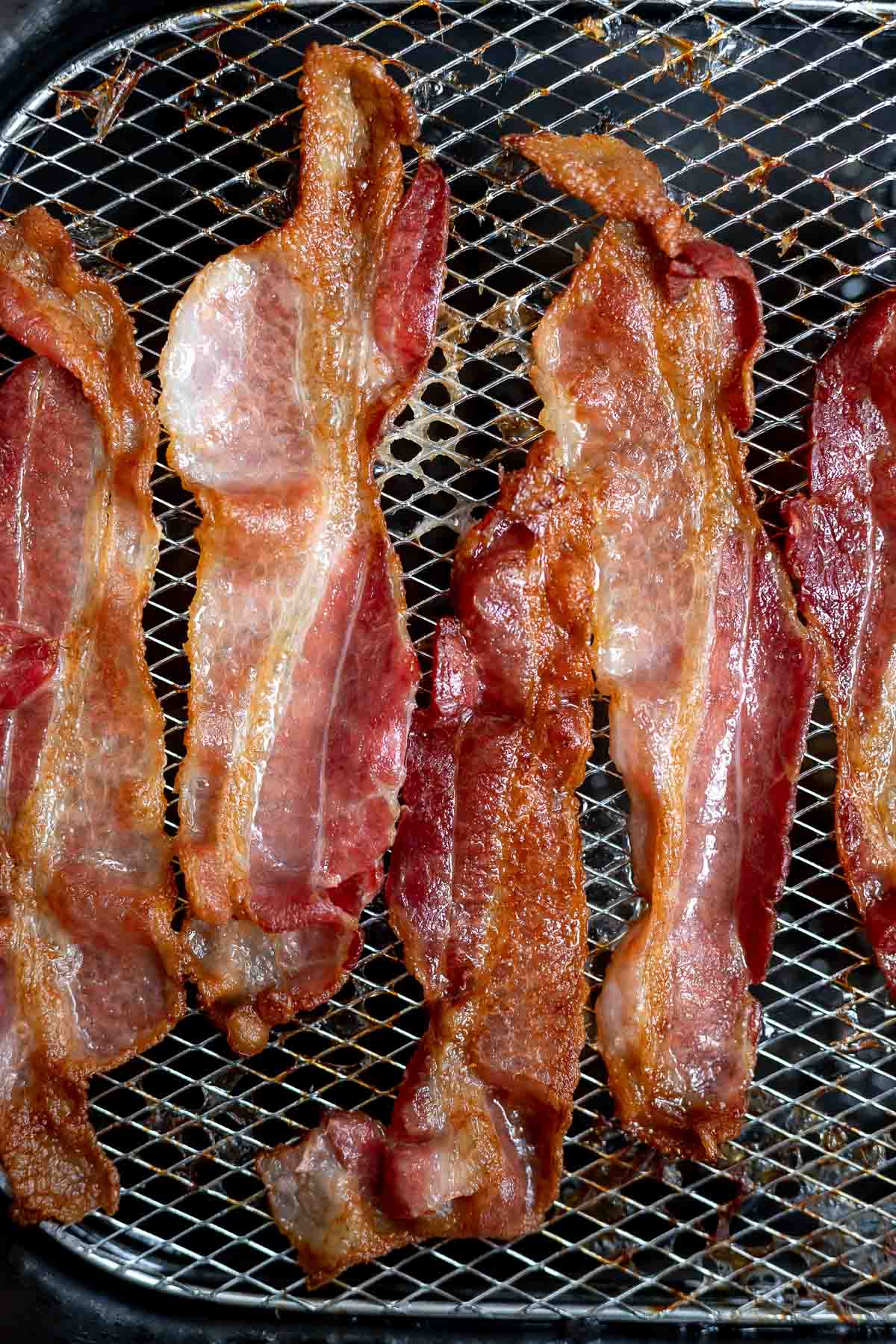
You’ve probably seen the viral videos of people tossing an entire pack of pork into a basket and hoping for the best. Honestly? Most of those people are eating rubbery, unevenly cooked grease strips. If you want air fryer thick cut bacon that actually rivals what you’d get at a high-end brunch spot, you have to stop treating the air fryer like a microwave. It isn’t a "set it and forget it" magic box. It’s a high-powered convection oven.
Treat it with some respect.
Thick-cut bacon is a different beast than that paper-thin stuff that shatters when you touch it. We’re talking about slabs from brands like Wright’s or Benton’s—meat that has some actual structural integrity. When you throw this into a circulating vortex of 400-degree air, things can go south fast if you don't know the physics of fat rendering.
The Science of Fat and Airflow
Air fryers work by pushing hot air down and around the food. In a pan, bacon sits in its own rendered fat, essentially confit-ing itself as it fries. In an air fryer, that fat drips away. This is great for health (sorta), but it’s risky for texture. If the fat drips off too quickly before the meat proteins have a chance to tighten up, you end up with "hammy" bacon. It’s cooked, sure, but it’s not crispy.
Why 400 Degrees Is Usually a Mistake
Most manuals tell you to crank the heat. Don't. When dealing with air fryer thick cut bacon, 375°F (about 190°C) is the sweet spot. At 400°F, the outside of the fat strips will scorch and smoke before the thick center of the meat reaches that perfect mahogany color. You want a slow enough render that the white fat turns translucent and then golden.
I’ve seen people complain about their smoke alarms going off. That’s because bacon grease has a smoke point of roughly 370°F to 400°F. If you’re pushing the limit, that dripping grease hits the bottom tray and atomizes into a cloud of blue smoke.
- Try putting a tablespoon of water in the bottom drawer.
- Some people swear by a slice of bread at the bottom to soak up the grease.
- Just make sure the bread doesn't fly up into the heating element. That’s a fire hazard.
Dealing with the Curl
One of the biggest annoyances with the air fryer is the "flying bacon" phenomenon. Because the fan is so powerful, thinner slices will literally blow around and fold over themselves. Thick cut bacon usually stays put because of its weight, but it can still curl.
If you want perfectly flat strips, you have to overlap them slightly—just a tiny bit—to weigh the edges down. Or, better yet, use a small metal rack (the kind that comes with some air fryer kits) to weigh them down.
The Parchment Paper Debate
Never use parchment paper that covers the whole basket. You’re killing the airflow. The whole point of the air fryer is that the air comes from underneath too. If you block those holes, you’re just baking the bacon. If you must use it for cleanup, poke extra holes in it. But honestly? Just wash the basket. It’s worth the extra two minutes of scrubbing to avoid soggy pork.
How Long Does It Actually Take?
Every air fryer is a snowflake. A Ninja Foodi cooks differently than a Cosori or a Philips.
For standard air fryer thick cut bacon, you’re looking at 10 to 12 minutes.
Check it at 8 minutes.
Seriously.
If you wait until the timer goes off, you’ve probably gone too far. Bacon continues to cook for about 60 seconds after you pull it out because the internal fat is still bubbling. If it looks "perfect" in the basket, it’ll be overdone by the time it hits the plate. Pull it when it’s a shade lighter than your target color.
The Secret Ingredient: High-Quality Sourcing
You can’t make a silk purse out of a sow's ear, and you can’t make world-class bacon out of the generic store brand that’s 70% water. Cheaper bacon is often "pumped" with a brine solution to increase weight. When you air fry this, the water evaporates, the bacon shrinks to half its size, and it steams rather than fries.
Look for "dry-cured" bacon. Brands like Nueske’s or local butcher cuts are superior because they haven't been injected with liquid. They hold their shape. They crisp up. They taste like actual smoke and salt, not chemicals.
Flavor Hacks for the Bold
If you want to get fancy, brush the slices with a tiny bit of maple syrup and a heavy crack of black pepper halfway through the cook. This is "Millionaire’s Bacon" territory. The sugar will caramelize in the high-velocity air, creating a candy-like shell. Just be careful—sugar burns way faster than fat. If you go this route, drop the temp to 350°F for the last 3 minutes.
Common Blunders to Avoid
- Overcrowding: If the slices are touching side-to-side, the edges will be soft. Leave a "breathable" gap between each strip.
- Cold Start: You don't have to preheat, but if you don't, add 2 minutes to the time. Consistent results come from a hot basket.
- Neglecting the Grease: If you’re doing back-to-back batches, you MUST dump the grease between rounds. If you don't, the second batch will taste like burnt oil and the smoke will be unbearable.
- The "Flip" Myth: You don't strictly need to flip thick-cut bacon in an air fryer because of the circular air, but doing it anyway at the 6-minute mark ensures the side touching the grate gets just as crispy as the top.
Is It Actually Healthier?
Let's be real. It’s bacon. But, according to researchers at various culinary institutions, air frying does allow more fat to render out and drip away from the meat compared to pan-frying where the meat sits in the pool. You’re probably saving about 30-50 calories per serving depending on the thickness.
However, the real benefit isn't the calories. It’s the acrylamide reduction. High-heat searing in a pan can sometimes lead to more charring, whereas the air fryer provides a more even "browning" via the Maillard reaction without as much localized burning.
Beyond the Breakfast Plate
Once you’ve mastered air fryer thick cut bacon, you start realizing it’s a component, not just a side dish.
- Lardons: Cut the thick strips into 1-inch squares before air frying. They turn into little "meat croutons" that are incredible on Caesar salads.
- BLTs: Thick cut is the only way to go here. Thin bacon gets lost under the tomato.
- The Grease Goldmine: Don’t toss that liquid gold in the bottom tray. Pour it into a glass jar. Use it to sauté Brussels sprouts or fry an egg the next morning. It has a slightly "cleaner" smoky flavor than pan-grease because it hasn't been scorched by the direct heat of a burner.
Step-by-Step Execution Strategy
To get this right the first time, follow this specific flow. Don't eyeball it.
- Preheat the air fryer to 375°F for 3 minutes. This stabilizes the internal environment.
- Arrange the bacon in a single layer. If your basket is round, you might need to cut the strips in half to make them fit without curling up the sides.
- Set the timer for 10 minutes.
- Flip at the 6-minute mark. Use tongs. Don't use a fork; you'll scratch your non-stick coating.
- Monitor from minute 8 onwards.
- Rest the bacon on a wire rack, not a paper towel. A paper towel traps steam under the bacon, which makes the bottom side soggy. A wire rack allows air to circulate, keeping both sides crunchy.
Troubleshooting Your Batch
If your bacon is tough or "leathery," you likely cooked it too long at too low a temperature. This dehydrated the meat before the fat could crisp.
If it's burnt on the edges but raw in the middle, your temperature was too high.
If it's unevenly cooked, you crowded the basket.
It takes about two tries to dial in your specific machine. Once you find the "golden number" for your favorite brand of bacon, write it down on a sticky note and put it inside your cabinet.
Final Thoughts on the Process
Air frying thick cut bacon is objectively the best way to prepare it for a group of 2-4 people. It's faster than the oven and cleaner than the stovetop. No grease splatters on your shirt. No smelling like a diner for three days. Just consistent, high-quality results that make you look like you actually know your way around a kitchen.
Next Steps for the Best Results:
- Clean your heating element: Most people forget this. Unplug the machine, let it cool, and wipe the "ceiling" of the air fryer. Old grease up there is what causes 90% of the smoke issues.
- Experiment with "The Soak": Some chefs recommend soaking bacon in cold water for 10 minutes before cooking. This sounds crazy, but it slows down the browning of the meat so the fat can fully render. It leads to an incredibly crispy, yet tender, bite.
- Store it right: If you have leftovers (rare, I know), don't microwave them. Put them back in the air fryer at 350°F for exactly 2 minutes. They will taste better than they did the first time.
The reality is that bacon is a simple pleasure, but the details matter. Get the temperature right, give it space to breathe, and don't be afraid of the grease. You'll never go back to the frying pan.