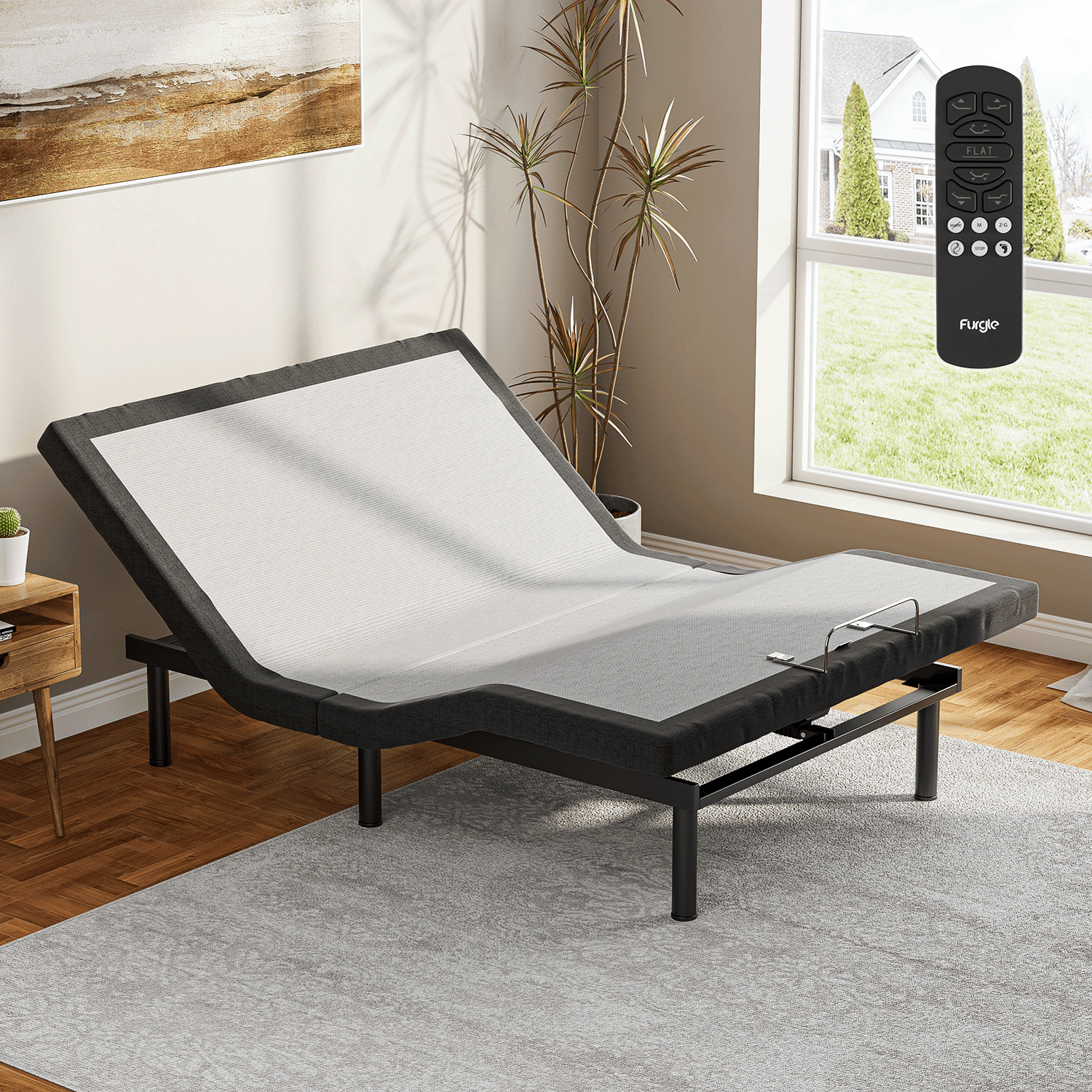
You’re probably lying to yourself about your mattress. We all do it. We spend three grand on a memory foam slab, toss a silk sheet over it, and wonder why our lower back still screams at 6:00 AM. The truth? Your mattress is just the cushion; the adjustable bed base frame is the engine. It’s the difference between just lying there and actually recovering.
Most people think these frames are for hospital rooms or people who eat dinner in front of the TV at 4:30 PM. That’s a massive misconception. If you’ve ever stacked three pillows behind your head to read or shoved a rolled-up towel under your knees to stop that dull ache in your hips, you’re already trying to manually create what an adjustable base does with a button. It’s about biomechanics, not just luxury.
Honestly, the "hospital bed" stigma is dying fast. Brands like Tempur-Pedic and Saatva have turned what used to be a clunky medical device into a sleek, upholstered piece of tech that looks like high-end furniture. But don't get distracted by the built-in USB ports or the under-bed lighting that makes your room look like a sci-fi movie set. The real value is in the articulation.
Why Your Spine Hates Flat Surfaces
Humans aren't flat. Our spines have a natural S-curve. When you lie on a standard flat foundation, gravity pulls your midsection down, forcing your spine out of alignment. This is why you wake up feeling like you’ve been folded in half.
An adjustable bed base frame lets you hit what experts call the Zero-Gravity position. Developed by NASA to help astronauts handle the intense G-force of takeoff, this position raises your head and feet just above your heart. It’s basically the "neutral" setting for the human body. By distributing your weight evenly, it takes the pressure off your lumbar region and improves circulation.
I’ve talked to people who struggled with chronic edema—swelling in the legs—for years. They tried compression socks. They tried cutting salt. Nothing worked as well as simply elevating their feet 6 inches above their hips for eight hours a night. It’s simple physics. Gravity helps the blood return to the heart.
But it isn't just about the back. Think about snoring. If your partner sounds like a chainsaw, it’s usually because their airway is collapsing slightly when they’re flat on their back. Elevating the head by just 7 to 10 degrees can open those airways. Some high-end bases, like the ones from Ergomotion, even have "Snore Detection" that automatically tilts the head up when it hears those first few rumbles. No more elbowing your spouse in the ribs at 2:00 AM.
The Brutal Truth About Compatibility
Here is where it gets tricky, and where a lot of sales reps will lie to your face. You can’t just put any mattress on an adjustable bed base frame.
If you have a traditional ultra-firm innerspring mattress with a thick border wire, do not buy an adjustable base. You will ruin the mattress, and you’ll probably burn out the motor on the frame. The mattress needs to be flexible enough to bend without buckling.
- Memory Foam: These are the kings of adjustability. They contour perfectly.
- Latex: Great choice, very resilient, though a bit heavier to move.
- Hybrid: This is the "maybe" zone. If the coils are individually wrapped (pocketed), you’re usually fine. If they’re interconnected, stay away.
Weight is another thing nobody talks about. A king-sized adjustable base can weigh 200 to 300 pounds. Add a heavy 15-inch hybrid mattress and two adults, and you’re asking a lot of your bedroom floor. If you live in an old house with shaky floorboards, you might want to check those joists before you go full-auto on your bed setup.
The Mechanics: Motors and Reliability
Let's talk about the guts of the thing. Most people look at the remote and the fabric, but the motor is the only part that matters after three years. Look for Okin or Linak motors. These are the industry standards for a reason—they’re quiet, and they don't die the second a power surge hits.
You also need to understand the difference between "Head and Foot" versus "Wall-Hugging" technology. Cheap frames just tilt. If you raise the head, it moves you forward and away from your nightstand. Suddenly, your water glass and your lamp are two feet behind your head. A wall-hugger base slides the whole platform back toward the wall as it rises, keeping you in line with your furniture. It’s a small detail that makes a massive difference in daily use.
Misconceptions That Cost You Money
People think they need a "Split King" to get the benefits. A Split King is just two Twin XL bases pushed together. Yes, it’s great if your partner wants to sleep flat while you want to be upright, but it requires special sheets and creates a "gap" in the middle of the bed.
If you’re single or you and your partner have similar sleep needs, a solid Queen or King base is much cheaper and easier to manage. Don't let a salesperson up-sell you on a Split King unless you specifically need independent movement.
Also, the "massage" feature? It's not a massage. It's a vibration motor. It feels like your phone is buzzing under the mattress. Some people love it because the white noise and steady hum help them fall asleep, but don't go into it expecting a Swedish deep-tissue experience. It’s a relaxation tool, nothing more.
Real World Wear and Tear
Nothing lasts forever. Even a high-end adjustable bed base frame has a lifespan. Most warranties are "limited," meaning they cover the metal frame for 20 years, but the electronics and motors for maybe three to five.
Check the "Quiet" rating. If you’re a light sleeper and your partner adjusts the bed in the middle of the night, a cheap, grinding motor will wake you up every single time. High-quality bases are almost silent. You should only hear a soft whir, not a mechanical groan.
Installation is also a beast. These things aren't IKEA desks; you can't just throw them together with an Allen wrench in twenty minutes. They are heavy, awkward, and full of pinch points. If you’re buying one, pay for the "White Glove" delivery. Let the pros carry it up the stairs and sync the Bluetooth remotes. Your back will thank you before you even lie down.
Digging Into the Health Science
It’s easy to dismiss this as "lifestyle" fluff, but the medical community has been on this for a long time. Dr. Robert Mansdorf, a specialist in spine health, has often noted that semi-fowler positions (where the head and knees are slightly elevated) reduce the intra-abdominal pressure that can lead to acid reflux.
If you suffer from GERD or frequent heartburn, gravity is your best friend. Sleeping flat allows stomach acid to travel up the esophagus. Elevating the torso by just 6 inches uses gravity to keep that acid where it belongs. It’s more effective than a wedge pillow because the wedge pillow only moves your head, often straining your neck in the process. An adjustable base moves your entire upper body from the waist, keeping your neck in a neutral alignment.
Making the Transition
If you're ready to pull the trigger, don't just buy the first one you see on a flash sale site. There's a hierarchy here.
- Measure your current frame. Make sure the adjustable base can sit "zero clearance" if you want to keep your existing decorative bed frame.
- Check the weight capacity. This includes the mattress! Some entry-level bases tap out at 650 lbs. Two adults plus a 150-lb mattress can blow past that easily.
- Test the "Flat" button. It sounds stupid, but make sure the remote has a one-touch return-to-flat button. You don't want to be fumbling with arrows when you're half-asleep and just want to roll over.
- Syncing. If you do get a Split King, make sure the bases can be synced to move together if you ever decide to go back to a single King mattress.
The adjustable bed base frame isn't a miracle cure, but it's the most significant upgrade you can make to your sleep environment. We spend a third of our lives in bed; it might as well be in a position that doesn't actively fight our anatomy.
Take a look at your current setup. If you find yourself constantly adjusting your pillows or waking up with "heavy" legs, the problem isn't your mattress. It's the floor-like surface you're putting it on. Upgrade the foundation, and the rest of the sleep experience usually falls into place.
Start by checking your mattress tag to ensure it's "adjustable friendly." If it's a memory foam or pocketed coil model, you're likely good to go. Next, measure your room's clearance—remember that these bases need a grounded outlet nearby, so plan your furniture layout accordingly. Don't skimp on the surge protector either; those control boards are expensive to replace if a storm hits. Once you’re set up, spend the first few nights experimenting with the leg height specifically; small 1-inch adjustments in the "Foot" section often do more for lower back relief than moving the "Head" section ever will.