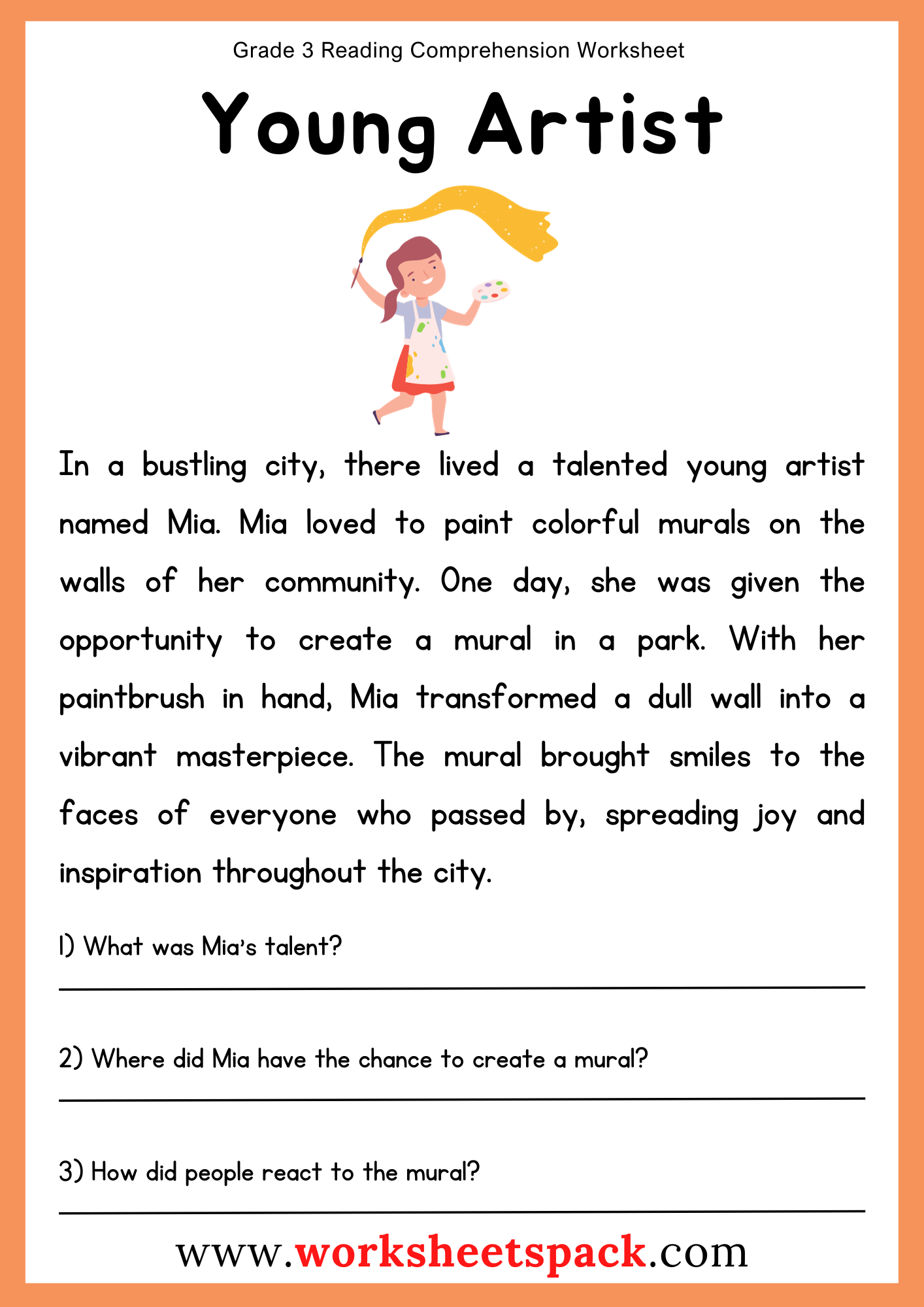
You've probably heard the statistic that the average American adult reads at an 8th-grade level. It's a common benchmark for journalists and marketers. But when we talk about 3rd grade reading level examples, we are entering a very specific territory of literacy. This isn't just "baby talk" or simple picture books. It is the exact moment in a child's development where they stop learning to read and start reading to learn. That's a massive shift. Honestly, it’s the most important transition in the entire K-12 pipeline.
If a kid doesn't hit this mark, they struggle with everything else. Science. History. Even word problems in math.
The Anatomy of a 3rd Grade Sentence
What does the text actually look like? Most people assume it's just "See Spot Run." That’s wrong. By third grade, students are expected to handle compound sentences. They're dealing with "decodable" words that have multiple syllables.
Think about a sentence like this: "The adventurous golden retriever sprinted across the muddy field to find his favorite tennis ball."
That’s a classic example. It’s got adjectives. It’s got a prepositional phrase. It isn't just a subject and a verb. According to the Lexile Framework for Reading, a 3rd-grade text typically falls between 520L and 820L. If you’re looking at the Fountas & Pinnell scale, we’re talking about levels N, O, and P.
The vocabulary starts getting spicy here. You’ll see words like cluttered, exhausted, or mysterious. These aren't words kids use every single day in the sandbox, but they are words they can figure out using context clues. That’s the "secret sauce" of this level. The text provides enough hints so the reader doesn't get stuck on a single tough word.
Why 3rd grade reading level examples matter for adults
You might wonder why copywriters or health professionals obsess over this. It’s about cognitive load. When you’re stressed—say, reading instructions for a medical device or trying to understand a tax form—your reading comprehension drops. Experts like Ann Wylie often suggest that for high-stakes information, writing at a lower grade level is actually a sign of respect for the reader's time.
It's not about being "dumb." It's about being clear.
If you look at the Common Core State Standards, 3rd graders need to be able to "describe characters in a story and explain how their actions contribute to the sequence of events." To do that, the text has to be complex enough to have a plot but simple enough that the mechanics of reading don't get in the way of the thinking.
Real-World Examples You’ll Recognize
Let's look at some actual books. Charlotte’s Web by E.B. White is the gold standard. It sits right in that 3rd-to-4th grade sweet spot.
"The night seemed long. Wilbur’s stomach was empty and his mind was full. And when your stomach is empty and your mind is full, it’s always hard to sleep."
Look at that structure. It’s rhythmic. It uses repetition. It’s sophisticated in its emotional depth but uses very accessible language. Contrast that with something like The Magic Tree House series by Mary Pope Osborne. Those are often on the lower end of the 3rd-grade spectrum. The sentences are shorter. The action is fast. There is less "interiority" (thinking about thinking) than you find in White’s work.
Another great example is The One and Only Ivan by Katherine Applegate. It uses short, punchy paragraphs. Sometimes a paragraph is just one sentence. This helps a 3rd-grade reader build momentum. They feel like they’re flying through the pages. That confidence is huge.
The Technical Side: Flesch-Kincaid and Lexiles
If you’re a data nerd, you probably want the numbers. The Flesch-Kincaid Grade Level formula looks at two things: average sentence length and average syllables per word.
To hit a 3rd-grade level, your average sentence should be about 10 to 12 words long. If you start hitting 20 or 25 words, you’ve jumped to middle school levels. If you use words like "utilize" instead of "use," the grade level spikes.
Here’s a quick comparison of the same idea at different levels:
College Level: "The manifestation of meteorological phenomena often necessitates the implementation of safety protocols within suburban environments."
3rd Grade Level: "When a big storm comes, people in the neighborhood need to stay safe and follow the rules."
See the difference? The second one is sticky. You don't have to work to understand it.
Misconceptions About "Simple" Writing
Some people think writing at this level is easy. It's actually incredibly hard. You have to kill your darlings. You have to strip away the jargon and the "academic" fluff that we use as a crutch to sound smart.
In the 1940s, Rudolf Flesch revolutionized this with his book The Art of Plain Talk. He argued that most people write to impress, not to inform. When we look at 3rd grade reading level examples, we see writing that has been distilled to its essence.
There is also a misconception that 3rd-grade level means no "big" words. Not true. You can use a word like "photosynthesis" in a 3rd-grade text, but you have to define it immediately. You might say: "Plants use a process called photosynthesis. This is how they turn sunlight into food."
How to Test Your Own Writing
If you're trying to reach this level, don't just guess. Use tools, but use them with a grain of salt. Microsoft Word has a built-in Flesch-Kincaid grader. There’s the Hemingway App. But the best test? Read it out loud.
If you run out of breath before the end of a sentence, it’s too long. If you stumble over a word, it’s too complex.
Actionable Steps for Improving Readability
- Audit your verbs. Use "strong" verbs. Instead of saying "He walked slowly," say "He trudged." It’s more descriptive and often easier for a 3rd-grade reader to visualize.
- Limit "Which" and "That." These words often signal the start of a complex clause. Try breaking the sentence in two instead.
- Use white space. Dense blocks of text are intimidating. 3rd-grade books have wide margins and lots of space between lines. Your digital content should, too.
- Stick to one idea per sentence. This is the biggest tip. Don't try to explain the "why" and the "how" in the same breath. Give the "how" its own space.
- Read children's literature. Seriously. Pick up a copy of Because of Winn-Dixie. Notice how Kate DiCamillo handles complex themes like loneliness and divorce using language that an eight-year-old can grasp. It's masterclass-level writing.
Understanding these examples isn't about "dumbing down" your message. It's about opening the door for more people to enter the conversation. Whether you’re writing for a literal 3rd grader or just a busy person on their phone at a bus stop, clarity wins every time.
The goal is to be understood. If a reader has to look up every fifth word, they aren't reading; they're decoding. When the decoding becomes effortless, the magic of the story or the information takes over. That’s the power of hitting the right reading level.
To apply this practically, start by taking your most recent email or blog post and running it through a readability checker. If the score is higher than grade 8, try to find three long sentences and split them in half. Replace three "SAT words" with simpler synonyms. Notice how the rhythm of the piece changes. It will feel faster and more urgent. That is the hallmark of effective, accessible communication.